


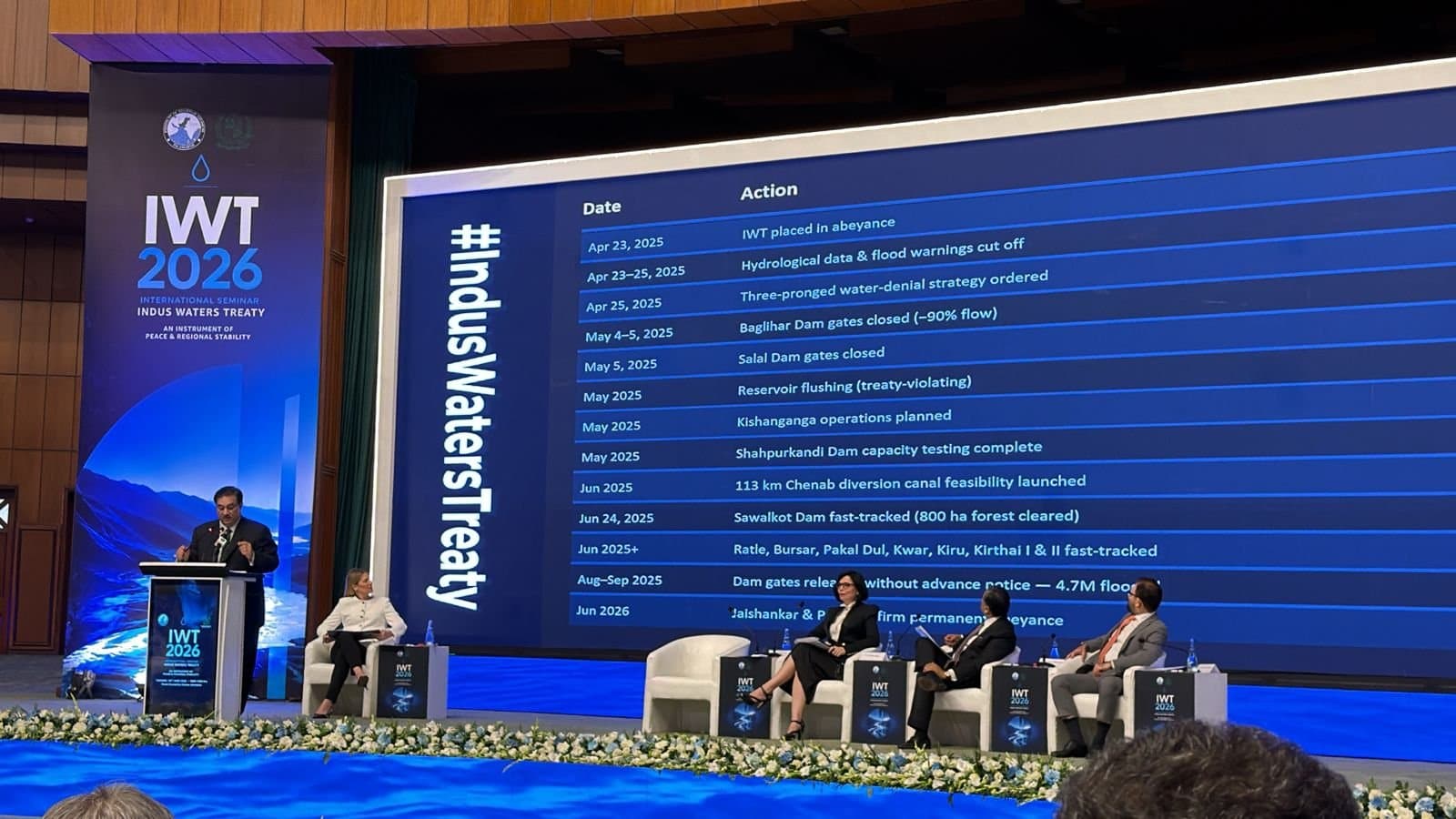
ISLAMABAD: Pakistan on Tuesday used the country's first international seminar on the Indus Waters Treaty (IWT) to reinforce its legal, diplomatic and political case against India's decision to place the landmark water-sharing agreement in abeyance, with senior government leaders and international experts warning that the dispute carries implications far beyond South Asia.
The day-long seminar, “Indus Waters Treaty: An Instrument of Peace and Regional Stability,” brought together cabinet ministers, former foreign ministers, diplomats, legal experts and international scholars to discuss the future of the 1960 World Bank-brokered treaty, which governs the sharing of the Indus river system between Pakistan and India.
The Indus river system, fed by six rivers that originate in or flow through India before entering Pakistan, underpins one of the world's largest contiguous irrigation networks. The three western rivers, the Indus, Jhelum and Chenab, allocated primarily to Pakistan under the 1960 treaty are the country's main source of freshwater, sustaining agriculture, drinking water supplies, hydropower and livelihoods for millions. Pakistan is also among the countries most vulnerable to climate change, facing increasingly frequent floods, prolonged droughts and accelerating glacier melt, making predictable river flows critical to its food, water and economic security.
The conference comes amid continued tensions over the treaty after India announced it was placing the agreement in abeyance following the 2025 Pahalgam attack. Pakistan has consistently rejected the move, maintaining that the treaty contains no provision allowing unilateral suspension and describing any attempt to obstruct Pakistan's share of water as the weaponization of a shared natural resource.
Dar calls treaty suspension legally baseless
Opening the seminar, Deputy Prime Minister and Foreign Minister Ishaq Dar said India's decision to place the treaty in abeyance had "no basis" in either the agreement itself or international law.
"It is deeply regrettable that this landmark treaty faces its gravest challenge," Dar said.
"India's unilateral decision to place the treaty in 'abeyance' has no basis in the treaty itself or in international law."
Dar said Pakistan had implemented the treaty "in letter and spirit" for more than six decades, including during periods of armed conflict, despite making significant adjustments to its irrigation system following the agreement.
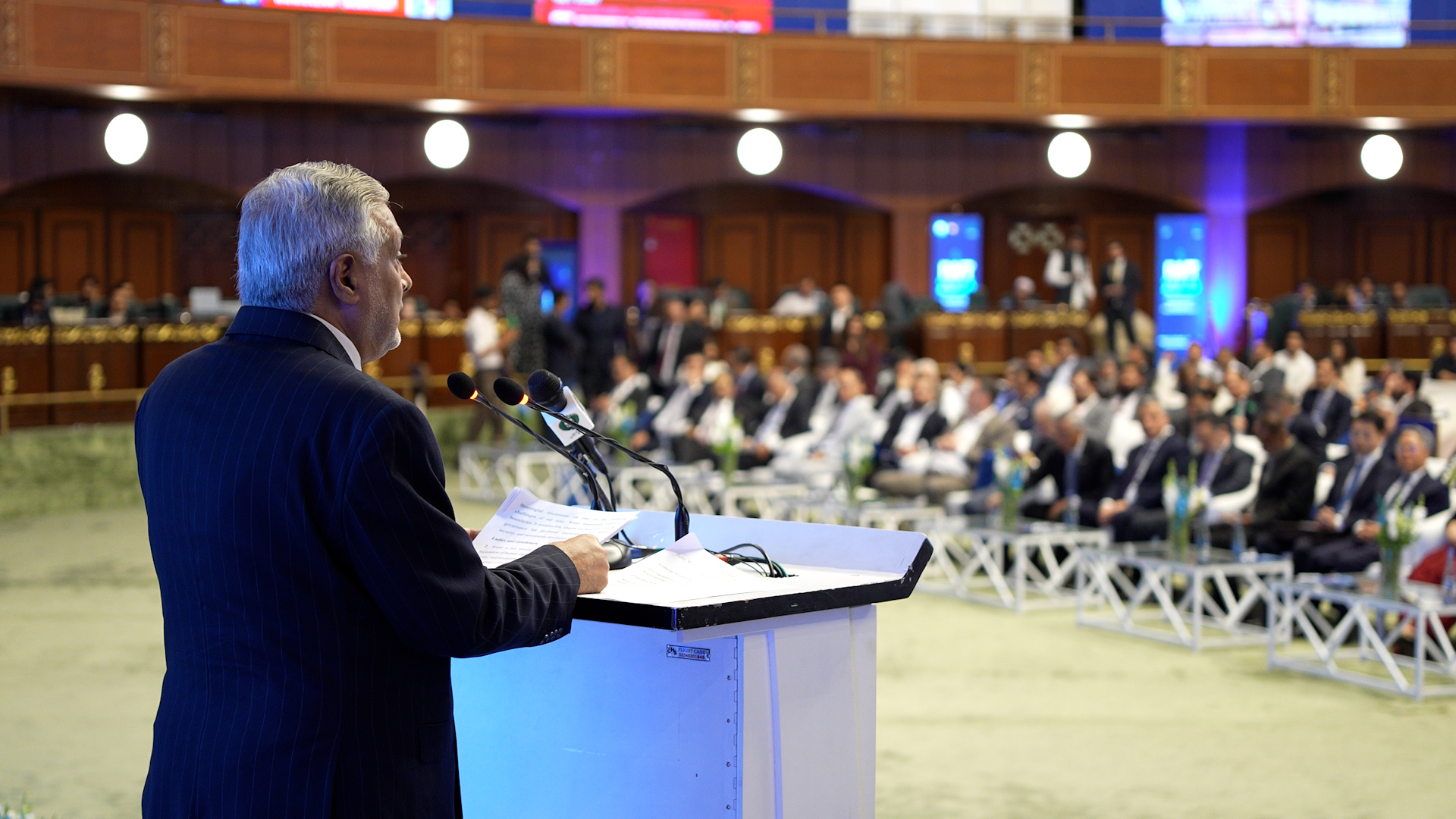
He said Pakistan's legal position had been reinforced by the Court of Arbitration, which affirmed that the treaty established "a permanent legal regime not susceptible to unilateral termination."
In a series of rulings, including its General Issues Award in August 2025 and a Supplemental Award in May 2026, the Court of Arbitration affirmed that the Indus Waters Treaty establishes a binding legal framework that cannot be unilaterally suspended or terminated. The court also reinforced substantive limits on India's ability to regulate water flows under the treaty, strengthening Pakistan's interpretation of key design and operational provisions for hydroelectric projects on the western rivers.
Expressing concern over abrupt variations in the flows of the Chenab and Jhelum rivers and India's continued expansion of water infrastructure, Dar during his address warned that such actions undermined the cooperative framework that had helped preserve regional stability for more than six decades.
"For Pakistan, this is not an abstract legal debate," he said. "Water is the lifeline of more than 250 million people."
He urged India to resolve disputes through dialogue rather than coercion.
"Shared waters must never be weaponized. They must remain a bridge between nations, guided by cooperation and respect for international law for the benefit of future generations."
‘Weaponization of water’
Former foreign minister and Pakistan Peoples Party Chairman Bilawal Bhutto-Zardari described the dispute as extending well beyond technical disagreements over river management.
"This is not a technical dispute or a clerical quarrel between commissioners; this is the weaponisation of water," he told the conference.
Bhutto-Zardari argued that the Indus Waters Treaty had served as one of the world's most durable international agreements, surviving wars and decades of political tensions.
He said lasting stability between Pakistan and India required restoration of the treaty.
"No ceasefire between India and Pakistan can hold without the Indus Water Treaty being restored," he said.
Calling for greater international engagement, the former foreign minister proposed a new global convention against the weaponization of waterways that would prohibit the use of civilian water dependency as a coercive instrument, establish emergency legal mechanisms against unilateral treaty suspensions and recognize water coercion as a form of aggression.
‘Crisis of justice’
Climate Change Minister Musadik Malik argued that the dispute represented not only a regional issue but also a broader test of international law and global water governance.
Opening his remarks with the story of Sindh farmer Ikbal Sulangi, whose livelihood was repeatedly devastated by floods, Malik said water insecurity ultimately became "a crisis of justice."
"This is not merely a crisis of climate or water; it is a crisis of justice," he said.
He warned that weakening one of the world's strongest transboundary water agreements would carry consequences beyond Pakistan.
"If this treaty does not hold, then no treaty in the world is worth the paper it is published on," Malik said.
He also cautioned that any precedent allowing unilateral disregard for treaty obligations could affect downstream countries across the world that depend on internationally shared rivers.
Information minister emphasizes treaty's legal sanctity
Information and Broadcasting Minister Attaullah Tarar described the treaty as a cornerstone of the rules-based international order and reaffirmed Pakistan's commitment to protecting its water rights.
"The treaty cannot be amended, revoked, suspended, or held in abeyance unilaterally," Tarar said.
He said respect for international agreements remained essential to regional peace, adding that "the weaponisation of water" undermined both international law and long-term stability.
Tarar also stressed the importance of combating misinformation surrounding the dispute, saying facts must prevail over propaganda in international discourse.
‘It survived three wars’
Former foreign minister Hina Rabbani Khar described the Indus Waters Treaty as a "gold standard" of international water cooperation, saying its durability had long demonstrated the value of legal frameworks governing shared rivers.
"It was durable. It was predictable. It survived three wars," she said.
Khar urged the international community, particularly European countries, to uphold the rules-based international order by defending international agreements governing transboundary resources.
She also warned that climate change was making cooperation over shared rivers increasingly important, particularly in the glacier-fed Indus basin.
International experts voice support for treaty
The seminar also featured participation by international legal scholars and geopolitical analysts.
Speaking to Pakistan TV Digital, Chinese policy analyst Victor Gao said both Pakistan and India should continue implementing the treaty.
"Respecting the integrity of the Indus Water Treaty is absolutely necessary for both India and Pakistan," Gao said.
He argued that India's decision to place the treaty in abeyance was "absolutely not allowed under the treaty provisions."
Goa further added that if China and Pakistan cooperate together, we may actually overcome the obstacles posed by India.
He emphasized that India action ‘should be condemned’ by the whole humanity, adding that “If India wants to divert the water or refuse to let any drop of water from the Indus River to flow into Pakistan, it would not only be a war crime, it will be also a crime against humanity,”
Russian geopolitical analyst Dr. Roxolana Zigon said Pakistan had strengthened its international narrative by grounding its position in international law.
"The narrative of Pakistan has turned to be much stronger because Pakistan has declared that the truth and justice and the conviction and belief in the international legal system is actually inside of the hands of Pakistan," she told Pakistan TV Digital.
Focus shifts to international engagement
Throughout the seminar, speakers repeatedly emphasized that the dispute should be addressed through international law, dialogue and the treaty's established dispute-resolution mechanisms.
Participants argued that preserving the Indus Waters Treaty was not only essential for Pakistan and India but also for maintaining confidence in international agreements governing shared natural resources at a time when climate change, population growth and water scarcity are placing increasing pressure on transboundary river systems.
The conference concluded with renewed calls for international engagement to safeguard the treaty, strengthen rules-based water governance and ensure that shared rivers remain instruments of cooperation rather than conflict.
Additional reporting and editing by Muhammad Ibrahim; writing by Maisam Ali and Batool Mufti.