

ISLAMABAD: Pakistan has moved from economic stabilization toward a new phase of growth after ending fiscal year 2025-26 with its strongest economic performance in four years, according to the Finance Ministry's latest Monthly Economic Update and Outlook released on Tuesday.
The report portrays an economy emerging from years of high inflation and external financing pressures, citing stronger public finances, resilient industrial activity, record workers' remittances and improving investor confidence as signs that macroeconomic stability has largely been restored.
It says the government now expects export-led growth, continued fiscal discipline, energy-sector reforms and stronger business confidence to underpin economic expansion in the coming fiscal year.
According to the report, Pakistan's gross domestic product (GDP) grew 3.7% during FY2025-26, the fastest pace in four years, while the economy expanded to a record $452.1 billion.
"Despite early year flood-related disruptions and subsequent volatility in global commodity markets, stabilization gains were preserved, growth remained broad-based across agriculture, industry and services, and average inflation stayed in single digits within the target range," the report said.
Fiscal discipline strengthens recovery
The ministry said prudent fiscal management continued to improve Pakistan's public finances.
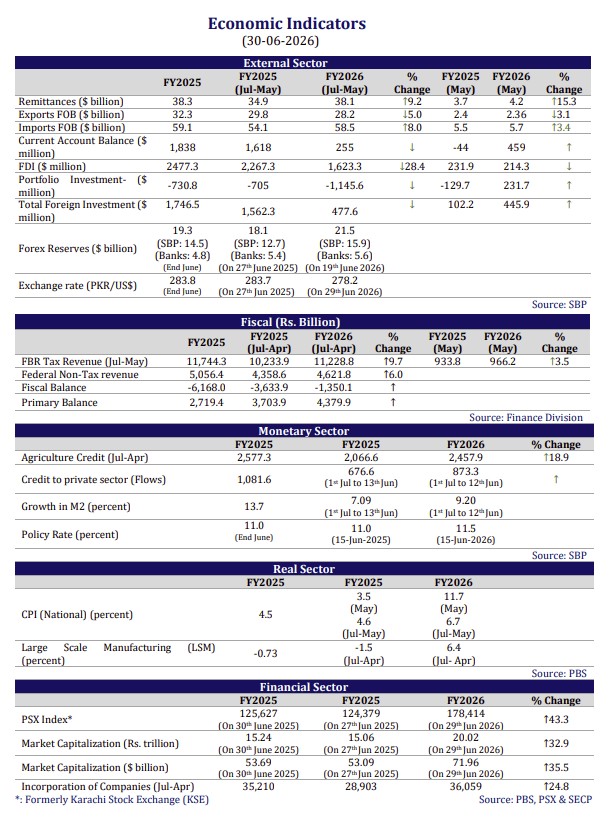
According to the report, the fiscal deficit narrowed to 1.1% of GDP during July-April FY2025-26 from 3.2% a year earlier, while the country posted a primary surplus of 3.5% of GDP, supported by higher revenue collection, expenditure management and provincial fiscal surpluses.
Federal Board of Revenue (FBR) tax collections rose 9.7% to Rs11.23 trillion during July-May FY2025-26, driven by growth in both direct and indirect taxes. Total government expenditure, meanwhile, declined nearly 10%, largely because of lower debt-servicing costs, while development spending continued to increase.
External sector remains resilient
The report said Pakistan's external position remained stable despite global uncertainty.
The current account recorded a $255 million surplus during July-May FY2025-26, while workers' remittances climbed to a record $38.1 billion, an increase of 9.2% compared with the previous fiscal year.
Information technology (IT) services exports increased 20.4% to $4.2 billion, while foreign exchange reserves rose to $21.5 billion, strengthening Pakistan's external buffers.
The report also noted that remittances reached a record monthly inflow of $4.3 billion in May, with Saudi Arabia and the United Arab Emirates remaining the largest sources of overseas inflows.
Manufacturing leads broad-based growth
Industrial activity continued to gather momentum during FY2025-26.
Large-Scale Manufacturing (LSM) expanded 6.4% during July-April, rebounding from a 1.5% contraction during the same period last year. The report attributed the recovery primarily to stronger output in automobiles, food processing, wearing apparel and petroleum products, with 16 of 22 manufacturing industries recording positive growth.
The agriculture sector also grew 2.9% despite flood-related damage, while agricultural credit increased 18.9%, supported by improved access to financing and higher imports of agricultural machinery.
Investor confidence improves
The Finance Ministry said improving macroeconomic conditions helped restore investor confidence during the fiscal year.
The report attributed the improvement to the government's continued commitment to the International Monetary Fund's Extended Fund Facility (EFF) and Resilience and Sustainability Facility (RSF), together with sovereign rating upgrades by Fitch and Moody's.
It said these developments enabled Pakistan to return to international capital markets through a Eurobond issuance after four years and launch its first Panda Bond.
"The Pakistan Stock Exchange also witnessed a remarkable rally, with the KSE-100 Index reaching an all-time high and remaining among Asia's fastest-growing stock markets," the report said.
Business confidence also strengthened, with company registrations increasing nearly 25% during July-April FY2025-26, while private-sector borrowing rose as firms increased investment activity.
Favorable outlook for FY2026-27
The ministry projected a favorable outlook for the new fiscal year.
It said continued reforms, export-led policies, fiscal discipline and stronger manufacturing activity are expected to sustain growth while preserving macroeconomic stability.
The report also said easing geopolitical tensions following the Iran-US ceasefire have improved global market sentiment, helping lower international crude oil prices.
For Pakistan, a net oil importer, lower energy prices are expected to reduce imported inflation, ease transportation costs and strengthen the country's external account by containing the oil import bill.
The ministry said improving external buffers, resilient remittance inflows, continued growth in IT exports and a more stable global environment are expected to reinforce Pakistan's growth momentum during FY2026-27.