
India's heatwaves kill 3,400 in a single day, four times the annual official toll: Study

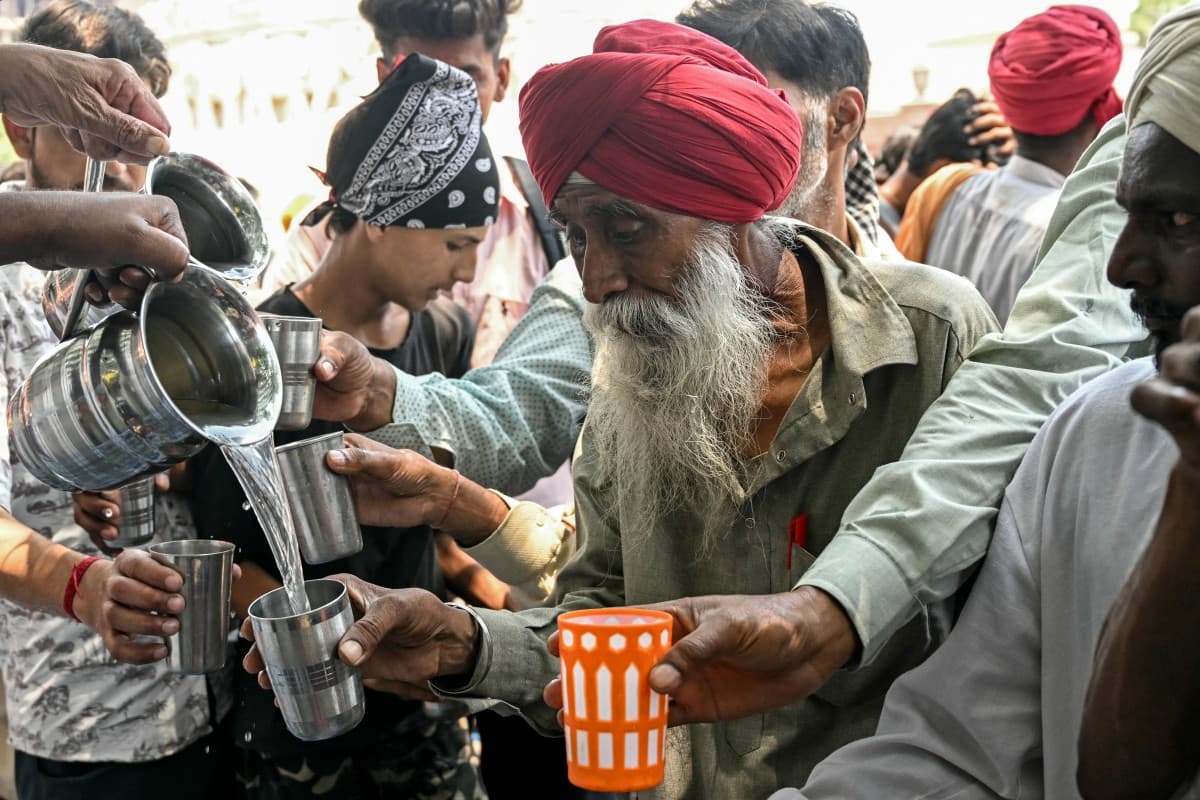
People drink sweetened water distributed by volunteers along a street on a hot summer day in Amritsar on June 4, 2026. (Photo by Narinder NANU / AFP)
ISLAMABAD: India is among the world’s most heat-exposed nations, with a single day of severe heat potentially causing about 3,400 deaths and a five-day heatwave causing nearly 30,000 deaths nationwide, according to the academic journal Frontiers in Environmental Health.
The peer-reviewed study, authored by Piyush Narang and Ashok Gadgil of UC Berkeley's Goldman School of Public Policy, said official heat-related death figures capture only a fraction of the true toll.
The all-India heat-related excess mortality reported in the press and by government agencies remains about 800 per year, meaning a single extreme day kills more than four times what officials count across an entire year, according to the journal.
"Heat mortality remains substantially undercounted," the study said, adding that many deaths triggered or worsened by extreme temperatures are often recorded under other medical causes rather than heat exposure itself.
"Our results suggest that even a single day of extreme heat yields thousands of excess deaths, and a multi-day heatwave results in tens of thousands of excess deaths," the researchers wrote.
Uneven distribution across India
To find the correct estimates, researchers combined findings from a 2024 multi-city epidemiological study covering ten Indian cities with district-level mortality records from the Civil Registration System and 2024 population projections.
They further matched each of India's 765 districts to the most climatically similar study city and used the city's established heat-mortality relationship to estimate excess deaths from one extreme-heat day and from five consecutive extreme-heat days.
The study found that the burden is unevenly distributed, with populous northern states experiencing the highest mortality rates.
Uttar Pradesh alone was estimated to account for more than 8,000 excess deaths, followed by Bihar (3,615), Madhya Pradesh (2,964), Rajasthan (2,664), and Gujarat (2,354).
According to the study, these five states together hold 43% of India's population but account for more than 60% of the projected national heat mortality.
Fiscal capacity
The study also questioned India’s economic resources.
The researchers calculated a GDP-weighted Gini coefficient of 0.432 — double the population-weighted figure — to show that the five states bearing the highest heatwave mortality burden account for 66% of national excess deaths while contributing only 29% of India's GDP.
"This divergence between population-weighted and GDP-weighted inequality demonstrates that heatwave mortality risk is not merely proportional to population size but is structurally concentrated in states with lower economic output, precisely those with the least fiscal capacity to invest in adaptation," the researchers concluded.
A precedent of underreporting
The study further reports a well-documented pattern of official undercounting.
An online data compilation by Heatwatch and the Veditum India Foundation identified 733 heatstroke-related deaths reported in news media between March and July 2023, while official figures from the Ministry of Health and Family Welfare reported only 360 heatstroke deaths during the same period, according to the journal.
The future
Moving ahead, India’s climate conditions are only going to get worse, with the country expected to experience more intense, longer heat waves, according to the journal.
"As an illustrative scenario only, if each district were to experience five heatwaves of five-day duration each summer — around-number planning assumption, not an empirically derived frequency — the implied national excess mortality would reach approximately 150,000 deaths per year," the study said.
According to the study, only a small fraction of India’s population (about 8%) has access to air conditioning. As a result, a growing share of India’s population is exposed to physiologically unsafe heat conditions during the summer months.
The authors called for stronger heat-action plans, improved early-warning systems, and better mortality tracking, warning that current reporting mechanisms may not reflect the true impact of extreme temperatures on public health.
"As extreme heat events become more frequent and intense under climate change, failure to act on such evidence is likely to result in continued large and avoidable loss of life," the study said.
Latest News
Brazil denies visas for US officials seeking election talks
31 MINUTES AGO

Two dead after plane crashes onto German house's roof
4 HOURS AGO

Syria bus crash kills at least 35
6 HOURS AGO
.jpg&w=3840&q=75)
Security forces foil terrorist attack in Pakistan's northwest, kill all four terrorists: Military
7 HOURS AGO
.jpg&w=3840&q=75)
US Congressmen laud strengthening Pakistan-US ties during Islamabad visit
7 HOURS AGO
