

.jpg&w=3840&q=75)
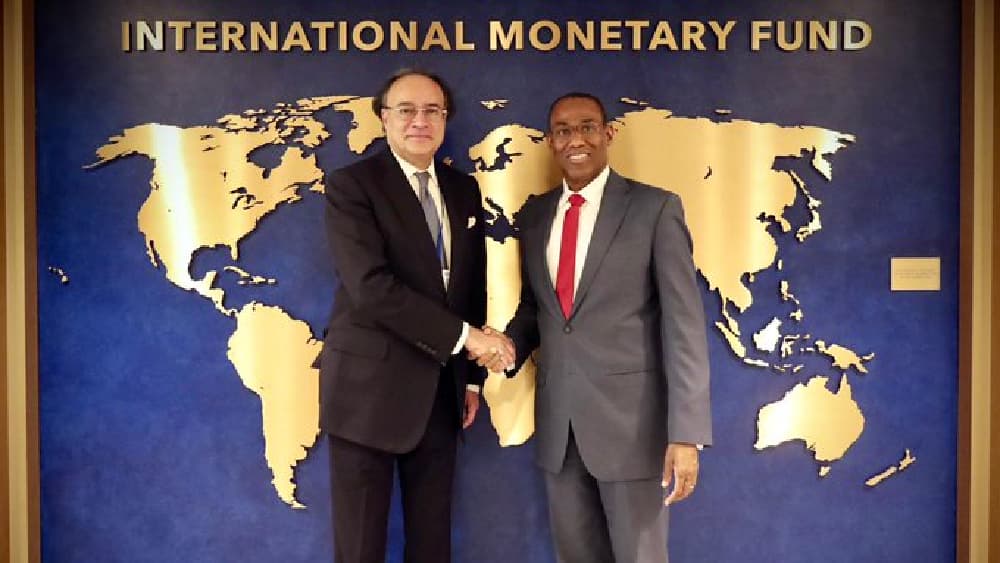
Pakistan's Federal Minister for Finance and Revenue, Senator Muhammad Aurangzeb, shakes hands with Francis Brooke, Deputy Secretary at the United States Department of the Treasury in Washington DC. (Photo: X/@Financegovpk)
ISLAMABAD: Pakistan’s Federal Minister for Finance and Revenue, Senator Muhammad Aurangzeb, in a meeting with Francis Brooke, Deputy Secretary at the United States Department of the Treasury, on the sidelines of the World Bank–IMF Spring Meetings in Washington, DC, discussed cooperation and collaboration in energy and mineral development sectors, said a post shared on X by Pakistan’s Ministry of Finance on Saturday.
The finance minister shared an overview of Pakistan’s macroeconomic stabilization, its planned re-entry into international capital markets, and its external debt management strategy.
He highlighted key investment opportunities in Pakistan’s minerals and energy sectors, and briefed the Treasury leadership on progress and prospects in digital and virtual asset regulation.
Both sides discussed avenues for cooperation and collaboration in energy, mineral development, and strengthening the anti-money laundering and countering the financing of terrorism (AML/CFT) framework.
Meeting with S&P Global representatives
Aurangzeb, held a constructive meeting with representatives of S&P Global Ratings on the sidelines of the World Bank-IMF Spring Meetings 2026, said a post shared on X by Pakistan’s Ministry of Finance on Saturday.
During the meeting, the finance minister confirmed that Pakistan has successfully concluded a Staff-Level Agreement with the International Monetary Fund (IMF), with approval by the IMF Executive Board expected shortly, paving the way for the disbursement of the next tranche under the program.
Aurangzeb informed that Pakistan has met its external obligations in a timely manner, including the repayment of USD 1.4 billion on its Eurobond during the current month.
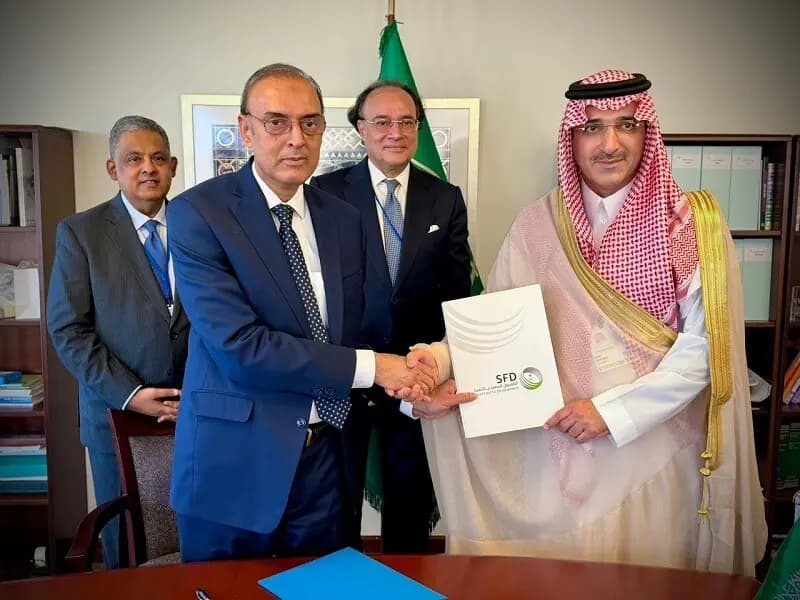
He also highlighted additional financial support from the Kingdom of Saudi Arabia, including a USD 3 billion facility and the extension of an existing USD 5 billion deposit from an annual rollover to a three-year term through 2028, further strengthening the country’s external position.
The finance minister noted that Pakistan has successfully re-entered international capital markets with the launch of a Eurobond through private placement after a gap of four years, priced at just under 7%, reflecting renewed investor confidence in the country’s macroeconomic trajectory.
He outlined Pakistan’s medium-term Global Medium Term Note (GMTN) strategy, which envisages diversified issuances across multiple instruments, including Eurobonds, Sukuk, and rupee-linked, dollar-settled bonds, aimed at broadening the investor base and mitigating foreign exchange risks.
Senator Aurangzeb also briefed S&P Global on progress towards Pakistan’s inaugural Panda bond issuance, noting that regulatory submissions have been made and approval from the National Association of Financial Market Institutional Investors (NAFMII) is awaited.
Finance minister meets AIIB president
Aurangzeb, held a productive meeting with Zou Jiayi, president of the Asian Infrastructure Investment Bank (AIIB), on the sidelines of the World Bank–IMF Spring Meetings 2026, said a post shared by Pakistan’s Ministry of Finance on Saturday.
During the meeting, the finance minister congratulated Jiayi on assuming office and appreciated AIIB’s robust engagement in Pakistan through an ongoing portfolio of approximately USD 1.7 billion, with an additional USD 1 billion in the pipeline.
Senator Aurangzeb highlighted Pakistan’s recent return to international capital markets, including the launch of a Eurobond through private placement after a gap of four years, describing it as an important validation of the country’s macroeconomic stabilization efforts. He also referred to Pakistan’s inaugural Panda bond issuance as a landmark initiative aimed at diversifying financing sources.
The finance minister briefed the AIIB president on the economic implications of the ongoing regional situation, particularly its impact on Pakistan’s energy supply chain.
Aurangzeb meets Citibank representatives
Aurangzeb, held a productive meeting with representatives of Citibank on the sidelines of the World Bank–IMF Spring Meetings 2026, said a post shared on X by Pakistan’s Ministry of Finance on Saturday.
During the meeting, the finance minister informed the Citi team that Pakistan has successfully concluded a Staff-Level Agreement with the International Monetary Fund (IMF) for the third review under the Extended Fund Facility (EFF) and the second review under the Resilience and Sustainability Facility (RSF), with approval by the IMF Executive Board expected imminently.
Senator Aurangzeb noted that Pakistan has met its external obligations in a timely manner, including the repayment of USD 1.4 billion on its Eurobond during the current month. He also acknowledged the continued and steadfast financial support extended by the Kingdom of Saudi Arabia.
World Bank Roundtable on Digital Social Protection and Inclusion
Aurangzeb, participated in a roundtable titled “Delivering Social Protection Digitally: Lessons and Innovations from Pakistan, Middle East and North Africa,” organized by the World Bank, on the sidelines of the World Bank–IMF Spring Meetings in Washington, DC, said a post shared on X by Pakistan’s Ministry of Finance on Saturday.
The roundtable featured presentations on two interconnected themes: Pakistan’s Digital Public Infrastructure (DPI) journey and the digital transformation of the Benazir Income Support Programme (BISP).
Opening the session, the finance minister drew a compelling parallel between COVID-19, described as the largest demand shock in recent history, and the ongoing Middle East conflict, which he characterized as the largest supply shock. He noted that countries that invested early in governance and technology were better positioned during COVID-19, and that Pakistan is now reaping similar dividends from its digital infrastructure as it navigates the current energy supply shock.
The finance minister highlighted that targeted digital subsidies for two-wheelers, public transport, and small farmers are being disbursed seamlessly through an established digital payments ecosystem already in place.
Meeting with JICA SVP
Aurangzeb also had a meeting with Senior Vice President, JICA, Hara Shohei.
Shohei in a post on X on Saturday, stated: “Had a very forward looking meeting with HE Mr Muhammad Aurangzeb, Federal Minister for Finance and Revenue of Pakistan. I cherish our long partnership and am very excited to materialise future cooperation.”
Latest News
Tech back in fashion as Asian markets extend rebound
2 HOURS AGO
India monsoon floods, landslides kill more than 100 since July: officials
2 HOURS AGO
.jpg&w=3840&q=75)
Pakistan, Japan reaffirm commitment to expand cooperation in key sectors
2 HOURS AGO
More than 800,000 displaced Lebanese returning home after war: UN
3 HOURS AGO
Total eclipse gives scientists chance to probe Sun's mysteries
3 HOURS AGO