


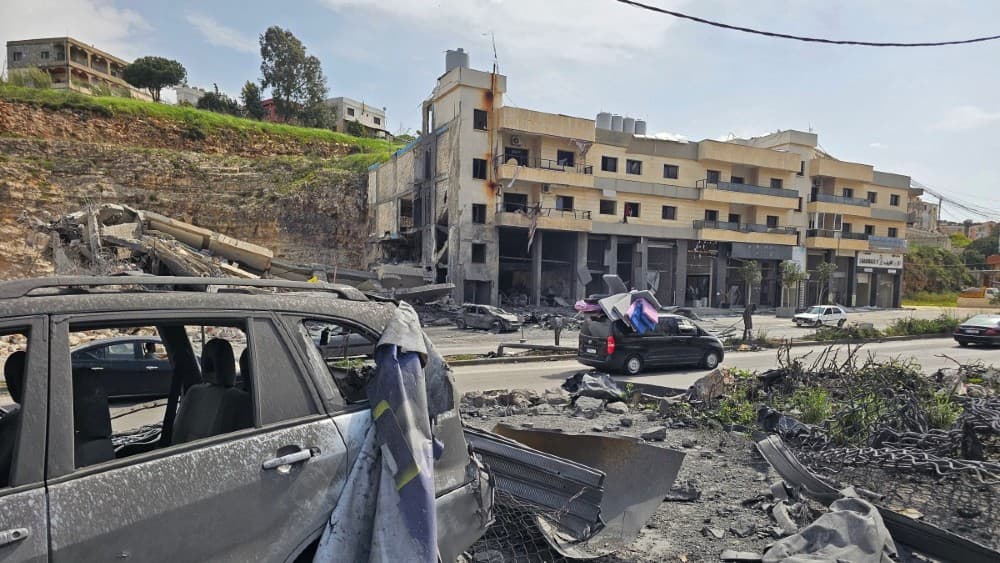
Nabatieh, Lebanon: Khodr Sahmarani stood dazed beside the rubble of his south Lebanon home, his forehead in a white bandage, staring at the wreckage where his brother, nephew and two neighbors died.
"I was upstairs, then I was underground. I screamed 'Where are you, where are you?', but there was no one," he said after surviving an Israeli airstrike on the city of Nabatiyeh just hours before the ceasefire began at midnight on Thursday night.
The afternoon attack flattened what residents say was a five-story building, creating a jumble of shattered concrete in the battered city.
Nabatiyeh rescuer Mohammad Sleiman told AFP they recovered one body from the strike site on Thursday night, and another three on Friday morning.
Sahmarani, 57, said rescuers "came and took me out of the rubble".
10-day ceasefire
Israel and Lebanon agreed to a 10-day ceasefire on Thursday in order to negotiate an end to six weeks of war between Israel and Hezbollah.
The conflict saw massive Israeli airstrikes across Lebanon and also a ground invasion in the south.
Lebanese authorities say the war that began on March 2 has killed nearly 2,300 people, and caused widespread devastation in southern towns and cities such as Nabatiyeh.
President Joseph Aoun said on Friday that "direct negotiations" with Israel "are crucial", and that the government aims to "consolidate a ceasefire, secure the withdrawal of Israeli forces from the occupied southern territories, recover prisoners, and address outstanding border disputes".
Hezbollah halted military operations after the ceasefire came into effect, but warned that it was keeping its "finger on the trigger" in case Israel violated the truce.
Nabatiyeh's streets were almost empty on Friday, and countless buildings in the city center have been damaged or destroyed.
Deadly Israeli strikes
A few kilometers outside the city, a group of Hezbollah supporters cheered on the trickle of cars coming from the direction of Beirut, flashing victory signs and waving the party's yellow flag.
Deadly Israeli strikes were reported up to the final few minutes before the midnight Thursday deadline agreed upon by the two governments.
"It was the last hours. If it was the beginning of the war, the middle of the war, one can come to terms with it, but it was the last hours," Sahmarani said, his eyes bloodshot and tearful.
Fadel Hassan Zahri, a neighbor, said the people who were killed had been "lifelong friends of mine".
"I wouldn't eat without them, I wouldn't drink without them."
Sahmarani said he has nowhere else to go, and would probably crawl back into the rubble of his home at night and find a ledge or somewhere to lay his head.