


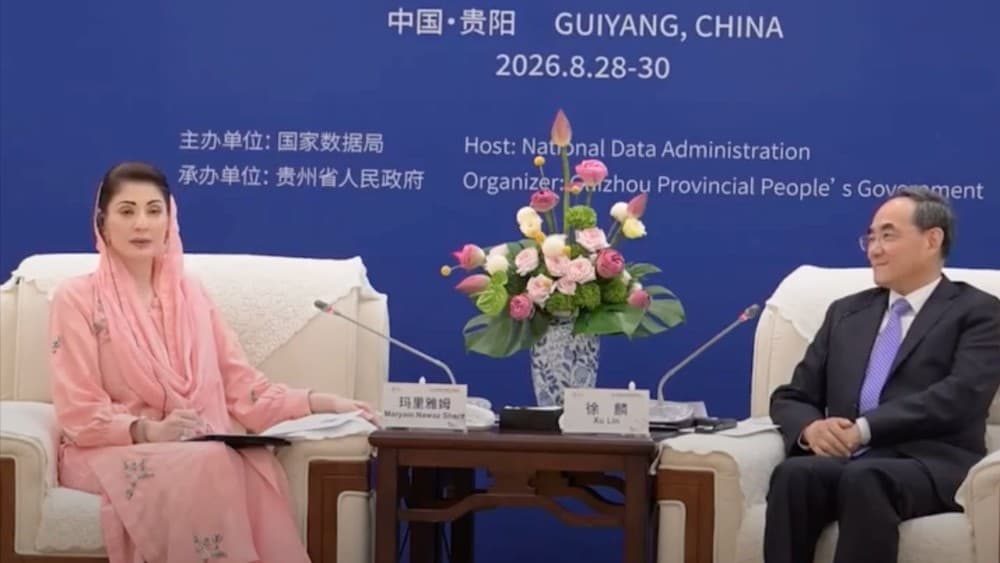
ISLAMABAD: Punjab Chief Minister Maryam Nawaz Sharif has proposed a Pakistan-China joint working group on artificial intelligence and smart agriculture, seeking to translate the countries’ longstanding strategic partnership into practical cooperation in technology, investment and innovation.
Speaking during her visit to China’s Guizhou province, Maryam said the proposed group could bring together government officials, universities and the private sector to prepare a 12-month action plan focused on digital cooperation and AI, smart agriculture, and business and investment opportunities.
Her proposal came as she held meetings with Chinese officials and technology companies during her visit, including discussions with Huawei and Alibaba, while inviting Chinese businesses to invest in Punjab’s technology and digital infrastructure.
At the International Big Data Industry Expo 2026 in Guiyang, Maryam described data as “critical infrastructure” and said Punjab was ready to work with China on the next frontier of digital cooperation.
“Punjab is the most AI-enabled province, and we are ready to be part of this amazing transformation,” she said.
She said Punjab was building a digital governance architecture linking data with identity, public services, infrastructure, energy, finance and economic opportunities, highlighting the province’s “one state shared data engine,” known as “one map,” which integrates more than 12 terabytes of spatial data and over 6,000 datasets from 31 departments.
Maryam also highlighted Punjab’s first dedicated AI office, sovereign cloud infrastructure, data lake and data centre, saying the province was seeking to use technology to improve governance and public services.
“Data must not be simply collected, it must be converted into action, and that action must improve the life of every citizen,” she said.
The chief minister also invited Chinese technology companies, investors and infrastructure leaders to partner with Punjab in developing energy, computing, cloud connectivity and tokenization infrastructure.
“Let us build this future together, not simply as users of technology but as partners in creating it,” she said.
During a meeting with Guizhou Party Secretary He Zhongyou in Guiyang, Maryam praised the province’s transformation in infrastructure, technology, industry, digitalization and rural development, saying Punjab wanted to learn from its experience.
“Pakistan and China share a historic, time-tested, and all-weather friendship,” she said, noting that the two countries are this year marking the 75th anniversary of diplomatic relations.
“This relationship is not between two governments and two countries. It is a relationship between hearts, between peoples,” she said, describing the partnership as built on “trust,” “mutual respect,” “affection” and “mutual cooperation and support.”
Maryam said Punjab, with a population of about 130 million, offered a large market, agricultural base, manufacturing capacity and young workforce, while Guizhou offered expertise in industrial upgrading, digital infrastructure, intelligent computing and technology.
She proposed a business and investment roundtable focused on joint ventures, technology transfer and local manufacturing, and invited a Guizhou delegation to Lahore to engage with provincial departments, universities, chambers of commerce and potential business partners.
During her meetings with Huawei officials, the Punjab government said the sides discussed investment in the Nawaz Sharif IT City, data centres, a sovereign data centre, cloud computing, AI, digital infrastructure and smart public services.
The sides also agreed to train 1,000 young people in Huawei’s master-trainer programme, while 300 women trainers will receive AI training, according to the Punjab government.
The discussions also covered potential cooperation in smart cities, command centres, healthcare, education, agriculture and manufacturing, as well as a possible AI delivery unit in Punjab.
Maryam said Punjab was seeking to move beyond traditional economic cooperation towards technology-led industrialization, innovation and greater private-sector participation.
“Punjab is ready for investment. Punjab is hungry for investment. Punjab is hungry for development, ready for partnerships and ready to deliver results,” she said.
She also highlighted Punjab’s infrastructure and environmental initiatives, including the construction and rehabilitation of around 50,000 kilometres of roads, the expansion of electric mobility using Chinese-manufactured buses and efforts to increase forest and green cover.
The chief minister’s China visit comes as Pakistan and China mark seven and a half decades of diplomatic ties, with Islamabad seeking to deepen cooperation under the next phase of China-Pakistan Economic Corridor (CPEC) through investment, industrialization, technology and people-to-people exchanges.
Maryam said the objective was to take the longstanding bilateral relationship to the provincial and people-to-people level and turn the countries’ friendship into “tangible projects, investments, jobs and tangible benefits for our people.”