


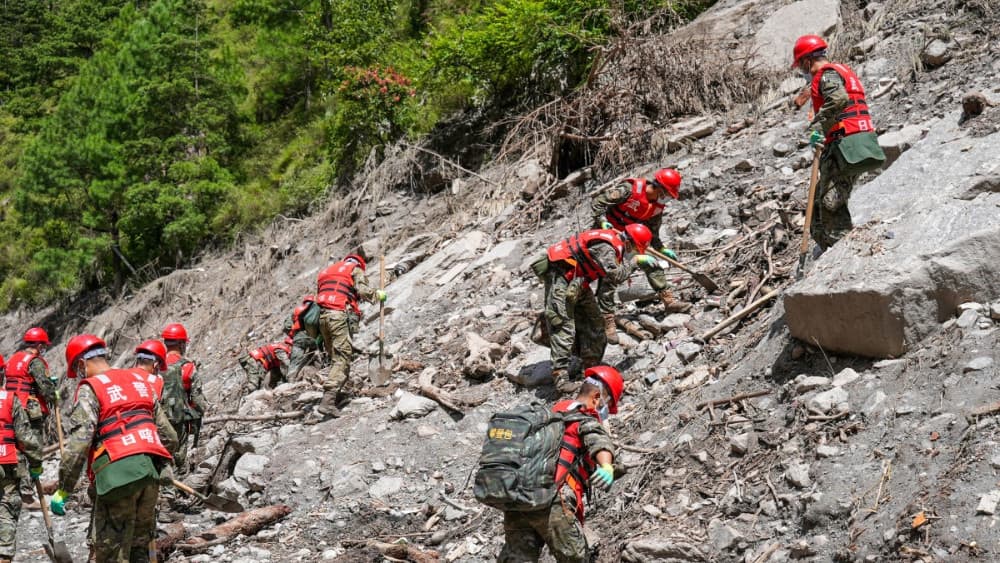
ISLAMABAD: A massive glacier collapse high in the Himalayas along the Nepal-China border has caused catastrophic flash floods and mudslides. The disaster occurred early in the morning on Aug 26, releasing a powerful surge of water, ice, and rock through mountain valleys. The following are updates as of Saturday, Aug 29.
Nepal warns of climate threat after deadly floods
Nepal's foreign minister warned on Saturday of the growing threat from climate change in the Himalayas, as China offered water and satellite data after devastating floods on their shared border killed hundreds.
The US Geological Survey said the disaster on Wednesday near the high-altitude China-Nepal border was caused by a glacial collapse that sent a torrent of debris downstream, with nearly 3,000 people missing and 682 confirmed dead.
While the exact cause of the collapse is unclear, climate change is causing glaciers to melt worldwide, increasing the risks of such disasters.
Canada announces CAN$5M in aid after Nepal flood
Canada said Friday it would provide CAN$5 million (US$3.6 million) in funding to help relief operations after devastating flooding in Nepal left hundreds dead and thousands missing.
"We are announcing that Canada is providing $5 million in humanitarian assistance to support emergency relief efforts in Nepal," Randeep Sarai, Canada's secretary of state for international development, told reporters.
Nepal rescuers drill for 100 workers trapped in tunnels
Nepali army rescue teams were using drilling equipment in a race to rescue more than 100 people trapped inside hydropower tunnels, three days after devastating floods struck the site.
"The government has been continuing efforts... to rescue people trapped inside the tunnel of the Trishuli 3A Hydropower Project in Rasuwa," the office of Nepal's prime minister said in a statement.
"As part of these efforts, work to clear the tunnel entrance has been intensified since early Saturday morning," it said.
Rescuers claw through mud as Nepal, China flood missing toll nears 3,000
Rescuers in Nepal and China were battling Saturday to locate thousands of people missing days after a deadly, tsunami-like wall of water and debris swept through the Himalayan region, engulfing entire villages.
Figures from both countries put the number of missing close to 3,000, with 633 bodies recovered -- and reports of some dead possibly swept downstream as far away as India.
Rescue worker Kawan Koirala, from the Nepal Scout Disaster Response Team, said they were struggling in thick, leg-sucking mud.
"People want their family member's body back, either dead or alive, but we cannot find them... you can see the mud," he told AFP, exhausted after an 18-hour shift.
"It is very traumatic for me too. It is my first time seeing these types of things. Everywhere is mud. We faced flood in Nepal before, but not like this."
Nepalis cling to hope for missing, three days after disaster
Desperate families in Nepal ran their fingers down long lists of rescued people pasted on a wall on Saturday, clinging to hope three days after devastating floods swept down the valley.
The lists spanned several pages, each name belonging to someone who escaped the tsunami-like wall of freezing water and debris that roared down from the Nepal-China border on Wednesday morning.
The floods left a trail of destruction, killing at least 626 people in Nepal and leaving 2,426 missing.
In Bidur, the last town before where the road to China was destroyed, few found what they were looking for.
Rishi Shrestha had summoned his deepest reserves of courage to read the list, searching for his missing cousin.
But he admitted that with every passing hour, he feared good news was becoming less likely.
"It's been more than three days, so 99 percent he is not alive," he told AFP outside the military base in Bidur, the main hub of rescue operations.
Nepal rescuers drill for 100 workers trapped in tunnels
Nepali army rescue teams were using drilling equipment on Saturday in a race to rescue more than 100 people trapped inside hydropower tunnels, three days after devastating floods struck the site.
"The government has been continuing efforts... to rescue people trapped inside the tunnel of the Trishuli 3A Hydropower Project in Rasuwa," the office of Nepal's prime minister said in a statement.
"As part of these efforts, work to clear the tunnel entrance has been intensified since early Saturday morning," it said.
Nepal says post-flood reconstruction could total 'billions of dollars'
Nepal's reconstruction bill after devastating floods could run into "billions of dollars", Foreign Minister Shisir Khanal said Saturday, as authorities grapple with the scale of the destruction.
"The reconstruction and rehabilitation would entail perhaps billions of dollars," he told reporters in Kathmandu.
"We will do loss and damage research and then we plan, but I am reaching out to our international community for support".
Three days after the disaster, Khanal said "the urgency is on rescue and saving lives as much as we can", but the scale of the disaster was already stretching the government's capacity.
Rescue teams have retrieved 626 bodies, and more than 2,426 people are still missing in Nepal.
Nepal floods leave trail of destruction, aid challenge
Nepal is reeling from devastating floods that cut a swath of destruction through the Himalayan nation, and the government has appealed for financial help in the daunting task of recovery.
Rescue efforts are focused on searching for the more than 2,400 missing. More than 620 people have been confirmed dead.
The government has called for aid for the landlocked nation, reporting a "heavy loss of life and property" as it continues to assess the full scale of the destruction. Risks of further flooding remain.
Here are some of the challenges ahead.
Tens of thousands in need
The trauma of Wednesday's catastrophic flooding has been "enormous," with as many as 93,000 people potentially affected in the country of about 30 million, the Red Cross said.
Entire communities have been swept away, leaving families homeless or sheltering in temporary facilities.
"Multiple bridges have been washed away and major roads disrupted, leaving some of the worst-affected communities extremely difficult to reach," the Red Cross said.
At least 18 schools have been destroyed and another 20 damaged, leaving about 10,000 school-age children affected, according to the UN Children's Fund.
For Aug 28 updates, click on the link