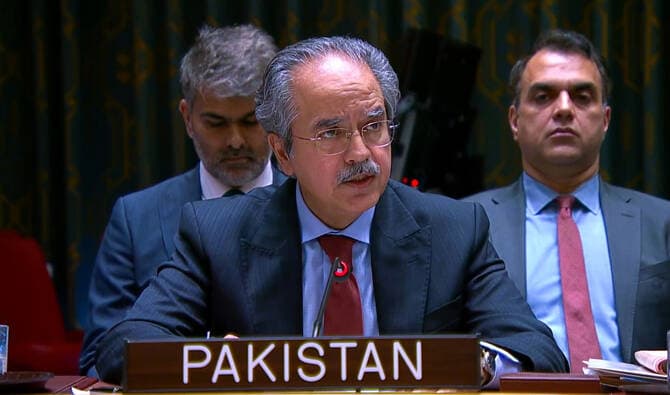
Pakistan’s Permanent Representative to the United Nations, Ambassador Asim Iftikhar Ahmed, speaking at the United Nations Security Council in New York on Sunday, February 1, 2026. (Permanent Mission of Pakistan to the UN/X)
ISLAMABAD: Pakistan has warned the UN Security Council that any unilateral disruption of the Indus Waters Treaty (IWT) carries “real and immediate” risks for regional peace, humanitarian stability, and environmental security, stressing that the treaty remains legally binding and cannot be suspended unilaterally.
Addressing the Council, Pakistan’s Permanent Representative to the United Nation,s Ambassador Asim Iftikhar Ahme, said that interference in established water-sharing arrangements would have severe consequences, particularly for Pakistan’s population of more than 250 million people living downstream.
“Any unilateral disruption to established water-sharing arrangements carries humanitarian, environmental, and peace and security implications,” he said. “When lifelines of millions are placed under unilateral discretion, risks are not just hypothetical.”
“They are real and immediate.”
Referring to recent proceedings at the Court of Arbitration in The Hague, Ahmed said the ruling had reaffirmed a core legal principle governing the treaty.
“The Indus Waters Treaty remains in force. Its dispute settlement mechanisms remain binding, and no party has the legal authority to unilaterally suspend or render it inoperative,” he said.
Warning of broader global implications, he said, allowing a binding treaty governing shared natural resources to be set aside would undermine the stability of international agreements more generally.
“If a binding treaty designed to prevent disputes can be unilaterally discarded, then no agreement is truly insulated from politics,” Ahmed told the Council. “Borders, demilitarized zones, trade corridors, and humanitarian arrangements all become more fragile.”
He added: “A treaty’s true test is not when it aligns with political convenience, but when it constrains unilateral impulse.”
The ambassador stressed that maintaining international peace and security required proactive defense of legal frameworks, not just reactive crisis management.
“Upholding international peace and security requires not only responding to crises after they erupt, but defending the legal frameworks that prevent crises from arising in the first place,” he said. “Compliance with treaties must therefore be regarded as a strategic imperative for conflict prevention and resolution.”
Concluding his remarks, Ahmed urged collective responsibility among states. “Let our message today be clear and collective: treaties must not become casualties of geopolitics. They must remain anchors of restraint, pathways of cooperation and safeguards for peace,” he said.
India announced a unilateral suspension of the Indus Waters Treaty last year following the Pahalgam attack in Indian-occupied Kashmir last year. Pakistan’s Prime Minister Shehbaz Sharif at the time condemned the move as “unilateral, unjust, politically motivated, extremely irresponsible and devoid of legal merit.”
Earlier this week, the Pakistani ambassador again slammed India of violating international law by placing the treaty in abeyance, warning that such actions undermine the sanctity of treaties and heighten risks to regional stability.
Last month, Pakistan’s Ambassador Usman Jadoon said that since India’s decision, it had committed “material breaches,” including “unannounced disruptions of downstream flows and withholding of hydrological information,” which he said had created “an unprecedented crisis for water security and for regional stability.”


.jpg&w=3840&q=75)

.jpg&w=3840&q=75)