


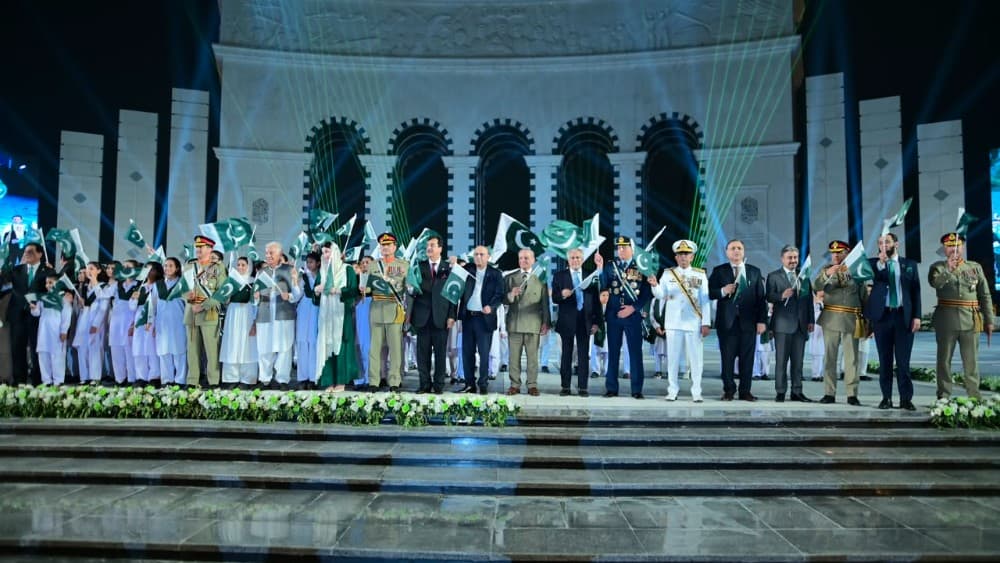
ISLAMABAD: President Asif Ali Zardari and Prime Minister Muhammad Shehbaz Sharif used Pakistan’s 79th Independence Day to reaffirm the country’s commitment to peace while making clear that sovereignty, national security and territorial integrity would remain non-negotiable.
Addressing the nation on the eve of Independence Day, President Zardari warned Afghanistan against allowing its territory to be used by terrorist groups for attacks against Pakistan, while PM Sharif called such use of Afghan soil “intolerable” and urged the Afghan leadership to prevent its territory from becoming a safe haven for terrorists.
At the same time, the prime minister reiterated Pakistan’s message to India nearly 15 months after the May 2025 confrontation, saying Islamabad wanted peace but would respond with greater force to any future challenge to its sovereignty and security.
Pakistan maintains that its response in May 2025 came in self-defense after an unprovoked Indian aggression.
Pakistan urges Kabul to end cross-border terrorism
In his Independence Day address, President Zardari said Pakistan had respected Afghanistan’s sovereignty and sought peaceful relations despite longstanding differences, but expected Kabul to reciprocate by preventing terrorist activity from its territory.
He urged the Afghan leadership to end actions against Pakistan and said the country’s armed forces were capable of confronting threats to national security.
PM Sharif struck a similar tone, saying Pakistan wanted peace and stability in Afghanistan but could not accept the use of Afghan territory for attacks against Pakistan.
“We also desire peace and stability in Afghanistan, but the use of Afghan soil for terrorism against Pakistan is intolerable,” the prime minister said.
“My sincere advice to the Afghan leadership is to immediately stop their territory from becoming a safe haven for terrorists.”
Islamabad has repeatedly raised concerns over terrorist groups operating from Afghan territory, particularly the Tehreek-e-Taliban Pakistan, or Fitna al-Khawarij. President Zardari made a similar appeal in May, saying Indian-sponsored terrorism through Afghanistan must end and Afghan authorities must ensure their territory is not used against Pakistan.
May 2025 remains a defining reference point
The Independence Day message also looked back at the May 2025 confrontation with India, which Islamabad officially commemorates as Marka-e-Haq and Operation Bunyan-um-Marsoos.
PM Sharif said Pakistan wanted peace but would not allow that desire to be mistaken for weakness.
“We want peace, not war, but our desire for peace should not be mistaken for weakness,” he said.
He described Pakistan as a guarantor of regional stability and said the message of the May 2025 confrontation had reached the world.
“The message of the battle of May 2025 has reached the entire world,” the prime minister said.
He warned that any future challenge to Pakistan’s sovereignty and security would receive a stronger response.
“If, in the future, anyone even mistakenly challenges Pakistan's sovereignty and security, they will be given a crushing response with even greater force than May 2025.”
Pakistan had described Operation Bunyan-um-Marsoos as its response to Indian aggression and said the operation was conducted in exercise of its right to self-defense. The two countries subsequently reached a ceasefire understanding on May 10, 2025.
President Zardari, recalling the episode, said Pakistan’s response had demonstrated the professionalism and capability of its armed forces while maintaining that Islamabad sought peace without compromising sovereignty.
Water rights remain Pakistan’s red line
PM Sharif also linked relations with India to the Indus Waters Treaty, which India suspended following the 2025 confrontation.
Calling the move “illegal,” the prime minister said Pakistan would defend its water rights.
“Every single drop of Pakistan's water is our red line; if India does not mend its ways, it will be given a direct response.”
Pakistan has repeatedly maintained that the Indus Waters Treaty cannot be unilaterally suspended and has described water security as a matter of national interest. The issue has featured prominently in the government’s post-May 2025 security and diplomatic messaging.