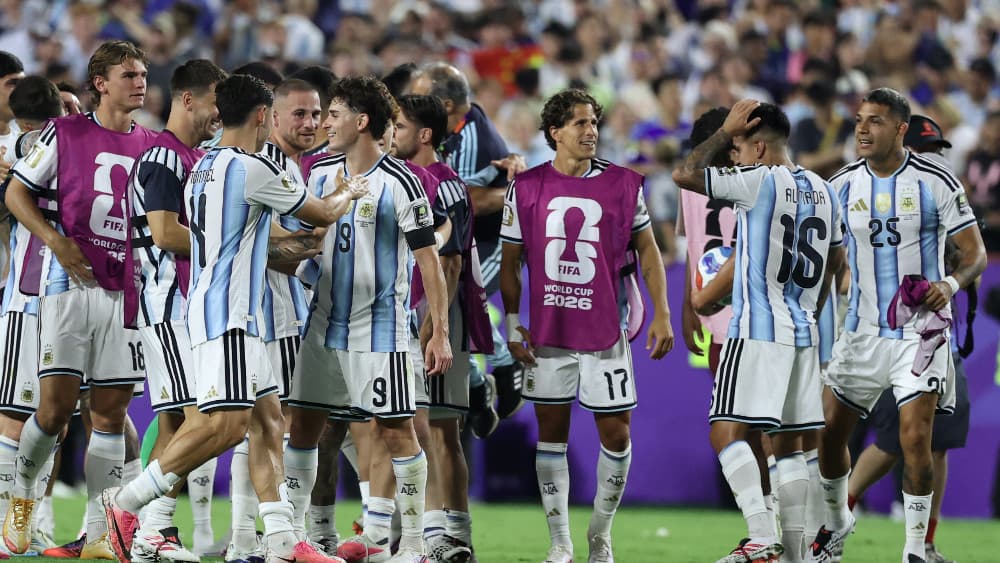
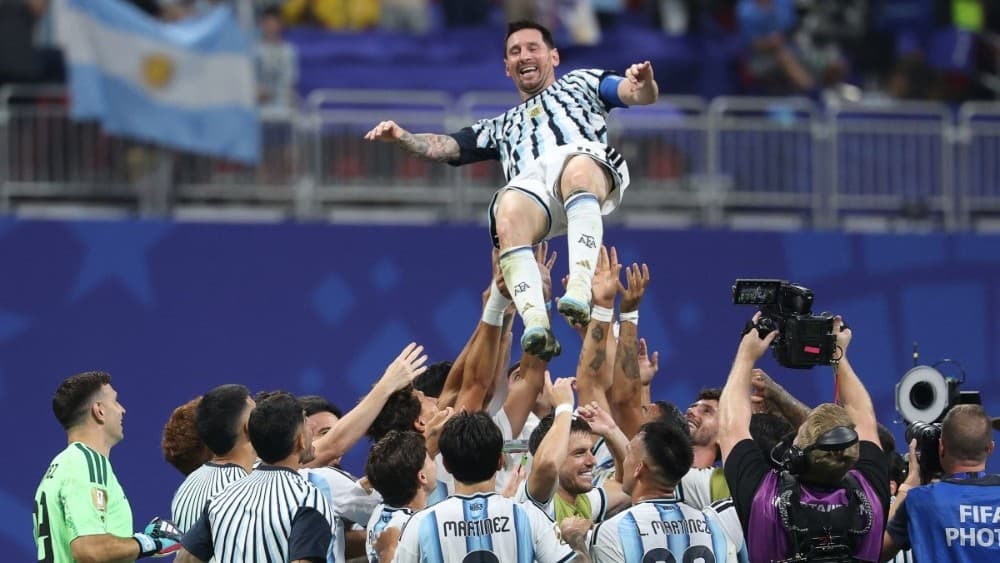
ATLANTA: Lionel Messi's brilliance has helped carry Argentina into a blockbuster World Cup semi-final with England in Atlanta on Wednesday.
But the defending champions' journey to the last four has been engulfed by online conspiracy theories claiming, without evidence, that the playing field has been tilted in their favour.
Social media is awash with AI-generated videos and memes which amplify this narrative, whether it's FIFA President Gianni Infantino and Messi sharing a loving embrace on the deck of the Titanic in the style of Leonardo DiCaprio and Kate Winslet, or simply Infantino's face being superimposed at the heart of the Sun of May at the center of Argentina's flag.
From contentious refereeing decisions to claims of being handed a kind draw to the final, AFP breaks down the main incidents which have given rise to the conspiracy theories:
Messi escapes red
In Argentina's group stage win over Algeria, with the South Americans leading 1-0, captain Lionel Messi raked his studs down the right calf and Achilles tendon of Algeria skipper Aissa Mandi in the 30th minute.
Polish referee Szymon Marciniak gave Algeria a free-kick but Messi received no further sanction and would go on to score a hat-trick.
Several pundits however were adamant that Messi had been guilty of serious foul play and under the letter of the law, should have been shown a red card that would have led to a suspension.
"It should have been a red card in my opinion," said ESPN pundit and former Manchester City defender Nedum Onuoha.
"Messi knew he did something that could have got him in trouble. I personally feel it is a red card."
Former Bundesliga referee Patrick Ittrich agreed: "For me, that is a red card. We have various examples from the Bundesliga where that was punished with a red. By the letter of the law, that is a red. If I had seen it like that on the pitch, I would have shown red."
Algeria's football federation subsequently filed an official complaint to FIFA over "refereeing injustice" in the game.
Egypt cry foul
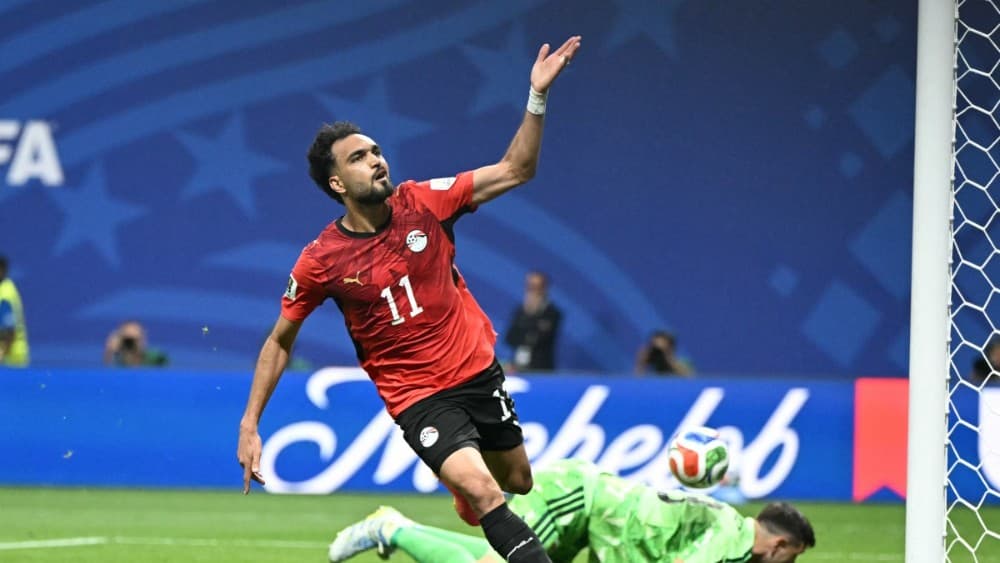
Argentina produced one of the all-time great comebacks to keep their World Cup campaign alive in the last 16 against Egypt, recovering from a 2-0 deficit to win 3-2 and reach the quarter-finals.
But Egypt's players and coaching staff were outraged by several decisions by French referee Francois Letexier that went in Argentina's favour at key moments.
The biggest post-game talking point surrounded a goal scored by Egypt in the second half which was disallowed after an intervention by the Video Assistant Referee (VAR), who had spotted a foul on an Argentina player several phases before Egypt's Mostafa Zico put the ball in the net, at the other end of the pitch.
Several analysts questioned whether VAR had overstepped its reach.
"VAR was looking at something too deeply and looking for something that has happened in the game to try to cancel the Egypt goal," former FIFA referee Mark Clattenburg said.
Egyptian coach Hossam Hassan also claimed that Egypt should have been awarded a penalty in the build-up to Enzo Fernandez's late winner for Argentina.
"There seems to have been pressure on the Argentinian side on the referee that has brought about this outcome," Hassan said.
"Perhaps they wanted to keep the world champions in the competition?" he told BeIn Sports.
"Perhaps they wanted Messi to stay in the running? In football, there are sometimes external factors that go beyond the technical aspects."
FIFA referees' chief Pierluigi Collina rejected the Egyptian allegations as "unfounded".
Pivotal VAR call
Another pivotal VAR call helped shape the outcome of Argentina's 3-1 extra-time quarter-final win over Switzerland on in Kansas City on Saturday.
In the 70th minute, referee Joao Pinheiro gave Argentina's Leandro Paredes a yellow card for a foul on Breel Embolo, shortly after Switzerland had equalised at 1-1 and were dominating the weary world champions.
However, a VAR intervention using FIFA's new mistaken identity rule determined that Embolo had initiated the foul in an act of simulation and the call was overturned. Yet because Embolo had already received a yellow card, he was shown a red and sent off -- leaving Switzerland down to 10-men and halting their momentum. Argentina would on to secure victory in extra-time.
"We were punished because of a rule that, in my opinion, is completely unacceptable," Swiss coach Murat Yakin said afterwards.
Many commentators though point out that Embolo was rightly punished for a clear dive.
"If you want to argue FIFA is rigging the World Cup for Lionel Messi and Argentina, and some of you are hellbent on doing just that, you're going to have to do better than this," wrote USA Today columnist Nancy Armour.
A kind draw?
Critics of Argentina's run to the semi-finals cite the ranking of their opponents as evidence of favouritism by FIFA.
So far Argentina has not had to face a team ranked higher than 19th in the world heading into their clash with England on Wednesday. After topping a group that included Algeria, Jordan and Austria, Argentina's knockout round opponents were Cape Verde, Egypt and Switzerland.
But this is due in in large part to FIFA's decision to seed the top four teams in the world in such a way that would keep them apart until the semi-finals.
England have not faced a team ranked in the top 10 so far while France did have to play seventh-ranked Morocco in the quarter-finals.
Spain has had the hardest route to the semi-finals, needing to beat fifth-ranked Portugal and Belgium (ninth) on their way to the last four.