


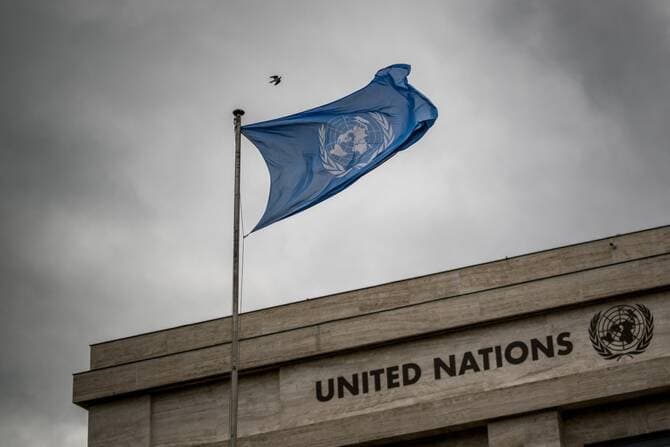
GENEVA: Washington on Monday pledged an initial $2 billion for United Nations humanitarian aid in 2026—far less than it has provided in recent years—warning individual UN agencies to "adapt, shrink or die".
With its pledge, announced at the US mission in Geneva alongside the United Nations' aid chief Tom Fletcher, the United States is pursuing a dramatic overhaul of how it funds UN humanitarian work.
Instead of handing funds to individual agencies, the United States will funnel its contributions through the UN aid agency OCHA, headed by Fletcher, which earlier this year launched a so-called Humanitarian Reset to improve efficiency and accountability.
The US funds will then be distributed to more than a dozen selected countries, including the Democratic Republic of Congo, Myanmar and Sudan.
"It is an initial anchor commitment," Jeremy Lewin, the senior US official for foreign assistance, humanitarian affairs and religious freedom, told reporters.
"There are other countries that we will add as we continue to get more funding into this mechanism."
He challenged other countries to match or beat US funding for UN aid.
"This new model will better share the burden of UN humanitarian work with other developed countries and will require the UN to cut bloat, remove duplication, and commit to powerful new impact, accountability, and oversight mechanisms," US Secretary of State Marco Rubio said on X.
According to UN data, the United States remained the top humanitarian aid donor in the world in 2025, but that amount fell significantly to $2.7 billion, down from around $11 billion in 2023 and 2024, and from over $14 billion in 2022.
Other key donor countries have also been tightening their belts, triggering major upheaval in the global aid sector.
"Individual UN agencies will need to adapt, shrink, or die," a State Department statement said.
Hard priority choices
Fletcher, who is British, said the US pledge was an "extraordinary" commitment.
"The US has long been the world's humanitarian superpower," he said in a statement.
"Hundreds of millions of people are alive today because of American generosity—and many millions more will survive in 2026 because of this landmark investment in humanity."
Fletcher said reform of the humanitarian system was in the pipeline, and US taxpayers would be able to see how their money was delivering life-saving impacts.
"The US is also placing a significant and encouraging vote of trust and confidence in the Humanitarian Reset, through which we are making humanitarian action faster, smarter and closer to the people on the front lines of emergencies," he said.
"We're cutting red tape, eliminating duplication, and prioritizing hard."
When Fletcher launched the UN's annual Global Humanitarian Appeal for 2026 earlier this month, he requested $23 billion to provide assistance to 87 million of the world's neediest people, with a heavy focus on dire conflicts like those in Gaza, Ukraine, Sudan, Haiti and Myanmar.
The amount and number of people covered by the appeal has been dramatically reduced over recent years, as the UN strives to adapt to a new reality after President Donald Trump slashed US foreign aid spending.
The United Nations has stressed that the smaller appeal does not mean needs have shrunk.
It estimates that some 240 million people—in conflict zones, suffering from epidemics, or victims of natural disasters and climate change -- are in need of emergency aid.
In 2025, the UN's appeal for more than $45 billion was only funded to the $12 billion mark, the lowest in a decade.
That only allowed it to help 98 million people, 25 million fewer than the year before.