


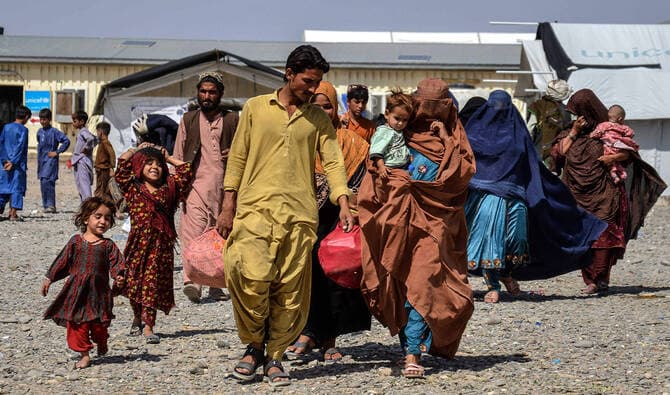
ISLAMABAD: The Islam Qala reception center, Afghanistan's second-largest border crossing with Iran, has suspended all operations except basic health services after Taliban authorities banned female humanitarian workers from non-medical roles, according to the International Organization for Migration's December emergency border response report.
The Taliban-imposed shutdown has left thousands stranded at the border during Afghanistan's harshest winter months. "Negotiations with authorities at the Herat level is ongoing, with DfA maintaining its stance that non-health female staff cannot work at the IQ Reception Centre at this stage," IOM reported, halting services for an average of 1,224 people crossing daily.
Taliban employment restrictions have created measurable disparities in humanitarian reach. Afghanistan's Eastern Region, operating with fewer Taliban-imposed constraints, achieved 122% of humanitarian targets. They were able to assist 196,831 people against a goal of 161,774, according to the Emergency Shelter and Non-Food Items Cluster's November snapshot.
The Central Region, which includes the shuttered Islam Qala crossing, reached only 37% of targets. This is a 63% shortfall the cluster attributed to operational restrictions.
The Central Highland Region, where Taliban authorities imposed severe limitations on humanitarian movement, recorded zero people receiving shelter assistance in November against a target of 8,963 households, according to cluster data.
The complete freeze occurred as Afghanistan entered winter, when the cluster documented a 77.5% national gap in winterization assistance. This has left 779,198 people without supplies.
"Only 12,200 households received winterization assistance as of December 15, against an assessed need of 57,000 households," according to the shelter cluster's winterization dashboard. The 78% gap affecting approximately 400,000 people resulted from "operational restrictions preventing delivery" despite available resources, the dashboard noted.
Organizations possess capacity to assist 22,700 households through $21.8 million in available resources, but Taliban-imposed constraints prevent delivery, the dashboard indicates. Only 22% of the $179.1 million emergency shelter requirement has been funded, with donors citing concerns about operating under Taliban restrictions, according to cluster data.
Taliban restrictions on women systematically block aid access. Women comprise 51% of all returnees but face layered Taliban-imposed barriers, according to UNHCR's December 2025 Post-Return Monitoring Survey Report interviewing 1,658 households.
"Only 37% of women reported mobile phone access compared to 96% of men," the UNHCR survey found, a gap that "continues to restrict women's ability to access information and assistance" due to Taliban restrictions on women's movement and communication.
Taliban employment bans devastated women's economic survival. "Only 24% of women among returnees reported earning an income, compared to 66% of men," UNHCR documented. Female-headed households suffered worst: "88% skip meals" versus 82% generally, and "74% of renters are unable to afford costs."
Taliban mahram requirements (mandating male guardians for women's travel) created healthcare crises. "Women were disproportionately represented among those with unmet care needs, reflecting the impact of movement restrictions and mahram requirements," with 34% of households unable to obtain needed medical attention, UNHCR reported.
The Taliban's education ban shattered access for girls. "71% of returnee households reported that no girls in the family were enrolled in school," with 37% citing the ban as the primary barrier, UNHCR found. Among Iran returnees, 44% cited Taliban "policies and laws" as the key obstacle versus 28% among Pakistan returnees.
Taliban policies are driving re-displacement. "40% of returnees cited restrictions on women's education and work as the primary reason" relatives left Afghanistan again after returning, UNHCR's survey found. "Among those from Iran who intend to leave, 71% reported that they would return to Iran."
The Taliban's Islam Qala shutdown occurred during peak flows. In Herat's Western Region, organizations recorded a 100% gap in emergency shelter: zero households helped against a target of 182,040, despite 34,431 returnees from Iran, according to cluster data.
Temporal data exposes how Taliban restrictions progressively strangled operations. The Central Highland Region assisted 12,104 people in March but zero by November. The Northern Region dropped 98% (from 24,675 to 385). The Southeastern Region fell 95%, from 7,610 to 407, according to monthly snapshots.
Between January and November, 2.7 million Afghans returned to Afghanistan, UNHCR reported. "UNHCR assisted over 475,000 Afghans returning from Iran and Pakistan despite significant operational and funding challenges", reaching only 18% due to Taliban-imposed operational constraints.
"Returnees continue to settle in areas with fragile conditions marked by deepening poverty and limited access to essential services," UNHCR concluded. "Many cannot return to their areas of origin due to lack of shelter, land, or livelihoods"—outcomes the agencies directly linked to Taliban restrictions preventing humanitarian organizations from operating at documented capacity.