


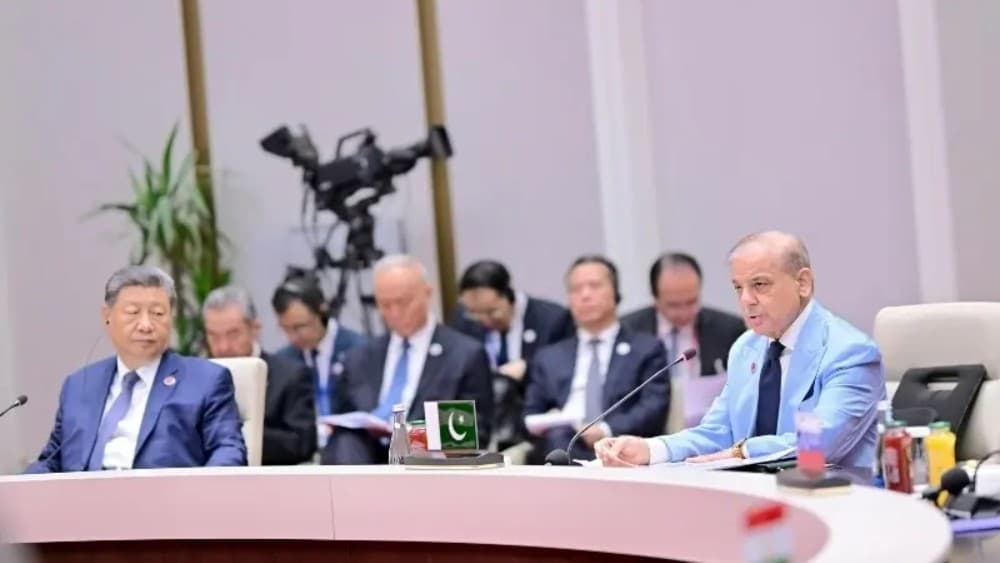
ISLAMABAD: Prime Minister Shehbaz Sharif on Tuesday called on Shanghai Cooperation Organization (SCO) member states to strengthen multilateral cooperation, uphold international law, and work collectively for regional peace and stability, as the bloc marked the 25th anniversary of its founding.
Addressing the 26th Meeting of the SCO Council of Heads of State, the prime minister described the summit as a historic occasion and thanked Kyrgyz President Sadyr Japarov and his team for hosting the gathering and successfully steering Kyrgyzstan's SCO chairmanship. He likened the organization’s growth over the past quarter-century to "a tender sapling into a towering tree that provided security and stability to the region."
World in flux
PM Sharif said the current global landscape was marked by intensifying geopolitical tensions, a fragmenting global economy, escalating climate crises, and unprecedented technological change. He said the SCO represented the collective resolve of member states to navigate these challenges together, and called for stronger multilateral institutions capable of turning commitments into practical action.
Regional peace and the Islamabad MoU
Reaffirming Pakistan's commitment to the UN and SCO charters, the prime minister said disputes must be resolved peacefully and in accordance with international law. He said Pakistan had staunchly advocated peace earlier this year when the sovereignty and territorial integrity of an SCO member state was violated, triggering a major regional crisis. The resulting disruption to energy supply routes, he said, had imposed a heavy economic cost on Pakistan and the wider international community.
He said Pakistan's sustained diplomatic efforts as an "honest and sincere mediator and facilitator" had culminated in the Islamabad Memorandum of Understanding, signed in June, which he called "the most viable and enduring pathway to lasting peace in the region."
Makkah Defence Agreement
The prime minister also referred to the recently signed trilateral Makkah Joint Defence Agreement between Pakistan, Saudi Arabia and Turkiye, describing it as an expression of shared commitment to sovereignty, territorial integrity, collective security and regional peace. He clarified that the pact was "fundamentally defensive in nature" and was not directed against any state or intended to create confrontation or division.
Gaza and the right to self-determination
Turning to the Middle East, PM Sharif expressed deep concern over the continuing plight of civilians in Gaza and the West Bank, calling their suffering unimaginable. He urged the international community to help Palestinians and other oppressed peoples secure their fundamental right to self-determination.
Water as a regional lifeline
On shared water resources, the prime minister said water was "the life and blood" of the region and must never be weaponized or used as a political or coercive tool. He said treaties governing shared waters were binding international commitments that must be honoured unconditionally, "in both letter and spirit."
Counterterrorism and regional security
Highlighting Pakistan's counter-terrorism record, PM Sharif said the country had sacrificed more than 90,000 lives and suffered economic losses exceeding USD 150 billion over the past two and a half decades in the fight against terrorism. As chair of the SCO Regional Anti-Terrorism Structure (SCO RATS), he said Pakistan had worked actively to strengthen regional counter-terrorism cooperation, and reiterated that peace would remain elusive so long as terrorist elements continued to use Afghan soil to launch attacks against Pakistan and other neighbouring countries.
Connectivity, development and Pakistan's upcoming chairmanship
On regional connectivity, the prime minister said the China-Pakistan Economic Corridor continued to serve as a gateway linking regional economies to the Arabian Sea, and reaffirmed Pakistan's commitment to trans-regional railway projects, road connectivity, and regional energy schemes. He called for full implementation of the SCO Development Strategy until 2035 and said establishing the SCO Development Bank would be a critical step forward. As the permanent chair of the SCO's Special Working Group on Poverty Reduction, he said Pakistan would continue to strengthen social protection and inclusive development across the region.
Looking ahead to Pakistan's incoming SCO chairmanship, PM Sharif said Islamabad would pursue an action plan prioritizing trans-regional connectivity, energy projects, IT and AI collaboration, poverty reduction, health and sports. He proposed establishing an SCO Sovereign AI Infrastructure and Governance Framework to promote responsible and inclusive AI development, strengthen digital sovereignty, and ensure no member state was left behind.
He also announced that Pakistan would host the Global Resilience Expo 2026–2027 in Islamabad to enhance regional disaster management, early warning systems and response coordination.
Call for unity
Closing his address, the prime minister said that just as many streams together form a mighty river, the combined strength and aspirations of SCO nations held limitless potential.
"Let us turn the vision of the SCO into action, its promise into progress, and its progress into a better future for all," he said, expressing hope that history would record the SCO as having "chosen cooperation over confrontation, dialogue over division, bridges over barriers, and hope over fear."
PM Sharif went on to sign the joint declaration of the SCO Council of Heads of State Summit. The event was attended by heads of state and government of SCO member countries, along with SCO Secretary General Nurlan Yermekbayev.
PM Sharif also extended greetings to the leadership and people of Kyrgyzstan and Uzbekistan on their respective independence days.
The prime minister arrived in Bishkek on Monday to participate in the two-day SCO summit, where leaders from China, Russia, Iran, Turkiye and India are also attending.
Pakistan is set to assume the SCO Council of Heads of State chairmanship for 2026-27, with Islamabad scheduled to host the next summit.
The SCO includes China, Russia, Pakistan, India, Iran, Belarus, Kazakhstan, Kyrgyzstan, Tajikistan and Uzbekistan.