


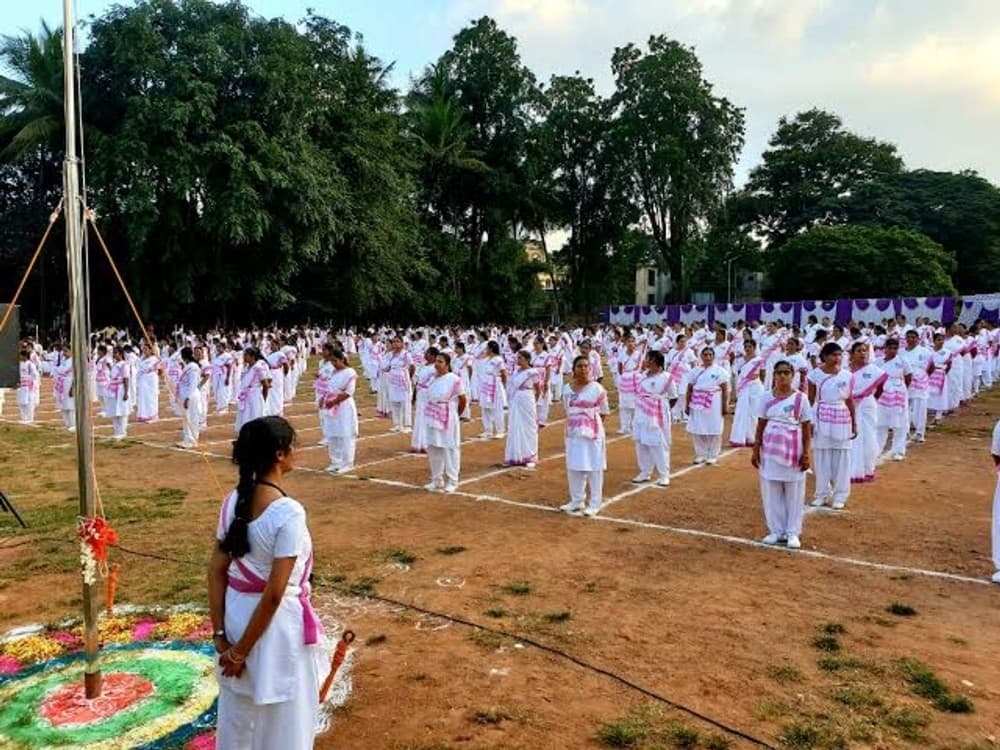
ISLAMABAD: A religious leader at a Hindu nationalist gathering in Indian Hyderabad called on parents to train their children in firearms and violence instead of traditional childhood education, according to on-ground reporting by Indian investigative outlet The News Minute.
"Stop teaching children 'Twinkle Twinkle Little Star.' Teach them how to fire a gun and sword fighting. Don't send girl children to dance classes. Send them to martial arts classes. Send them to RSS shakas, Bajrang Dal's training centers," chief speaker Girdhar Swami Shastri told the gathering on Saturday, according to The News Minute.
The statement was made at the Dharma Rakshana Sabha, organized by the Ganesh Utsav Committee, which is affiliated with the right-wing Hindu nationalist volunteer organization Rashtriya Swayamsevak Sangh (RSS).
'Twist their necks'
The Jan. 24 event was held in Balapur, a location in Hyderabad that hosts a settlement of Rohingya Muslims who fled religious persecution in Myanmar.
The Indian government does not categorize Rohingya Muslims as refugees and considers them "illegal immigrants," as noted by The News Minute.
The report noted how the chief speaker, Shastri, declared he would not step down from the dais until India became a "Hindu Rashtra." He claimed Muslims enter countries "either to convert or to behead" non-Muslims.
He urged Hindus to organize "physically and militarily," stating: "The Hindu society will not survive unless the community gets organized and starts responding to bricks with stones, sticks with swords and spears with pistol revolvers."
The speech included direct exhortations to violence: "If you see any Bangladeshi Muslim or a Rohingya Muslim, hold them by their neck, pin them on the ground and twist their necks," according to the report.
Shastri also urged Hindu women to have more children, claiming that "strength lies in numbers." He said children should be trained in violence.
Scale of operations
According to the RSS Annual Report 2025, the organization operates over 73,000 daily shakhas (training branches) across India.
The organization's educational arm, Vidya Bharati, operates schools enrolling 3.5 million children. Over 70% of new RSS members belong to the 14-25 age group.
RSS ideology has also been integrated into formal education systems, according to Indian media reports. In late 2025, the Delhi government began introducing lessons on the history of the RSS and its founders into the public school curriculum under the "Rashtraneeti" (National Policy) program.
In remote tribal areas, the organization operates thousands of "Ekal Vidyalayas" — one-teacher schools providing basic education while making Hindutva ideology compulsory curriculum, according to reports on the organization's educational activities.
Academic research published in the Journal of South Asian Studies describes RSS shakha activities as including physical training with a "lathi" (bamboo staff), ideological instruction that reinterprets Indian history as a continuous struggle against Muslim "invaders," and concluding with a Sanskrit prayer to the "Motherland."
The Bajrang Dal, the youth wing of the Vishva Hindu Parishad, operates annual "Shaurya Prasikshan Varg" (Valour Training Camps), according to VHP official charter documents.
BBC has documented some camps where training includes knives and firearms. In 2016, a video from an Ayodhya camp showed trainees "fighting" men dressed in traditional Muslim attire.
Historical pattern
The rhetoric calling for the militarization of Hindu youth dates to the founding of Hindu nationalist ideology, according to academic historical research. In 1923, V.D. Savarkar argued that only through "rifle practice" could Hindu youth assert dominance. In 1937, B.S. Moonje established the Bhonsala Military School in Nashik to train Hindu boys in military discipline.
Human Rights Watch documented Bajrang Dal leaders in the 1990s calling for "militarization" of Hindu youth. In 2002, Shiv Sena leader Bal Thackeray publicly suggested Hindus needed "suicide groups armed with bombs."
Violence connections
Human Rights Watch and judicial commissions have documented connections between RSS/Bajrang Dal training and communal violence. HRW reports and tribunals found that Bajrang Dal and RSS members "were most responsible" for organized anti-Muslim violence in Gujarat 2002 that killed over 1,000 people. Witnesses reported that mobs used organized tactics similar to those in training drills, according to tribunal testimony.
More than 600 incidents of violence against Christians were reported in 2024, with RSS and Bajrang Dal youth groups identified as primary aggressors, according to United Christian Forum and Human Rights Watch.
A December 2025 New York Times investigation uncovered a network of over 400 hostels serving tribal youth that function as recruitment centers for Hindu nationalist mobilization.
Legal enforcement gap
India's Juvenile Justice Act, 2015, criminalizes recruitment of children by "non-state self-styled militant groups" with penalties up to seven years, according to the Act's provisions. However, RSS and Bajrang Dal successfully defend activities in court as "cultural education" protected under constitutional rights, according to legal analyses.
According to India Hate Lab data, there were 1,318 verified hate speech events in India in 2025 — a 13% increase from 2024 and nearly double the 668 incidents in 2023.
Almost 90% of events occurred in BJP-governed states, according to IHL analysis. The highest numbers were in Uttar Pradesh (266 events), Maharashtra (193), Madhya Pradesh (172), Uttarakhand (155), and Delhi (76).
International concern
The United Nations Office of the High Commissioner for Human Rights issued multiple statements in 2024-25 expressing alarm over "incitement to violence" targeting Muslims in India, according to official UN communications. For the sixth consecutive year, the US Commission on International Religious Freedom recommended in its 2025 report that India be designated a "Country of Particular Concern."
Human Rights Watch's World Report 2025 documented growing use of "hate speech" at religious gatherings where speakers call for an exclusively Hindu state, noting that local authorities often fail to take action.