
Execution video exposes how Manipur became India's invisible conflict zone

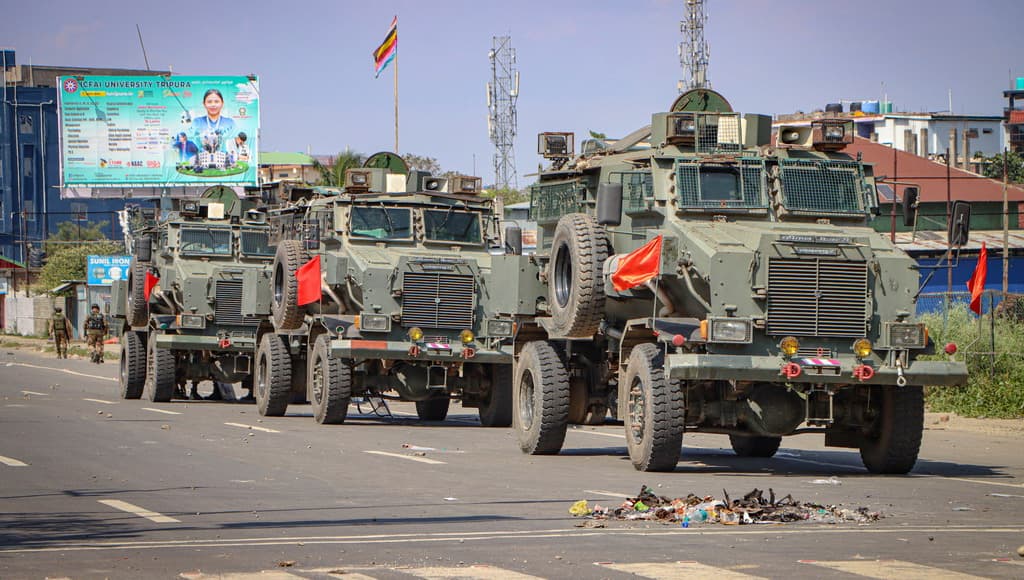
Security forces conduct a flag march along the Imphal Airport Road, to enforce a curfew in Imphal on June 8, 2025, a day after violence was triggered following the arrest of members of radical Meitei group Arambai Tenggol. (AFP)
ISLAMABAD: A man kneels in the dirt, hands clasped, pleading for his life. Gunshots crack. His body slumps forward. The video, filmed in India's remote northeastern state of Manipur, would be viewed by millions within hours.
The graphic clip has become the latest flashpoint in an ethnic conflict that has killed at least 260 people and displaced 60,000 since May 2023. It is a crisis that has left the state effectively partitioned along ethnic lines, yet remains largely unknown beyond India's borders.
The victim, identified by the Press Trust of India as Mayanglambam Rishikanta Singh, was a member of the Meitei community. His wife belongs to the Kuki ethnic minority.
According to Indian media reports, four masked men abducted Singh and his wife from their home in the Tuibong area on Jan. 8, 2026. His wife was released. Singh was not.
Vijatia Singh, the deputy editor of The Hindu, one of India's leading newspapers, reported that the video was filmed and "published on WhatsApp within an hour" of the killing.
Soon, the town of Kakching erupted in protests. Demonstrators burned tires on roads and shut down markets, according to journalists covering the unrest. The Press Trust of India attributed the killing to "suspected Kuki militants," alleging the gunmen belonged to the United Kuki National Army, a group that has not signed a ceasefire agreement with Indian authorities.
But in Manipur, a state where ethnic identity determines which roads you can travel and which neighborhoods you can enter, the question of who killed Singh has become inseparable from a larger, more intractable question: How did India allow an entire state to collapse into segregation?
A state divided by invisible lines
Manipur, a lush, mountainous state bordering Myanmar, is now effectively two separate territories. The Imphal Valley, a flat basin comprising just 8% of the state's land, is home to the Meitei, a predominantly Hindu ethnic group that makes up roughly 44% of Manipur's 3 million people, according to India's 2011 census.
Surrounding the valley are hills controlled by the Kuki-Zo, a collective term for more than 20 tribes, most of them Christian, who hold official "Scheduled Tribe" status under India's Constitution. That designation grants them land protections and government job quotas that the Meitei do not have.
Between the two communities lies what locals call a "buffer zone," though authorities prefer terms like "sensitive areas" or "vulnerable stretches." It is a no man's land patrolled by federal paramilitary forces where neither Meitei nor Kuki can pass without risking their lives.
The violence that created this division began on May 3, 2023, after a Manipur High Court order directed the state government to consider granting Scheduled Tribe status to the Meitei. For the Kuki, the ruling represented an existential threat. Scheduled Tribe protections, established decades ago to shield indigenous communities from land grabs, would suddenly extend to the state's dominant ethnic group.
"This is what happens when decision-makers are fed a false sense of normalcy," said an analysis by Vantage Monitor, an open-source intelligence firm that tracks conflicts from an ‘Indian lens’. "On paper, things may look calm. On the ground, fear, armed groups, and deep mistrust still exist."
Conflict with roots in land and identity
The tensions in Manipur did not begin in 2023. For years, the state government, led until early 2025 by Chief Minister N Biren Singh, pursued policies that many Kuki leaders described as discriminatory.
Authorities conducted eviction drives in hill districts, clearing villages they claimed were encroaching on protected forests. Singh's government publicly referred to some Kuki groups as "illegal immigrants" and "narco-terrorists," according to Human Rights Watch.
The Meitei, meanwhile, argued they were being squeezed. Community leaders pointed to census data showing their share of Manipur's population had dropped from 59% in 1951 to 44% in 2011. Confined to the valley, they could not legally buy land in the hills. But hill tribes, they said, faced no such restrictions in purchasing valley property.
When violence erupted, both sides were armed. Over 6,000 weapons and 600,000 rounds of ammunition were looted from state armories in the conflict's early days, according to official figures cited by Amnesty International.
Vigilante groups emerged. The Meitei formed militias with names like Arambai Tenggol and Meitei Leepun. The Kuki relied on a patchwork of militant organizations, some with histories stretching back to separatist insurgencies of the 1990s.
The Indian Supreme Court later described the situation as an "absolute breakdown of law and order." It noted that the police appeared "inept" and, in some cases, "colluded with the perpetrators."
International alarm over government complicity
The conflict drew international condemnation after a video surfaced in July 2023 showing two Kuki women being paraded naked by a Meitei mob before being gang-raped. United Nations experts said the footage provided evidence of "systematic sexual violence" and stated that Indian authorities were potentially aiding "the incitement of racial and religious hatred."
Human Rights Watch and Amnesty International have both documented what they describe as a "pro-Meitei bias" in the state government's response. According to these organizations, authorities provided "political patronage" to Meitei vigilante groups and failed to prosecute mob leaders.
The Indian government imposed one of the world's longest internet shutdowns in response to the crisis, cutting access for over 200 days in 2023. The blackout, which continued intermittently through 2025, made it difficult for journalists and aid workers to document abuses or coordinate relief efforts, according to the United Nations.
In relief camps housing displaced Kuki families, conditions have been described by Amnesty International as "inhumane," with severe shortages of clean water, sanitation and medical care. As of May 2025, India's Union Home Ministry had allocated approximately $256,000 for relief efforts. An amount aid workers told the organization was "falling far too short of needs."
Authorities also targeted critics. Journalists, activists and fact-finding teams, including members of the Editors Guild of India, faced criminal charges such as sedition and defamation after publishing reports critical of the government's handling of the violence, according to Human Rights Watch.
Division remains
On Feb. 9, 2025, Chief Minister Singh resigned after audio recordings surfaced that allegedly linked him to the instigation of ethnic violence. Four days later, the Indian government imposed President's Rule, suspended the state legislature and placed governance under a federally appointed governor. The move was meant to ensure neutral administration. Yet even under federal control, the state remains split.
Kuki political leaders, represented by the Kuki-Zo Council, continue to demand what they call a "separate administration" — in effect, a new territory carved from Manipur where they would govern themselves.
On Jan. 13, 2026, the council and 10 elected Kuki lawmakers formally resolved to boycott any future Manipur government unless New Delhi provides a "written, time-bound commitment" to their autonomy demands, according to official council resolutions.
Approximately 40,000 to 60,000 Kuki remain in displacement camps as of late 2025, according to academic studies tracking the crisis. Researchers have documented what they describe as a "mental health emergency" in these camps, with widespread cases of post-traumatic stress disorder, anxiety and suicides among elderly residents.
Neither community can travel freely. Meitei cannot access the hills. Kuki cannot enter Imphal, the state capital, where hospitals, universities and government offices are located. The buffer zone remains.
"Human life is indispensable," Vantage Monitor wrote in its analysis of Singh's killing. "Once lost, no statement, inquiry, or reassurance can bring it back. If ground reality is misread today, the long-term consequences, politically, socially, and strategically, will be far more damaging tomorrow. This is not just a law-and-order failure. It is a warning signal."
For now, that warning remains unheeded. The video of Singh's execution continues to spread on encrypted messaging apps, watched by millions who still cannot answer a simpler question: In a democracy of 1.4 billion, how does an entire state descend into ethnic partition while the world looks away?

Latest News
LIVE: Trump describes US-Iran talks as 'positive' after 'daylong' negotiations
AN HOUR AGO
Pakistan close on series-levelling win against West Indies
3 HOURS AGO

Pakistan leadership reaffirms solidarity with Kashmiris on Youm-e-Istehsal
2 HOURS AGO
Oil giants warn next energy crunch will be refined fuels, not crude
6 HOURS AGO
US revokes visa of Brazilian ambassador to Washington
7 HOURS AGO