


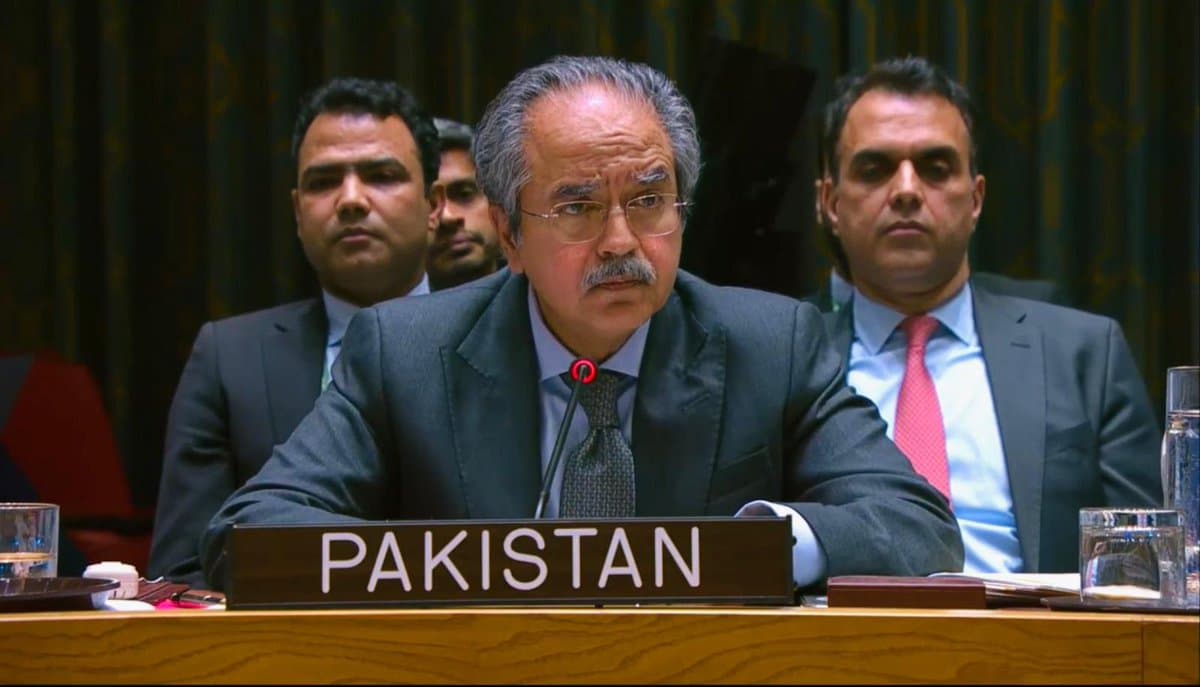
ISLAMABAD: Pakistan has said that at a time when the multilateral system is facing an unprecedented stress, and there are widespread calls for a United Nations that is truly fit for purpose, demands for special privileges and new permanent seats should have no place in the reform discussions.
Speaking during the second IGN meeting on the cluster of “Categories of Membership,” Ambassador Asim Iftikhar Ahmad, Pakistan’s Permanent Representative to the UN, said that Pakistan’s position has remained consistent and unequivocal: the addition of new permanent members will not dilute the disproportionate influence of the existing permanent members; rather, it risks entrenching and further expanding it, said a press release shared on X by Pakistan's Permanent Mission to the UN, on Saturday.
“Two wrongs cannot make a right and a larger oligarchy is no antidote to an elite power club,” he said.
He said that a circle of permanence within the Security Council, even though expanded, will still remain a closed circle, adding that no wonder some of the P5 are happy to expand this club, primarily to protect what he termed as “their own outdated status in today’s Council.”
The Pakistan UN Ambassador suggested a proposal of a meaningful increase in the number of elected, non-permanent members to balance the unequal power of the P5 as part of efforts to make the Security Council more democratic, accountable and representative.
He said that this shift in the internal balance of an expanded Council in favour of the wider UN membership will enhance transparency, inclusivity, and accountability in the Council’s decision-making process.
Referring to Africa’s demand for permanent seats in the reformed Council, Ambassador Ahmad explained that Pakistan fully respected and understood the demand, stating that advanced on behalf of and for the entire region, this demand was fundamentally different from other proposals that are divisive as they seek permanent membership for individual States.
Addressing proposals for longer-term fixed regional seats, he acknowledged the Co-Chairs’ efforts to bridge differences and explore middle-ground solutions.
He noted that such ideas implicitly recognize the lack of feasibility surrounding the creation of new permanent members and instead point toward models based on longer-term elected seats, re-election, and regional rotation.
'Reform for All – Privilege for None'
While describing these ideas as constructive and worthy of consideration, he stressed that any arrangement must avoid evolving into de-facto permanence.
Reform, he emphasized, must not result in expanded exclusivity or privilege. In this context, Pakistan reiterated its longstanding position that expansion of the veto is neither desirable nor feasible.
The ambassador stated that any viable reform model must ensure genuine rotation and equitable regional representation.
This, he said, can only be achieved through a reasonable expansion in elected, non-permanent seats — including longer-term and regular two-year terms — particularly to address the under-representation of certain regions.
He further stressed the importance of accommodating sub-regional and cross-regional groupings, including Small Island Developing States (SIDS) and the Organization of Islamic Cooperation (OIC), consistent with commitments outlined in the Pact for the Future.
Concluding his statement, the ambassador reaffirmed Pakistan’s readiness to engage constructively and in a spirit of flexibility with the Co-Chairs and all Member States to advance genuine reform.
He reiterated Pakistan’s guiding principle: “Reform for All – Privilege for None.”