


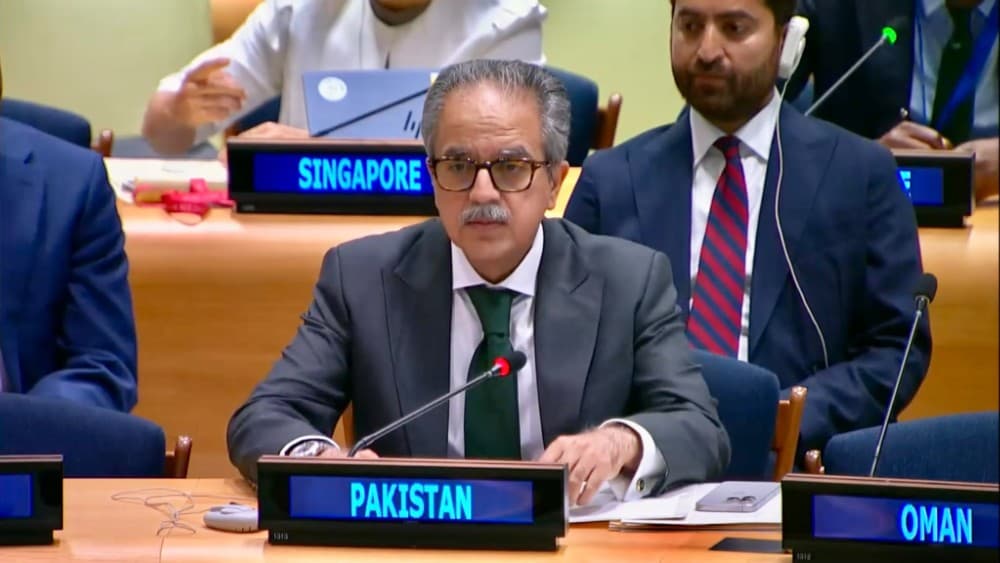
ISLAMABAD: Pakistan has called for strengthening United Nations peacekeeping operations, warning that reforms must improve the effectiveness of missions rather than weaken or “hollow out” their mandates, said a statement from the Permanent Mission of Pakistan to the UN on Thursday.
Speaking at the UN Secretary-General’s briefing on the review of the future of all forms of UN peace operations, Pakistan’s Permanent Representative to the UN, Ambassador Asim Iftikhar Ahmad, said, adding that Peacekeeping remains the UN’s most visible and vital instrument for maintaining international peace and security.
Pakistan aligned itself with a statement delivered by Morocco on behalf of the Non-Aligned Movement and welcomed the long-awaited review report amid increasingly complex conflicts, shrinking resources and rising expectations from the United Nations.
Ambassador Iftikhar further said, “Peacekeeping cannot substitute for political processes but can create conditions for political solutions by supporting ceasefires, protecting civilians and monitoring fragile peace arrangements.”
He stressed that peacekeeping and peacemaking should be treated as mutually reinforcing elements, in line with the UN Charter’s emphasis on the peaceful settlement of disputes under Chapter VI.
“Where political processes are stalled,” Pakistan said, the Secretary-General’s good offices, proactive Security Council engagement and other diplomatic efforts should be used with greater urgency to restore political momentum towards peace and settlement.
Pakistan also cautioned against interpreting reform recommendations selectively in ways that could undermine the mandates of UN missions.
“The bar must therefore be set not at how mandates can be reduced, but at how their efficiency can be improved, and their implementation strengthened,” the Pakistani envoy said.
He emphasized that reform should strengthen peace operations, not hollow them out, while supporting greater efficiency and reduced duplication.
Pakistan further warned that cost-cutting should not become the central logic of UN peacekeeping, describing it as a global public good that requires adequate resources and sustained political support from the Security Council and the wider UN membership.
The ambassador also called for closer coordination among the Security Council, the General Assembly, the Special Committee on Peacekeeping Operations (C34), the UN Secretariat, host countries, and troop- and police-contributing nations.
Pakistan welcomed the report’s recognition of accountability for crimes against UN peacekeepers, including through the implementation of Security Council Resolution 2823.
“Pakistan stands ready to engage constructively on the report and its follow-up,” the ambassador added.