


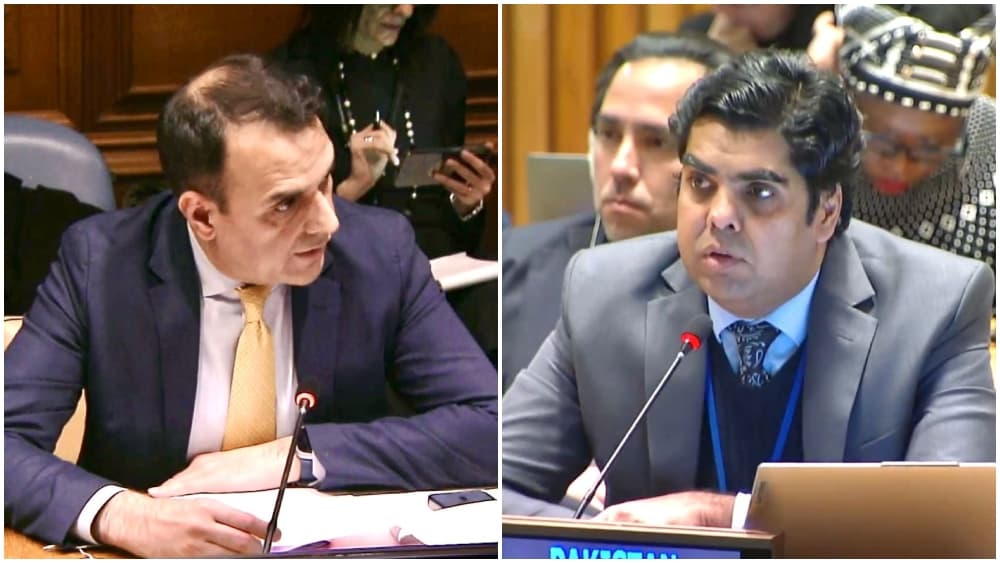
ISLAMABAD: Pakistan at the United Nations on Tuesday said that “acrobatics with words will not legitimize” India’s illegal occupation of Kashmir, and warned that India was “deliberately weaponizing water.”
First Secretary Zulfiqar Ali from Pakistan’s Permanent Mission to the United Nations said that the assertion that Indian Illegally Occupied Jammu and Kashmir was an “integral part of India does not stand the test of history, geography, justice, fairness, and most significantly, international law.”
“Acrobatics with words will not legitimize India’s illegal occupation of Kashmir, nor could the marginalization of Indian minorities do it any good,” Ali said while speaking during the Preparatory Committee for the UN Conference of Plenipotentiaries on Prevention and Punishment of Crimes against Humanity meeting.
Pakistan will continue to extend “political and moral support to the freedom struggle of Kashmiri people,” the first secretary said, adding that the country would call for “holding a UN-supervised plebiscite in Jammu and Kashmir, as per UNSC resolutions, and the wishes and aspirations of the Kashmiri people.”
Ali also urged the international community to “keep a close watch” on human rights violations against minorities in India, lest our collective failure to do so might sleepwalk us to another great tragedy.”
India's abeyance of Indus Water Treaty
In a separate statement given at the Global Water Bankruptcy Policy Roundtable at the UN, Pakistani Ambassador Usman Jadoon said since India’s abeyance of the Indus Water Treaty in April last year, the neighbor has carried out “material breaches; including unannounced disruptions of downstream flows and withholding of hydrological information, creating an unprecedented crisis for water security and for regional stability."
“This is not nature's doing. This is a nation state deliberately weaponizing water,” Pakistan’s acting permanent representative to the UN said.
The ambassador said that for more than six decades, the treaty “has provided a time-tested framework for equitable and predictable management of the waters of the Indus River basin.”
“Pakistan’s position is unequivocal; the treaty remains legally intact and permits no unilateral suspension or modification,” he added.
Ambassador Jadoon said Pakistan believed that as we move toward the UN’s water conference this year, the process must acknowledge water insecurity as a systemic global risk.
He added that cooperation and respect for international water law must be placed at the center of shared water governance, ensuring that commitments translate into real protection for vulnerable downstream communities.