

A dealer counts US dollars at a money exchange market in Karachi on March 2, 2023. (AFP/File)
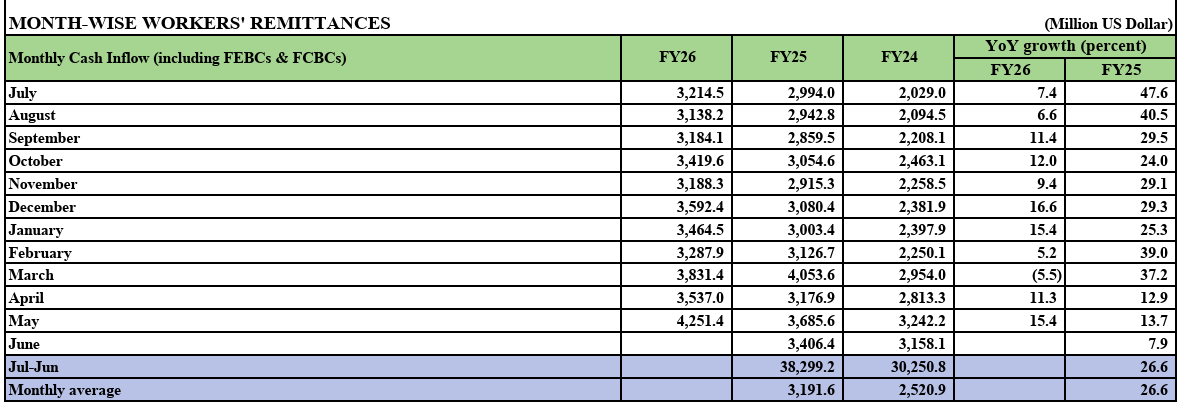
ISLAMABAD: Pakistan recorded its highest-ever monthly workers’ remittances inflow, receiving a record US$ 4.25 billion in May 2026, according to the latest data released by the State Bank of Pakistan (SBP) on Wednesday.
The landmark figure represents an increase of more than 20% compared to April 2026 and over 15% higher than the amount received during the same month last year, highlighting the continued confidence of overseas Pakistanis in the country’s economy.
The latest inflows have pushed cumulative workers’ remittances during July-May of fiscal year 2025-26 to US$ 38.1 billion, reflecting a 9% year-on-year increase. With one month remaining in the fiscal year, Pakistan is now on course to surpass the US$ 41 billion mark in annual remittances for the first time in its history, according to financial experts.
Khurram Schehzad, advisor to Pakistan’s finance minister, in a post on X said that the unprecedented inflow is a major boost for Pakistan’s external sector at a time when the country is focused on strengthening macroeconomic stability and rebuilding foreign exchange reserves.
Workers’ remittances remain one of Pakistan’s most reliable sources of foreign exchange, providing critical support to the balance of payments and helping ease pressure on the national currency.
The sustained growth in inflows has also enhanced the country’s ability to manage external financing requirements and improve investor confidence.
Schehzad also described the record inflows as a powerful vote of confidence by overseas Pakistanis, whose contributions continue to play a vital role in supporting economic resilience.
Millions of Pakistani expatriates working across the globe, particularly in Gulf countries, regularly send money home to support their families and communities.
Pakistan is among the world’s largest recipients of workers’ remittances, receiving tens of billions of dollars annually from its diaspora. For countless households, these funds serve as an economic lifeline, helping cover essential expenses such as food, housing, education, healthcare, and other daily needs.
According to SBP data, Saudi Arabia and the United Arab Emirates remained the largest contributors to Pakistan’s remittance inflows, accounting for more than half of the country’s record $38.3 billion received during fiscal year 2024-25.
Other major sources include the United Kingdom, the United States, and other Gulf Cooperation Council countries.
State Bank of Pakistan said that remittances during May 2026 were mainly sourced from Saudi Arabia ($1,025 million), the United Arab Emirates ($1006.6 million), the United Kingdom ($645.5 million), and the USA ($349.8 million).
Analysts believe the continued growth in remittances reflects stronger formal banking channels, improved digital transfer mechanisms, and sustained employment opportunities for Pakistani workers abroad.
Khurram Schehzad further said that the May performance further reinforces the importance of overseas Pakistanis in the national economy and underscores the increasingly strategic role remittances play in maintaining financial stability and supporting long-term economic growth.

.jpg&w=3840&q=75)
Latest News
Polling begins across Mirpur Division in first phase of Azad Jammu and Kashmir elections
3 HOURS AGO

Oil prices drop more than 5% on renewed hopes for US-Iran deal
3 HOURS AGO

Masood leads Pakistan to 199-3 against West Indies
6 HOURS AGO

Pakistan armed forces pay tribute to Capt Sarwar on 78th martyrdom anniversary
7 HOURS AGO

Pakistan condemns Indian defense minister's remarks on Kashmir
7 HOURS AGO