


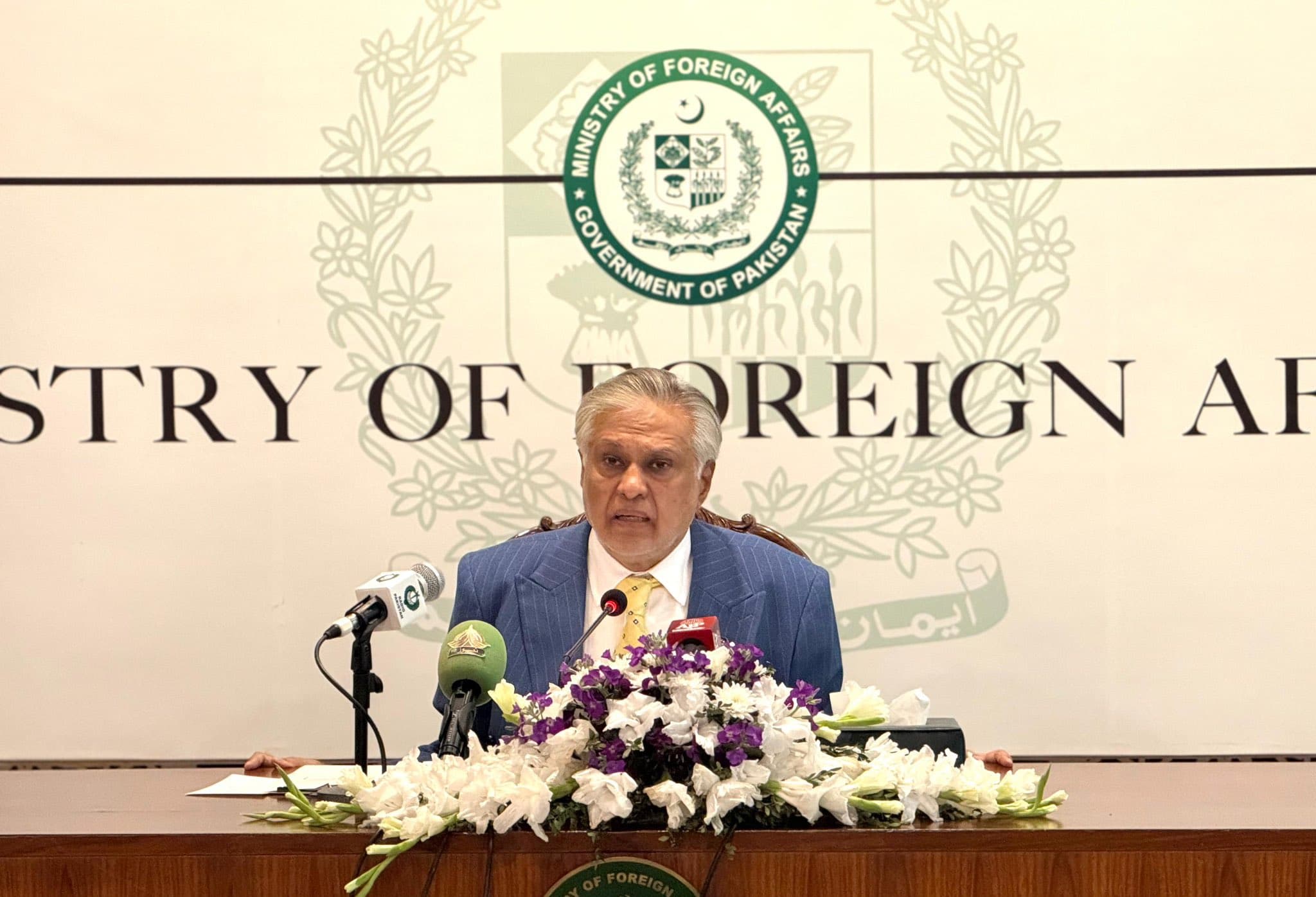
ISLAMABAD: Pakistan passed on to Iran Saudi assurances that their territory would not be used for attacks against it. This resulted in minimal or no attacks by Iran on Saudi Arabia and Oman during the recent escalation, said Pakistan’s Foreign Minister Ishaq Dar on Tuesday.
Addressing a media briefing at the Foreign Office in Islamabad, the foreign minister said that Pakistan remains engaged in "shuttle communication" to de-escalate the recent situation in the Middle East.
Dar said he spoke with his Iranian counterpart, Abbas Araghchi, and mentioned the Strategic Mutual Defense Agreement that Pakistan and Saudi Arabia signed in September 2025.
Based on the agreement, Dar said that he sought assurances from the Saudis and passed them on to the Iranian side, reiterating that Saudi territory would not be used for attacks against Iran. Because of these assurances, he said, there have been minimal or no Iranian attacks on Saudi Arabia and Oman during the recent escalation.
In the session, the foreign minister said that he has been in contact with foreign ministers of Turkey, the Maldives, Bangladesh, Palestine, Uzbekistan, Saudi Arabia, the UAE, Qatar, Oman, Iraq, Azerbaijan, and Bahrain, as well as representatives from the European Union, to promote diplomacy and dialogue.
Regarding Afghanistan, Dar said that Pakistan continues to pursue regional connectivity, specifically a rail project connecting Uzbekistan to Pakistan via Afghanistan.
He expressed disappointment that the current Afghan regime has failed to prevent its soil from being used by terrorist groups like the Tehreek-e-Taliban Pakistan (TTP) and Balochistan Liberation Army (BLA).
Addressing concerns about stranded Pakistanis in Iran and the Gulf region amid the fluid security situation, Foreign Minister Dar noted that, with the exception of Oman and Saudi Arabia, most airspace in the region is currently closed.
To assist stuck citizens, the Ministry of Foreign Affairs has activated its Crisis Management Unit, which is operational 24/7.
The minister said that 792 Pakistanis have already returned from Iran through various border points: 694 via Taftan, 59 via Ramdan, and 39 via Astara. Additionally, 46 students returned through Taftan and 62 through Ramdan, he added.
Because the northern part of Iran is closer to Azerbaijan, the Azerbaijan government is providing "Visa on Arrival" and logistical support to Pakistanis, he added.
So far, 64 Pakistanis have reached Azerbaijan from Iran; 42 have arrived in Lahore via Azal Airlines
‘Unwarranted’
Earlier, Foreign Minister Dar sharply condemned the recent attack on Iran and the martyrdom of Ayatollah Ali Khamenei, calling for an immediate halt to regional escalation through diplomacy.
Addressing the Senate, Dar described the Feb. 28 strike against Iran as "unwarranted" and expressed deep concern over the violation of international law, noting the "age-old convention" that heads of state should not be targeted.
"The government and the people of Pakistan join the people of Iran in their hour of grief and sorrow," Dar said, following a formal statement of condolence from the prime minister.
The deputy prime minister revealed that, prior to the escalation, Pakistan had been actively mediating between the United States and Iran, alongside Oman.
He noted that IAEA Director General Rafael Grossi had expressed optimism about the "positive direction" of the talks during a recent meeting in Austria.
Dar told the Senate that Pakistan has consistently advocated for Iran's right to the "peaceful use of nuclear energy." He disclosed that Pakistan had argued against the total destruction of Iran's nuclear infrastructure, supporting the 3.67% enrichment level previously accepted under the JCPOA, provided it remained under international surveillance.
According to Dar, both Washington and Tehran had previously expressed willingness to use Islamabad as a venue for mediation.