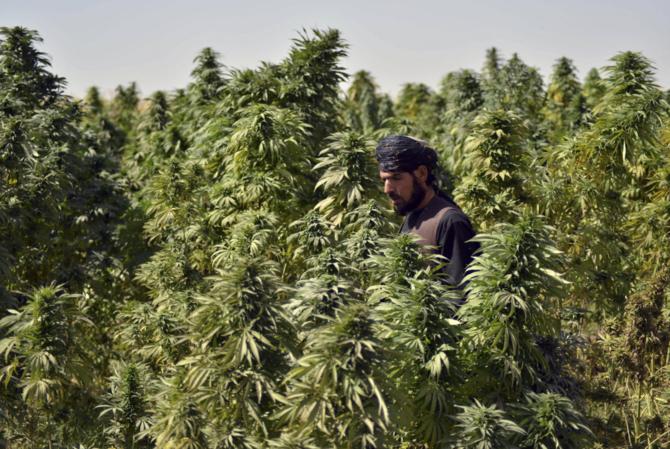
PESHAWAR: The Khyber Pakhtunkhwa government is considering a formal legal framework to regulate cannabis cultivation for industrial and medical purposes, according to official documents, as it explores new income streams for farmers and the wider economy.
The initiative, which remains in the proposal stage, seeks to bring a long-stigmatized plant into a regulated system while assessing its benefits for local livelihoods, investment, and exports.
A sub-committee of the Cannabis Regulatory Committee, chaired by Director General Excise Abdul Haleem Khan, met earlier this week to discuss licensing structures, documentation requirements, and excise duty proposals, according to minutes obtained by Pakistan TV Digital.
Under the framework being considered, a license to cultivate medicinal cannabis on five acres of land is proposed at Rs600,000, while an industrial hemp cultivation license with less than 0.3% THC (tetrahydrocannabinol content) for the same area is suggested at Rs300,000.
Licensing for cannabis processing could cost Rs1.5 million per tenure, and industrial hemp processing licenses are proposed at Rs700,000 per tenure. A combined license covering both cultivation and processing of cannabis or hemp could cost Rs2 million per tenure.
The sub-committee also suggested that excise duties be levied only at the processing and finished-product stages, leaving cultivation and transport exempt to prevent high-end product prices.
“Hemp is widely used in the production of pharmaceuticals, CBD [cannabidiol, a compound] oil, and fibers,” said Director General Khan. “We are initially proposing it as an alternative cash crop in districts such as Orakzai and Khyber, where the plant grows naturally.”
Dr Khan Bahadur, former Peshawar vice chancellor of the University of Agriculture, told Pakistan TV Digital, “Cannabis is a global commodity used in dozens of advanced economies. The plant is an incredible resource for manufacturing durable fabrics, sacks, rope, and a source for low-cost and sustainable paper.”
He also stressed the medical potential of cannabis, noting that refined extracts such as CBD oil are widely used to treat conditions like glaucoma. “Pakistan must explore this industry with a scientific mindset and not shy away, as global demand continues to increase,” Dr Bahadur added.
Speaking to Pakistan TV Digital, an agricultural landowner from Khyber Pakhtunkhwa, Farman Ullah, said:
“This is a great step for farmers. It provides a much-needed alternative source of income, as the ‘bhang’ (cannabis) plant is hardy and can grow just about anywhere.”
While the proposals remain under review and require provincial cabinet approval, officials anticipate that a regulated cannabis and hemp industry could generate significant economic activity, potentially adding up to $1 billion within the first few years through exports of raw hemp and high-value derivatives such as CBD oil and industrial textiles.
Khyber Pakhtunkhwa’s favorable climate and fertile soil make it particularly suited for industrial hemp and medicinal cannabis cultivation. By carefully developing a regulatory framework first, the government aims to ensure sustainable, phased development of the sector while balancing economic opportunity with regulatory oversight.
At the federal level, Pakistan set up the Cannabis Control and Regulatory Authority, a regulatory body established in 2024 to manage industrial and medicinal cannabis.