


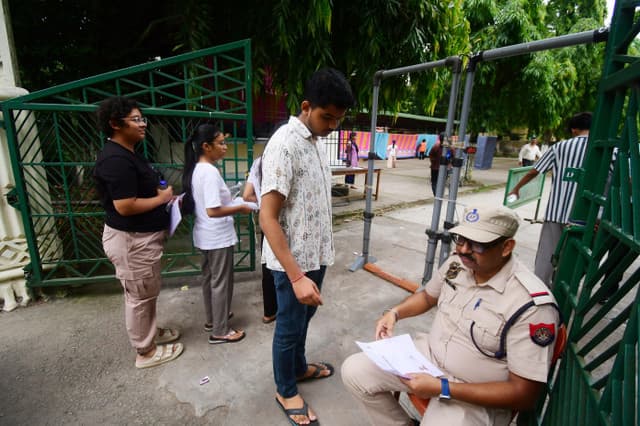
ISLAMABAD: Indian police raided a hotel room hours before dawn on Saturday and found the answer to one of the country's most persistent governance failures sitting on a table: stolen exam questions, ready to be sold, for a test that 600,000 people had spent months preparing to take.
The cancellation of Maharashtra state's Teacher Eligibility Test, a licensing exam that determines whether working teachers keep their jobs, is the latest episode in what investigators and lawmakers describe as a systemic breakdown of India's public examination infrastructure, one that has now disrupted tens of millions of candidates across multiple national and state-level tests in the past two years alone.
Officers acting on a confidential tip raided the Diamond Hotel in Bhiwandi, a town outside Mumbai, and arrested three men who had traveled from India's capital, Delhi, specifically to sell the papers, according to The Indian Express.
Police summoned senior education officials to the scene. The seized documents matched the sealed exam packet word for word. According to the Times of India, the syndicate had expected to collect roughly $180,000 for the stolen materials.
Maharashtra's Chief Minister Devendra Fadnavis ordered a 20-member investigation team to trace how the papers left official custody. Deputy Chief Minister Eknath Shinde said the state would seek to apply its organized crime statute against the masterminds of the operation, as per The New Indian Express.
Not the first time
The Maharashtra leak did not occur in isolation. In 2026, India's national medical entrance examination (NEET-UG, which determines entry to the country's medical universities) was cancelled and re-administered after insiders leaked questions during the translation phase, the process by which papers are converted from English into regional languages, The Indian Express reported.
A government-contracted headmistress in the western city of Pune recalled physics questions from memory and passed them to a private coaching network. Chemistry and biology translators committed parallel breaches for financial payment, The Indian Express reported. Thirteen people were arrested, and a federal investigation was launched.
The scale of what is at stake helps explain why the fraud market exists and thrives. According to the policy research body NEXT IAS, more than 2.27 million candidates sat the 2026 NEET-UG exam, competing for roughly 120,000 university medical places, a ratio of nearly 19 applicants per seat.
A government job or a medical degree represents, for most families, the primary path out of poverty, according to a policy analysis published by the Centre for Competition, Inclusion and Economic Regulation.
Yet the probability of being caught and convicted remains low enough to make the gamble attractive. An investigation by The Indian Express into 45 major paper-leak cases between 2002 and 2025 found convictions in only two. Of 1,658 people arrested across that period, just 925 (roughly 55%) were ever formally charged.
Testing agency shielded from government accountability
The body responsible for administering most national exams, the National Testing Agency, operates not as a statutory government authority but as a registered civil society organization under a 19th-century law, a legal status that limits its parliamentary accountability and shields it from routine government audits, according to Deccan Herald.
As of late 2024, the agency employed 22 seconded civil servants, 38 contract workers, and 138 outsourced staff to run more than 18 major national examinations annually for over 12.5 million candidates, Deccan Herald reported.
That dependence on private contractors has introduced its own vulnerabilities. Investigative reporting by Newslaundry found that companies awarded examination contracts by the agency included one firm declared ineligible by a central government training authority in 2020 and another blacklisted by a state energy company and separately banned by the testing agency itself after being linked to remote hacking at an exam center.
A 2026 parliamentary inquiry found that India's national school board had systematically weakened its own contractor screening standards, including the removal of clauses that barred previously sanctioned firms from bidding, according to The Hindu.
Student suicides on the rise
The institutional failures carry a measurable human cost. India's National Crime Records Bureau recorded 14,488 student suicides in 2024, accounting for 8.5% of all suicides in the country that year, according to the Bureau's official data.
Research published in the medical journal PMC found that 73.4% of exam-linked student deaths were associated with high-stakes competitive entrance tests, with the majority of victims between 15 and 20 years old.
The private test-preparation industry (which NEXT IAS valued at the equivalent of $7 billion in 2024 and projected to nearly double by 2028) has drawn regulatory warnings for exploiting student anxiety, according to India's Central Consumer Protection Authority.
The Indian parliament passed anti-cheating legislation in 2024, imposing up to 10 years in prison and fines exceeding $120,000 for organized fraud syndicates, according to PRS India, the country's independent legislative research body.
The northern state of Uttar Pradesh added parallel legislation making life imprisonment possible for paper-leak offenses, PRS India reported.
Punitive laws not enough
However, researchers at PRS India cautioned that punitive laws do not address the physical and administrative vulnerabilities that allow papers to be stolen before any penalty is applied.
A government-appointed expert panel recommended encrypting question papers and transmitting them digitally to exam centers, where they would be printed inside locked, monitored rooms only hours before candidates are seated. This, they argue, will eliminate the transport-and-storage chain that investigators identified as the primary point of compromise, according to The Indian Express.
As of the May 2026 national medical examination, most of those recommendations had not been carried out, the Economic Times reported.
Candidates affected by Saturday's cancellation in Maharashtra will not be required to re-register or pay additional fees, according to the Maharashtra State Council of Examinations.
A new examination date will be set within approximately three weeks, the council said.