


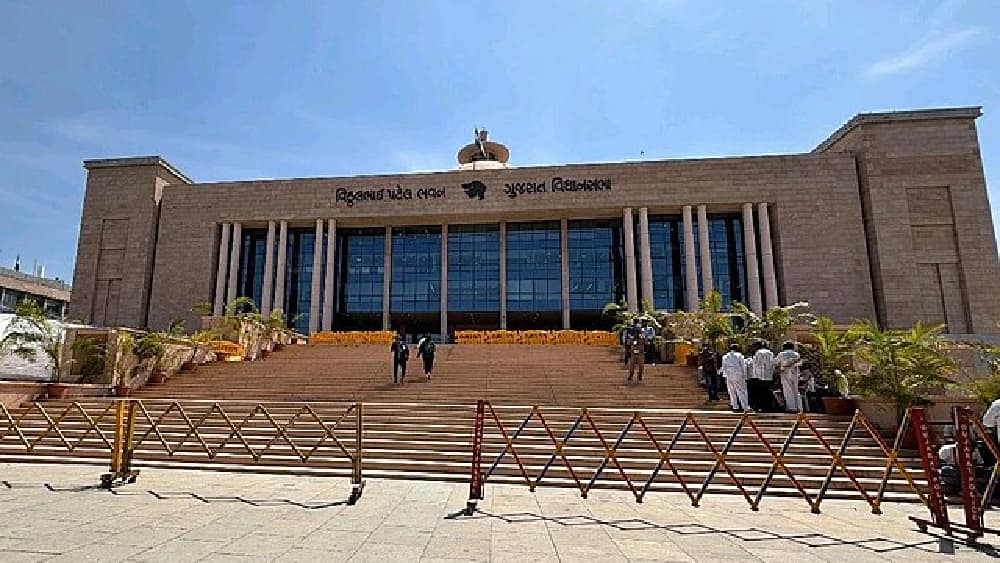
ISLAMABAD: Criticism of Gujarat’s new Uniform Civil Code (UCC) has been mounting since the bill was passed this week, with opposition parties and Muslim representatives arguing that the measure hits the state’s Muslim minority hardest while being presented as a neutral reform.
India Today and Livemint reported after Tuesday’s vote that Congress called the law “anti-Muslim,” while The Indian Express said the lone Muslim Congress MLA in the Assembly argued it would push Muslims away from Shariat-based personal law.
The Gujarat Assembly passed the UCC Bill on March 25 after more than seven hours of debate, making Gujarat the second BJP-ruled state after Uttarakhand to adopt such a code.
The law creates a common framework for marriage, divorce, succession, and adoption across communities, but opposition lawmakers said the government was using the language of equality to override minority personal-law protections.
Times of India said the code standardises family-law rules across religions but exempts Scheduled Tribes. That tribal exemption has become one of the sharpest lines of criticism.
Opponents say a law marketed as “uniform” cannot credibly claim equal treatment while carving out one group but overriding the personal laws of others.
Critics argue that, in practice, this makes the burden of legal change fall most heavily on Muslims, because Muslim personal law has been at the centre of the BJP’s UCC politics.
The Quint, Indian Express, and Times of India all highlighted the contradiction between the bill’s universal branding and its selective reach.
The broader political context also explains why many Muslims see Gujarat’s UCC as targeted rather than neutral.
Gujarat’s UCC is being challenged not simply as a civil-law reform, but as a majoritarian project dressed up as uniformity; its structure, exemptions and political framing show that minorities, especially Muslims, are the real target.