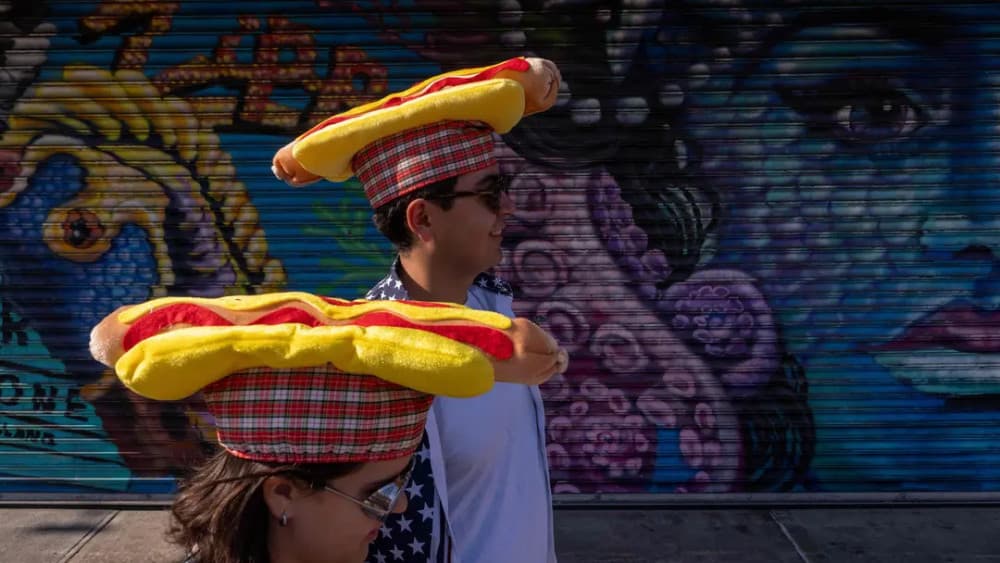
Two people wearing hotdog hats line up to watch Nathan's Annual Hot Dog Eating Contest on July 4, 2025 in the Brooklyn borough of New York City. (AFP)
ISLAMABAD: Smoke rises from backyard grills across the United States every July 4, the day Americans commemorate their 1776 declaration of independence from British colonial rule.
What began as a small logistical practice at 19th-century political rallies has grown into the largest food, retail and leisure ritual on the American calendar, comparable in commercial scale to major national holidays elsewhere in the world.
Overall domestic spending on Fourth of July food totals an estimated $9.4 billion, according to consumer tracking compiled by the National Retail Federation, a US industry body that monitors retail sales nationwide.
Americans consume roughly 150 million hot dogs, a grilled sausage in a bun, on Independence Day alone, more than 10% of the summer's entire retail sausage revenue, per data published by Fortune magazine.
Retail logs also show the day drives $111 million in charcoal briquette sales and $167 million in watermelon sales, reflecting how central outdoor grilling has become to the celebration.
US founders' original menu
None of that resembles what the country's founders ate. According to foodways research from the Smithsonian Institution, a US government-funded network of museums and research centers, today's uniform menu of grilled meat and processed sausage is a 20th-century development that replaced diverse, hyper-local dishes. Archival records from the Southern Foodways Alliance note the holiday once featured New England poached salmon, Southern pit-roasted mutton and coastal turtle frolics.
In the late 1700s and early 1800s, the New England region in the northeastern US marked the day with poached Atlantic salmon, egg sauce, peas and new potatoes, timed to summer salmon runs on rivers like Maine's Penobscot, according to research by writer Catherine Schmitt.
Political elites favored turtle soup, hosting "turtle frolics" that served green turtle meat from its overturned shell, according to research by Megan Hagseth at Texas A&M University. George Washington, the country's first president, along with Alexander Hamilton and William Howard Taft, was an enthusiast, and Abraham Lincoln served the dish at both of his inaugurations, according to the White House Historical Association.
Collapse of old traditions
Both traditions ended with industrialization. Dammed rivers and pollution reduced wild salmon stocks, forcing today's version of the New England meal to rely on farmed fish, Schmitt's account notes. Overharvesting nearly eliminated green sea turtles, and international protections adopted in 1977 ended the practice.
Barbecue took their place. The technique traces back to the Indigenous Arawak word "barbacoa," adopted by British colonists in the American Southeast, according to lectures from the US Library of Congress and research by historian Adrian Miller, author of "Black Smoke."
After the War of 1812, a conflict between the US and Britain, Fourth of July barbecues became large political gatherings with 13 formal toasts and volunteer speeches, according to culinary historian Robert F. Moss. Candidates funded these events to draw crowds for stump speeches, a term coined because politicians spoke from felled tree stumps.
Enslaved black cooks did the labor behind these feasts, digging trenches, splitting wood and tending coals through the night, Miller's research details. After the abolition of slavery, formerly enslaved communities held their own barbecues; on Jan. 1, 1863, thousands in South Carolina's Sea Islands marked the Emancipation Proclamation, the decree that freed enslaved people in Confederate states, with ten roasted oxen, per the Charleston City Paper.
The backyard grill arrived after World War II, as suburbanization moved 20 million Americans from cities to newly built residential neighborhoods between 1950 and 1960, according to the Smithsonian Institution. In 1952, Chicago metalworker George Stephen welded legs onto a halved marine buoy to create the Weber kettle grill, now a globally recognized outdoor cooking design.
By the Cold War's peak, the era of political and ideological rivalry between the US and the Soviet Union, Nation's Business declared in 1955 that "crabgrass never made a revolution," contrasting American backyard abundance with Soviet scarcity. Research published by Oxford University Press notes that corporate and political leaders promoted homeownership and backyard leisure as ideological shields against radicalism.
From frankfurters to hot dogs
The hot dog followed its own path of immigration and elite mockery. German immigrants sold frankfurters from pushcarts in Manhattan in the 1860s, according to historian Bruce Kraig. In 1867, baker Charles Feltman began serving them in warm milk rolls on Coney Island, a beachfront district in New York, a venture that grew into a multi-block dining pavilion by 1871. The term "hot dog" was coined in the 1890s by students at Yale, an elite US university, who mocked vendors' "dog wagons," not from a cartoonist's error, according to The Yale Book of Quotations.
The sausage also crossed diplomatic lines. President Franklin Roosevelt served hot dogs to Britain's King George VI during a 1939 picnic in Hyde Park, New York, according to the Franklin D. Roosevelt Presidential Library. In 1959, Soviet Premier Nikita Khrushchev sampled one at a US meatpacking plant and conceded that the US had surpassed the Soviet Union in sausage-making, according to eyewitness accounts preserved by the State Historical Society of Iowa.
Nearly seven decades later, the same sausage still sits at the center of the American grill every July 4, from Coney Island's boardwalk stands to backyard patios across the country.
24 MINUTES AGO

2 HOURS AGO
3 HOURS AGO
4 HOURS AGO

4 HOURS AGO