


ISLAMABAD: As Bangladesh moves toward its next general election, voters are set to face more than just a choice of political parties. Alongside parliamentary polls scheduled for Feb. 12, the country plans to fundamentally reshape its governing structure through a referendum on the July Charter, a proposed reform framework that emerged from last year’s student uprising that ended Sheikh Hasina's rule.
The caretaker government, led by Nobel laureate Muhammad Yunus as chief adviser, has pledged to oversee a credible election while advancing political reforms demanded during the uprising.
It is within this transitional context that the July Charter — and the proposal to seek public approval for it through a referendum — has taken shape.
The dual vote represents an unprecedented moment in Bangladesh’s political history, with the Election Commission announcing in December that it would hold the referendum and the country’s 13th parliamentary election simultaneously.
What is in the July Charter Referendum?
According to the National Consensus Commission (NCC), which drafted the document under the authority of the Interim Government of Bangladesh, the July Charter is a political reform blueprint reflecting demands raised by protest leaders, civil society actors, and political groups calling for systemic changes to prevent the concentration of power and strengthen democratic safeguards.
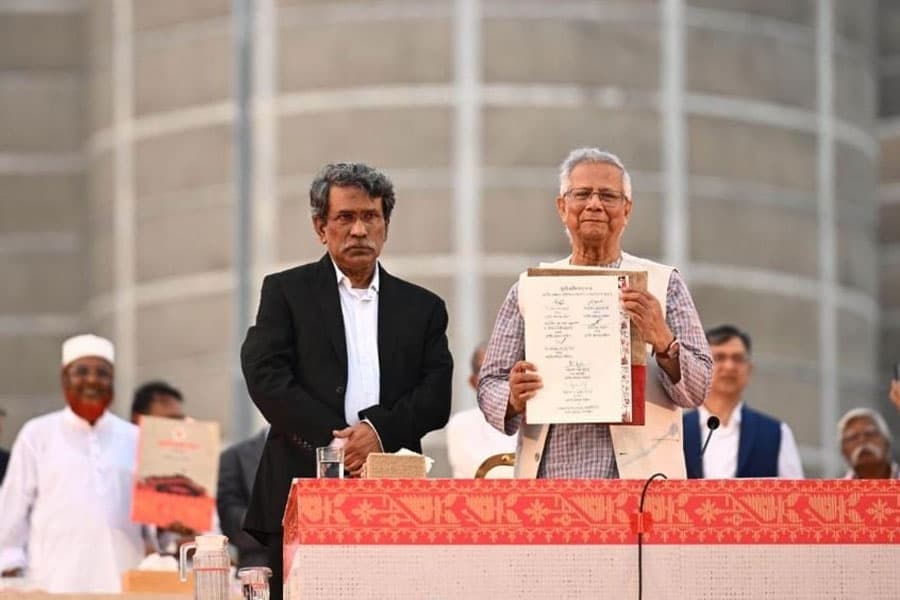
Signed on October 17, 2025, by 24 political parties and the National Consensus Commission, the Charter contains over 80 proposals for reform, including almost 50 of constitutional nature, state news agency Bangladesh Sangbad Sangstha (BSS) reported.
Central to the Charter is a plan to shift key appointment powers from the prime minister to the president, covering institutions like the National Human Rights Commission, Bangladesh Bank, and various regulatory bodies. The reforms also propose limiting any prime minister to ten years in office and barring them from simultaneously leading their political party.
The Charter advocates for reinstating a caretaker government system to oversee elections, a mechanism previously used but later abolished. It calls for establishing a bicameral parliament with a 300-member lower house and a 100-member upper house elected through proportional representation, whose approval would be required for constitutional amendments.
Other proposals include amending Article 70 to allow lawmakers to vote independently on most issues, adopting an inclusive definition of Bangladeshi nationalism that recognizes the country's ethnic and linguistic diversity, and creating stronger checks on executive authority.
Voters will face a single yes-or-no question encompassing the major reform areas rather than voting on individual provisions.
Political opposition
Despite having signed the document, major political parties have raised objections.
The Bangladesh Nationalist Party, though a signatory, objected to at least nine provisions, including the proportional representation system for the upper house and presidential appointment powers. BNP has questioned both the timing and legality of the referendum, arguing that major constitutional reforms should be debated and enacted by an elected parliament rather than decided through a vote organized by an interim administration.
"The signed Charter does not include opinions and dissenting notes from political parties," BNP Secretary General Mirza Fakhrul Islam Alamgir said at an Oct. 30, 2025, press conference, as reported by BSS. He called the process "meaningless, a waste of money and time, a mockery, and a deception of the nation."
Other opposition and left-leaning parties have raised similar objections, describing the move as constitutionally ambiguous and warning that Bangladesh's existing legal framework does not clearly provide for such a referendum.
Bangladesh Jamaat-e-Islami pushed unsuccessfully to hold the referendum before the election. "Our number one demand is that the July revolution must be recognized. The July Charter must be given a legal basis. Without that legal foundation, there is no possibility of holding elections in 2026," Jamaat Ameer Dr Shafiqur Rahman said at a rally at Paltan intersection, according to BSS.
The National Citizen Party refused to sign the Charter altogether, demanding clearer implementation plans.
Chief Adviser Muhammad Yunus has sought to distance himself from claims that the referendum is being imposed, stressing that the interim government does not intend to unilaterally rewrite the constitution and that any reforms would ultimately require parliamentary approval.
During his speech at the 80th UN General Assembly, Yunus stated that his administration had chosen the "hard path" of "reforms built through inclusion and sustained through consensus" rather than simply using executive orders to bypass political processes.
In his November 13, 2025, address to the nation, broadcast by BSS, Yunus noted that disagreements were mainly over whether reforms should be enshrined in the constitution or enacted through legislation. "Despite global declines in foreign investment after the uprising, Bangladesh's foreign direct investment increased by 19.13% in the first year — a remarkable achievement contrary to global trends."
Why it matters
With political trust still fragile after last year’s unrest, the July Charter referendum has become a focal point of debate over how Bangladesh should manage its transition back to elected rule.
According to the Implementation Order gazette, an official government publication that formalizes legal and administrative directives, if voters approve the referendum, a Constitutional Reform Council will be formed from elected parliamentarians to complete constitutional reforms within 180 working days.
“The Council shall complete the constitution reform in accordance with the July National Charter and the results of the referendum,” the BSS report stated.
The interim government has said it will respect the referendum result, although implementation details remain unclear if voters approve the Charter while electing a parliament that opposes specific provisions.
Election Commissioner, Md. Anwarul Islam Sarkar told BSS the commission is "cent percent ready to hold the national election and referendum on the same day," adding that polling will run from 7:30 a.m. to 4:30 p.m., an hour longer than usual, at 42,761 polling centers with 244,739 booths to accommodate dual voting for around 128 million voters.