


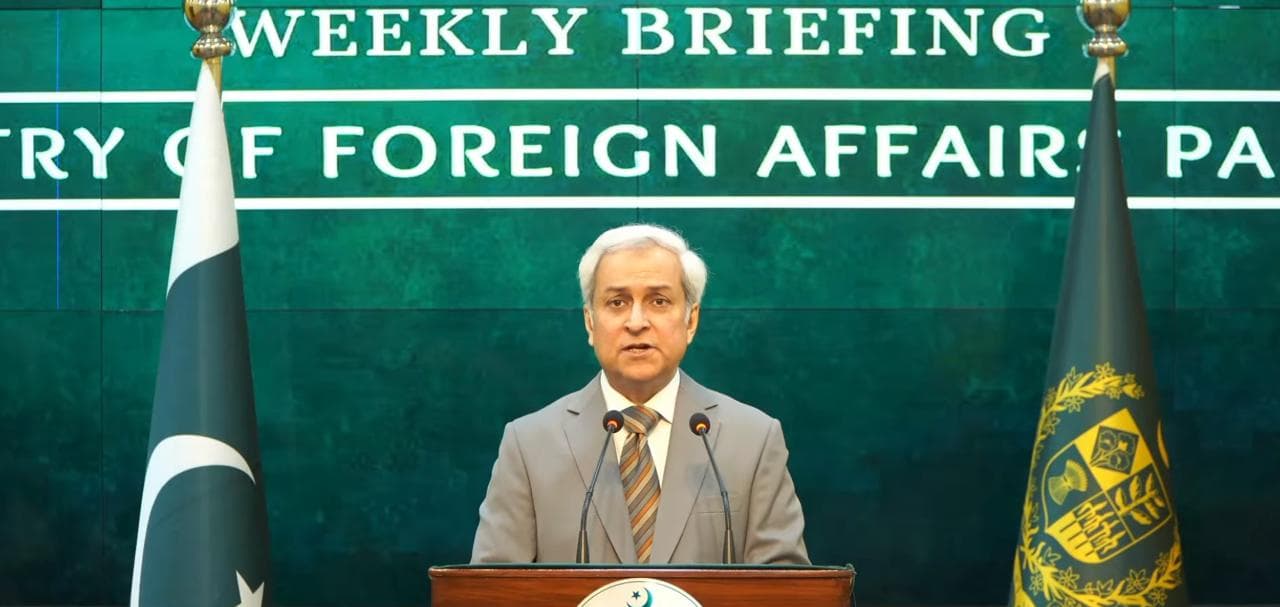
ISLAMABAD: Pakistan on Thursday rejected any attempt to draw a “false equivalence” between the situation in Indian Illegally Occupied Jammu and Kashmir (IIOJK) and matters relating to Azad Jammu and Kashmir (AJK), while also raising concerns over India’s expanding strategic capabilities.
Speaking at the weekly media briefing in Islamabad, Foreign Office Spokesperson Tahir Andrabi said Pakistan was addressing issues in Azad Jammu and Kashmir within a “democratic and constitutional framework” and rejected recent remarks by the Indian leadership and its foreign affairs office.
“Any attempt to conflate the two is misleading and does not withstand objective scrutiny,” Andrabi said.
Responding to questions regarding Indian statements on AJK, the spokesperson said Pakistan rejected India's remarks “in their entirety.”
“It’s untenable for a state like India, which has consistently denied the people of Jammu and Kashmir their right to self-determination, to claim concerns over the rights of Kashmiris,” he said.
The remarks come amid continued tensions between Pakistan and India over the disputed Jammu and Kashmir region, a longstanding issue between the two nuclear-armed neighbours.
Pakistan maintains that the final status of Jammu and Kashmir should be determined in accordance with relevant United Nations Security Council resolutions and the aspirations of the Kashmiri people.
The spokesperson said India’s statements appeared aimed at diverting attention from the “unresolved status of Jammu and Kashmir” and what he described as its “abysmal record” in IIOJK.
“We also reject any insinuation of a false equivalence between the situation in Indian Illegally Occupied Jammu and Kashmir and matters relating to Azad Jammu and Kashmir,” Andrabi said.
“Indian Illegally Occupied Jammu and Kashmir is an illegally annexed, internationally recognized disputed territory whose people have suffered systemic abuses under draconian laws and have been denied their rights, including the right to self-determination, as affirmed by the relevant UN Security Council resolutions and as promised by the Indian founding fathers to the Kashmiri people,” he added.
Concerns over India's strategic capabilities
The Foreign Office also commented on a recent Stockholm International Peace Research Institute (SIPRI) report suggesting India may have altered aspects of its traditional nuclear posture by reportedly deploying nuclear warheads during peacetime alongside developments in missile systems.
Andrabi said Pakistan did not wish to endorse SIPRI’s methodology but noted that the findings were “not surprising.”
“We do not wish to endorse or lend credence to SIPRI’s methodology. Its findings, nevertheless, are ‘not surprising,’” he said, adding that Pakistan had consistently raised concerns regarding India’s continued “vertical proliferation.”
The spokesperson said open-source assessments might not fully reflect the actual scale of India’s nuclear arsenal.
“We also believe that open-source estimates, such as SIPRI’s, may not fully reflect the actual scale of India’s nuclear arsenal, which may actually be higher than the existing estimates,” he said.
According to Andrabi, Pakistan remained “cognizant of developments in India’s strategic capabilities,” including the canisterization of missile systems, the expansion of sea-based nuclear-capable submarines and the pursuit of longer-range missile systems extending beyond India’s immediate region.
“These developments enhance operational readiness, complicate crisis stability, and carry implications that extend beyond South Asia, with grave consequences for international peace and security,” he said.
Reiterating Pakistan’s position, Andrabi said the country did not seek an arms race.
“Pakistan does not seek an arms race and matching warheads or arms and ammunition by number. However, we remain mindful of the evolving security environment. We will continue to take measures essential for preserving strategic stability and deterring India’s aggression,” he said.
The spokesperson urged the international community to closely monitor developments related to India’s strategic capabilities and their potential impact on regional and global security.
He also called on countries supplying advanced technologies to India to consider the wider implications of emerging capabilities being incorporated into India’s strategic posture.
“These developments threaten consequences far beyond South Asia into the wider world,” Andrabi said.