


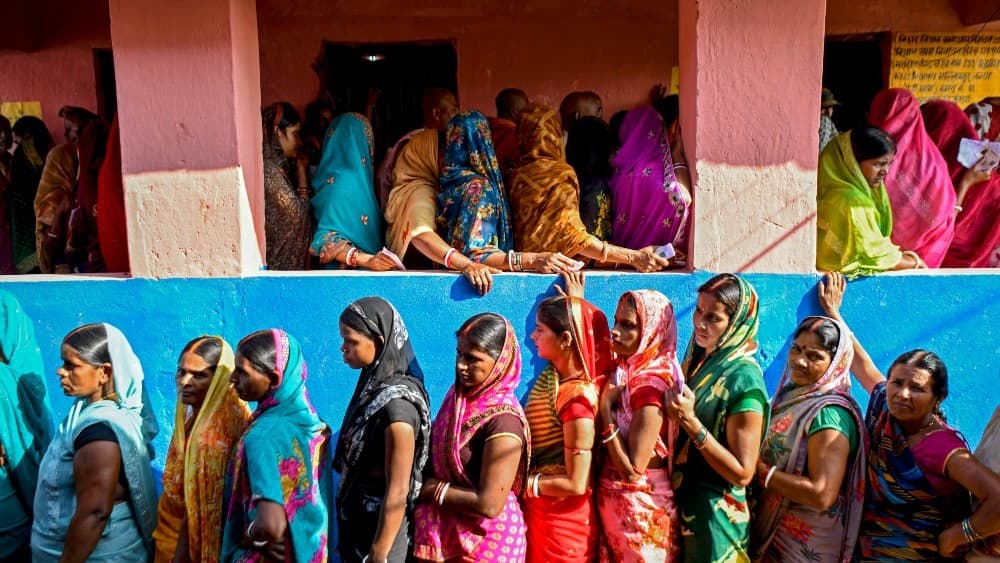
ISLAMABAD: Fears of large-scale voter disenfranchisement have intensified after the Election Commission of India (EC) released draft electoral rolls under the Special Intensive Revision (SIR) 2025, showing massive deletions across nine states and three Union Territories, Indian media reported on Wednesday.
Preliminary figures indicate that nearly 13% of electors have been removed so far, a number that could translate into close to 110 million voters losing their voting rights if not adequately corrected.
The most striking case is Uttar Pradesh, where the draft rolls show 28.9 million fewer voters than the previous list, nearly 18.7% of the state’s electorate.
Similar patterns have emerged elsewhere: around 5.8 million voters were deleted in West Bengal (7.6%), 2.408 million in Kerala (8%), and 9.73 million in Tamil Nadu.
BJP-ruled states have also seen sharp reductions, with about 4.2 million deletions in Madhya Pradesh, 41.85% of voters removed in Rajasthan, and at least 7.3 million deletions in Gujarat as per the draft electoral rolls.
The EC maintains that most deletions involve duplicate entries, deceased voters, or those who have permanently shifted or were absent during verification.
While a month-long window has been provided for objections and corrections, the final number of deletions is likely to be around two or three per cent less than the currently known figure.
‘Opacity and arbitrariness’
Opposition parties, however, have raised serious concerns over the transparency and design of the SIR process.
West Bengal Chief Minister Mamata Banerjee has accused the EC of “opacity, arbitrariness and informality,” alleging procedural violations and misuse of IT systems.
The Congress, DMK and Left parties have echoed similar objections, warning that the exercise is being conducted in a hurried and ad hoc manner.
‘Fundamentally flawed’
Political scientist Yogendra Yadav has described the 2025 SIR as fundamentally flawed, arguing that it places the entire burden of proving eligibility and even citizenship on voters, unlike the 2002 revision, which relied on trained enumerators and existing records.
He has also highlighted disproportionate deletions among women, migrants and residents of net in-migration states.
With the EC yet to release detailed data on wrongful exclusions, critics warn that unless corrective measures are taken urgently, the SIR could result in unprecedented mass disenfranchisement, undermining the credibility of India’s electoral process.
Exclusion of over 6 million names
India launched a revision of its voter rolls on Nov. 4, 2025, expanding a contentious exercise that activists warn could fuel disenfranchisement in the world's largest democracy, according to an AFP report.
The three-month voter registration overhaul, the SIR — kicked off in 12 states and territories, many of which are slated to hold local elections next year.
Earlier last year, the ECI conducted a similar revision in the eastern state of Bihar, home to more than 130 million people, ahead of its state elections.
The process led to the exclusion of around 6.5 million names, which the ECI said was necessary to prevent the inclusion of "foreign illegal immigrants."