


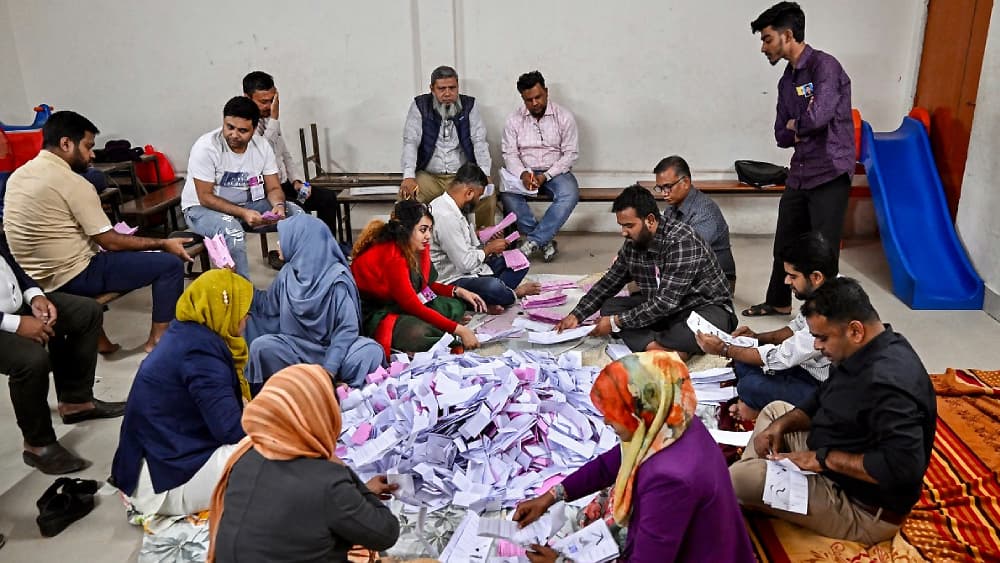
DHAKA: Bangladesh concluded voting on Thursday in its first national election since the deadly 2024 uprising, with ballot counting beginning nationwide amid tight security, marking a decisive moment in the country’s political reset after years of contested polls.
Polling closed at 4:30 p.m. local time across 299 constituencies, after which election officials opened transparent ballot boxes and began hand-counting votes at polling centres, according to state media. Authorities have yet to announce when preliminary results will be released.
The vote follows last year’s student-led uprising that toppled former prime minister Sheikh Hasina and ended her 15-year rule. An interim administration led by Nobel Peace Prize laureate Muhammad Yunus has overseen the transition and barred Hasina’s Awami League from contesting.
Hasina remains in India and has been sentenced to death in absentia for crimes against humanity related to the crackdown on protesters.
Election officials said turnout built steadily through the day. By 2:00 p.m., 47.91% of registered voters had cast ballots at 36,031 polling centers, Election Commission Senior Secretary Akhtar Ahmed told reporters, with voting underway at 42,651 centers nationwide.
“So far, voting has not been suspended at any polling center. There is no alarming situation,” Ahmed said earlier in the day, adding that authorities had received no reports of election-related fatalities. He said the commission would review complaints of irregularities raised by Jamaat-e-Islami.
Voting began at 7:30 a.m. under heavy security, with more than 300,000 personnel from the army, police and paramilitary forces deployed nationwide. Dhaka observed a public holiday, with shops closed and vehicle movement restricted, lending the capital an unusually quiet atmosphere.
At polling centres, party representatives described a calm and festive mood.
“This polling centre is very peaceful, and there is a festive atmosphere,” Dr Mahdi Amin, adviser to the Bangladesh Nationalist Party (BNP), told Pakistan TV Digital. “After nearly 18 years, an election should feel like a celebration. We want people to come forward and vote freely, according to their own will.”
Jamaat-e-Islami spokesman Dr S.M. Khaliduzzaman also expressed optimism.
“The election is fair, and we are hopeful of victory, InshaAllah,” he told Pakistan TV Digital. “For the past 17 years, people were deprived of genuine elections.”
“This time, people are voting with hope.”
Participation patterns shifted as the day progressed. Election officials reported that women and young voters were increasingly visible at polling stations in the afternoon, particularly in parts of Old Dhaka.
“The response from young voters is excellent,” said Presiding Officer M.D. Abdul Latif while talking to Pakistan TV Digital at one center. “Youth are eager to cast their votes, and the election process here is free and fair.”
Among first-time voters was 23-year-old Sanjeeda Akhtar Anjuman, who said she was voting with optimism shaped by last year’s Gen-Z-led protests.
“This is my first time voting,” she said. “I am very optimistic about this entire process.”
International observers closely monitored the vote. European Union chief observer Ivars Ijabs called the election “a big day for Bangladesh’s democracy,” saying EU teams were deployed nationwide to assess polling, counting and result tabulation as part of an impartial review.
Earlier in the day, Yunus cast his ballot in Dhaka, describing the vote as a turning point.
“This is a day of freedom,” he said. “Through this, we have ended the nightmare and begun a new dream.”
After polls closed, Yunus hailed the process as peaceful and orderly.
“The spontaneous turnout of voters, the responsible behaviour of political parties, and the professionalism of state institutions have shown that our commitment to democracy is firm,” he said in a statement, urging parties to maintain restraint once results are announced.
“This election marks a joyful beginning of a new Bangladesh.”
More than 51 political parties and over 2,000 candidates contested the election, including 275 independents. Voting was held in 299 constituencies after polling in Sherpur-3 was cancelled following a candidate's death. Alongside parliamentary ballots, voters also took part in a nationwide referendum on proposed democratic reforms aimed at preventing a return to one-party dominance.
As counting continues into the night, analysts say turnout, credibility and acceptance of results will determine whether the vote succeeds in restoring public trust after years of political turmoil.
This live blog is now closed.
5:40 p.m. Nearly half of voters cast ballots by mid-afternoon, election commission says
Nearly 48% of registered voters had cast their ballots by 2:00 p.m. on Thursday in Bangladesh’s 13th national parliamentary election, according to the country’s Election Commission.
Election Commission Senior Secretary Akhtar Ahmed told reporters that 47.91% turnout had been recorded at 36,031 polling centers nationwide by mid-afternoon, with voting underway at 42,651 centers.
Responding to complaints raised by Jamaat-e-Islami over alleged irregularities, Ahmed said the commission would review the claims.
Voting in both the parliamentary election and a nationwide referendum began at 7:30 a.m. and continued until 4:30 p.m., using ballot papers cast into transparent ballot boxes.
Polling was held in 299 of Bangladesh’s 300 constituencies, after voting in Sherpur-3 was cancelled following the death of a Jamaat-e-Islami candidate.
A total of 51 political parties contested the election, with 2,034 candidates, including 275 independents.
5:15 p.m. Chief adviser calls election beginning of “new Bangladesh”
Chief Adviser Professor Muhammad Yunus on Thursday hailed the conclusion of Bangladesh’s 13th national parliamentary election and the referendum as peaceful, orderly and celebratory, thanking citizens for their participation.
“The spontaneous turnout of voters, the responsible behaviour of political parties, and the professionalism of state institutions have shown that our commitment to democracy is firm,” Yunus said in a statement issued by his press wing after polling ended at 4:30 p.m.
He said citizens had exercised their constitutional rights to help shape the country’s future and praised election officials, security forces, administrators, observers and media workers for ensuring the process ran smoothly.
“This massive democratic exercise was possible because of their dedication and hard work,” he said.
Yunus urged political parties and candidates to maintain tolerance and respect once the results are announced. “Differences will exist, but national unity must come first,” he said.
Calling the vote a historic moment, Yunus said, “This election marks a joyful beginning of a new Bangladesh,” adding that the country had once again proven that “the people are the source of all power.”
“If this peaceful continuity continues, our democracy will reach its highest standard,” he said, urging all stakeholders to work together to strengthen democratic institutions.
4:30 p.m. Polling ends nationwide, vote counting begins
Voting has officially ended across Bangladesh, with polling staff opening ballot boxes to begin counting, according to Bangladeshi state media.
State-run broadcasters reported that election officials started counting immediately after polls closed at 4:30 p.m. local time, under the supervision of presiding officers and security personnel. The counting process is being conducted at polling centres and is expected to continue into the evening.
Authorities have not yet announced when preliminary results or turnout figures will be released.
3:10 p.m. Jamaat chief on turnout, security conduct
Jamaat chief Shafiqur Rahman said he hoped Bangladesh would see a credible election by the end of polling day, while alleging isolated incidents of violence and irregularities.
“If the armed forces carry out their duties sincerely, we hope the nation will have good voting and a good election,” Rahman said.
He warned that any government formed through fraud would lack legitimacy and public trust.
Rahman said he observed generally calm conditions and satisfactory turnout at most polling centers he visited after casting his vote in Mirpur.
2:20 p.m. Youth, women drive late-afternoon turnout
With two hours remaining before polls close, women, particularly young voters, were visible in significant numbers at several polling centers in Old Dhaka, where turnout patterns shifted over the course of the day.
While men dominated queues in the early hours, election officials said participation by young women increased steadily through the afternoon.
At one polling center, Presiding Officer MD Abdul Latif described youth engagement as particularly strong.
“The response from young voters is excellent,” Latif told Pakistan TV Digital.
“Turnout at this polling station is around 30%. Youth are eager to cast their votes, and the election process here is free and fair.”
Among those waiting to vote was 23-year-old Sanjeeda Akhtar Anjuman, standing in line with her friends and discussing women’s issues and public safety.
Casting her ballot for the first time, she said she was hopeful political change driven by last year’s Gen-Z-led protests would lead to greater security for women.
“I am very optimistic about this entire process,” she told Pakistan TV Digital. “This is my first time voting.”
1:43 p.m. Turnout nears 33% by midday, EC says
Bangladesh’s Election Commission said just under one-third of registered voters had cast their ballots by midday, as polling continued nationwide in the 13th parliamentary election.
At a 12:45 p.m. briefing, the commission said turnout had reached 32.88% by noon across around 32,000 polling centers.
EC Senior Secretary Akhtar Ahmed said voting was proceeding in all centres despite isolated disturbances reported in some areas.
“So far, voting has not been suspended at any polling center,” Ahmed told reporters. “There is no alarming situation.”
He added that authorities had received no reports of fatalities linked to sporadic election-related violence.
Polling began at 7:30 a.m. in 299 constituencies under heavy security and is scheduled to continue until 4:30 p.m. at more than 42,000 polling stations across the country.
11:20 a.m. ‘Big day for democracy’
The head of the European Union’s election observation mission described Thursday’s vote as a milestone for Bangladesh’s democracy, as EU observers fanned out across the country to monitor polling and counting.
“This is really a big day for Bangladesh’s democracy,” said Ivars Ijabs, chief observer of the EU Election Observation Mission, speaking to reporters after observing the opening of voting in Dhaka.
He said the EU hopes to see a “participatory, credible and trusted” election at what he called a historic moment for the country.
Ijabs said the EU has deployed around 200 observers nationwide, including 90 short-term observers covering all 64 districts, who will monitor polling, counting and the tabulation of results.
Their findings, he added, would form a key part of the mission’s impartial assessment of the election.
10:25 a.m. Muhammad Yunus casts vote
Bangladesh Chief Adviser Muhammad Yunus cast his vote at a polling station in Gulshan locality of capital Dhaka at around 10:25 a.m. local time. Security was on high alert in the area.
Bangladesh’s interim leader Muhammad Yunus said Thursday’s election marked a turning point for the country, describing it as the end of a “nightmare” and the beginning of a new chapter after last year’s deadly uprising.
“This is a day of freedom,” he said after casting his vote in Dhaka. “Through this, we have ended the nightmare and begun a new dream.”
9:55 a.m. NCP candidate urges citizens to vote for democracy
Nahid Islam, convener of the National Citizen Party (NCP) and candidate for the Jamaat-led alliance in Dhaka-11, cast his ballot early Thursday morning at A.K.M. Rahmatullah University College in Badda.
Speaking to reporters afterward, Nahid said he had voted smoothly for the first time and called on all citizens to head to polling stations. “I encourage everyone to exercise their right to vote and help restore democracy in our country,” he said.
09:15 a.m. Chittagong votes
BNP candidate for Lakshmipur-3, Shahid Uddin Chowdhury Anee, expressed satisfaction with the morning’s voting environment after casting his ballot.
“The long-awaited hopes of the people are finally being realized. Citizens have struggled for this election for a long time. So far, the atmosphere has been very positive. If it continues like this and voters can participate in a festive spirit, I am confident of my victory,” he told reporters at the Lamchari Government Primary School polling center.
Meanwhile, Jamaat-e-Islami candidate Dr Rezaul Karim Choupalli voted at the Kalidas High School polling station, describing the voting environment as “good” and expressing optimism about his own chances.
9:00 a.m. Have come to vote after 19 years: voter
Speaking to Pakistan TV Digital, Voter Riazul Hasan said the environment was very conducive to voting, adding that everyone could vote all day and should not rush.
“It is not difficult,” Hasan said.
“I have come here to vote after 19 years, have not given a vote as of yet; this will be the first time,” he said, adding that he had tried to vote in 2008 but Sheikh Hasina's people kicked him out of the station.
“I am very happy. I am very happy to give my vote from here today. All the people are happy,” he said.
8:36 a.m. 'Now is the time for something positive'
A student at Dhaka City College, who lined up early to vote to avoid the crowds, told AFP that it was his first vote and that he hoped for something positive.
"This was my first vote, and I hope after everything we went through the last few years, now is the time for something positive," 21-year-old Shithi Goswami said.
50-year-old Nur Alam Shamim — who was first to vote at the New Model Degree College in Dhaka-10 constituency — said he last voted in 1991 and was casting his vote for the country after "many years."
8:31 a.m. Pakistan sends election day greetings
Pakistan President Asif Ali Zardari extended his best wishes to the people of Bangladesh as voting got underway, expressing hope for a peaceful process that strengthens democracy and stability.
“I extend my best wishes to the people of Bangladesh as they exercise their democratic right,” Zardari said.
“I hope the election will be conducted peacefully and contribute to democratic stability.”
7:30 a.m. Bangladesh votes amid tight security
Voting opened at 7:30 a.m. local time on Thursday in 299 of the country’s 300 constituencies, with one seat postponed following the death of a candidate. Polls will remain open until 4:30 p.m., with hand counting to begin shortly after closing.
 (1).jpg)
The election is being held amid unusually tight security. In the capital, Dhaka, vehicle movement has been sharply restricted, and shops and businesses remain closed under a public holiday.
Security personnel from the army, police, and paramilitary forces have been deployed nationwide, maintaining checkpoints and patrols since midnight.
Bangladesh, a Muslim-majority nation of around 170 million people and one of the world’s fastest-growing economies in recent decades, is voting for the first time since mass protests last year overthrew Sheikh Hasina’s government. The student-led uprising, initially triggered by opposition to the public-sector quota system, quickly grew into a nationwide movement against authoritarian rule and ended Hasina’s tenure in August 2024.
An interim administration led by Nobel Peace Prize laureate Muhammad Yunus has overseen the transition and barred Hasina’s Awami League from contesting the polls. Hasina, now in India, was later sentenced to death in absentia for crimes against humanity related to the crackdown on protesters. A verdict that her supporters and rights groups have criticized.
More than 51 political parties and over 2,000 candidates are contesting the election, which will decide 300 directly elected parliamentary seats, alongside a referendum on a proposed democratic reform charter aimed at preventing a return to one-party dominance.
The Bangladesh Nationalist Party (BNP), led by Tarique Rahman, is widely seen as a frontrunner and says it expects to form the next government if voting is free and fair. Rahman, who returned from years in exile late last year, has framed the election as a chance to restore stability and revive an economy battered by political unrest.
Challenging the BNP is the Jamaat–e–Islami–led 11-party alliance, which was sidelined for years under Hasina’s rule and is now seeking its strongest showing in decades.
Jamaat leader Shafiqur Rahman has cast the vote as an opportunity to rebuild governance on principles of justice and accountability, while allied groups, including the National Citizen Party formed by former student leaders, say young voters could play a decisive role.
Opinion polls have offered mixed projections, with some suggesting a BNP lead and others pointing to a tightly contested race.
In addition to parliamentary voting, citizens are also casting ballots in a nationwide referendum on the July National Charter, a reform package proposed by the interim government that includes term limits for prime ministers, changes to parliamentary structure, and stronger judicial oversight.
More than 300,000 security personnel have been deployed to oversee the process, with polling centres monitored by CCTV, drones, and body-worn cameras, according to the Election Commission. Authorities have urged all parties and voters to refrain from violence, warning that any attempts to disrupt the process will be dealt with firmly.
“The significance of this day is far-reaching,” Yunus said ahead of the vote. “It will determine the future direction of the country, the character of its democracy, and the fate of the next generation.”