
Violence against Palestinians continues across Gaza, West Bank despite ceasefire

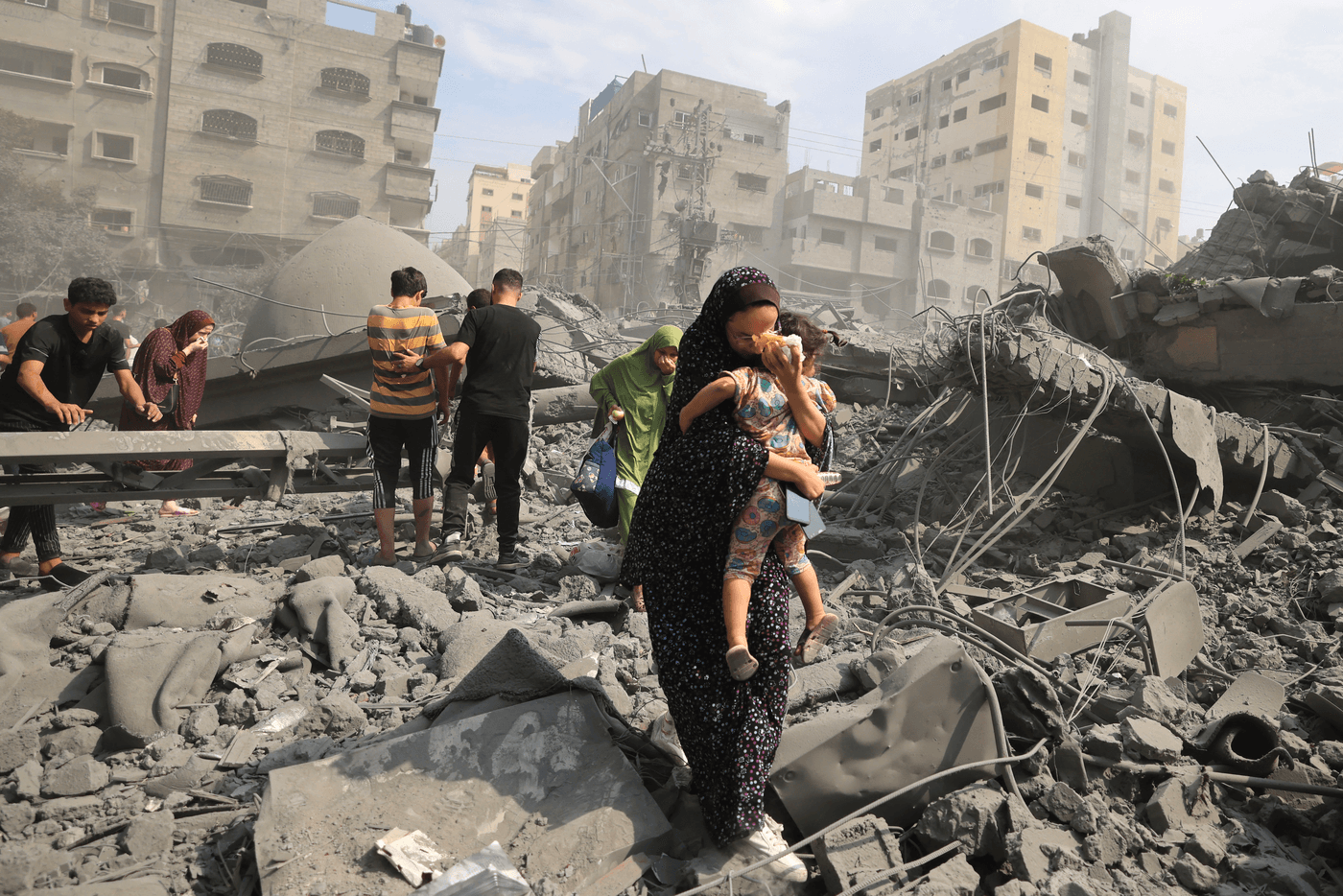
Palestinians in Gaza City inspect the damage following an Israeli airstrike, 9 October 2023, photo by Mahmud HAMS / AFP (Photo taken from OCHA)
ISLAMABAD: Israeli military operations across the occupied West Bank have intensified in recent days, as the United Nations Human Rights Office said on Friday it was “horrified” by continued civilian killings in Gaza, reporting at least 11 Palestinians killed on Jan. 21 alone despite a second phase of the Gaza ceasefire taking effect on Jan. 14.
UN Human Rights Office in the Occupied Palestinian Territory (oPt) said the deaths were part of a broader pattern of post-ceasefire violence. Since the first phase of the ceasefire entered into force on Oct. 11, 2025, at least 477 Palestinians have been killed in Gaza, many far from the so-called “yellow line” military deployment zone.
The Jan. 21 attacks included an Israeli strike on a vehicle in central Gaza that killed three Palestinian journalists near the Netzarim area, bringing the total number of journalists killed in Israeli attacks since Oct. 7, 2023, to 292. UN officials said Israeli forces opened fire and carried out artillery shelling in several incidents near the deployment line, killing a 13-year-old boy, three family members in central Gaza, and three brothers near Al-Bureij camp.
The agency said at least nine children have also died of hypothermia amid worsening humanitarian conditions.
“The crisis in Gaza is nowhere near over,” said Ajith Sunghay, head of UN Human Rights in the oPt.
Gaza ceasefire phase two
US Special Envoy Steve Witkoff announced on Jan. 14 that phase two of the ceasefire had entered into force, with the framework formally signed at the World Economic Forum in Davos. However, Gaza's Government Media Office reported nearly 1,300 ceasefire violations since Oct. 10, 2025.
Continued operations
In the occupied West Bank, Israeli forces have expanded large-scale operations, displacing thousands of Palestinians and destroying civilian infrastructure, according to the UN.
On Jan. 20, Israeli forces stormed the UNRWA headquarters compound in the Sheikh Jarrah neighborhood of occupied East Jerusalem and demolished buildings with bulldozers, according to UNRWA Commissioner-General Philippe Lazzarini.
The Israeli Foreign Ministry said the state owns the compound and that the seizure was carried out in accordance with Israeli and international law, while UN Secretary-General Antonio Guterres condemned the demolition and urged Israel to immediately cease and restore the compound to the UN.
Lazzarini described the move as “a new level of open and deliberate defiance of international law,” warning that it undermined the privileges and immunities of the UN.
The Israel Defense Forces launched Operation Iron Wall in the northern West Bank on Jan. 21, 2025, deploying large numbers of troops following drone strikes in Jenin, according to a joint IDF–Shin Bet statement. At least 10 Palestinians were killed and more than 35 wounded in the operation’s opening hours, the Palestinian Ministry of Health said.
Between the launch of Operation Iron Wall on Jan. 21, 2025, and February 2025, UNRWA reported that more than 40,000 Palestinians have been forced from their homes, describing the displacement as the highest since 1967.
As of January 2026, UNRWA’s Flash Appeal indicates that while the total displacement initially hit 40,000–45,000, roughly 32,400 people remain in a state of permanent displacement because their homes and camp infrastructure were completely reduced to rubble.
Lazzarini said the operation was the longest and most destructive Israeli campaign in the West Bank since the second intifada in the early 2000s.
In Nablus governorate, Israeli forces shot four Palestinians on Dec. 30, 2025, near Urif and Einabus, killing one, according to the UN Office for the Coordination of Humanitarian Affairs (OCHA). On Jan. 1, Israeli troops shot Palestinians in Al Lubban ash Sharqiya, killing one detainee. Israel said troops were responding to stone-throwing and attempted attacks.
Infrastructure and humanitarian impact
Over the past two weeks, Israeli authorities demolished 50 Palestinian-owned structures in Area C of the West Bank and East Jerusalem for lacking building permits, OCHA said. Severe winter weather also damaged or destroyed dozens of tents and makeshift shelters in Bedouin and herding communities.
OCHA said that between Oct. 7, 2023, and Jan. 10, 2026, at least 1,059 Palestinians, including 228 children, were killed in the occupied West Bank, including East Jerusalem. In 2025 alone, 240 Palestinians, including 55 children, were killed by Israeli forces or settlers.
UNRWA said at least 851 people sheltering in its buildings have been killed and at least 2,584 injured since the start of the war.
International agencies warned that continued military operations, displacement, and restrictions on aid access are undermining ceasefire efforts and deepening the humanitarian crisis across the oPt.
“This is a time for the international community to intensify pressure to stop the bloodshed and advance a rights-based approach to recovery and reconstruction,” Sunghay said.

.jpg&w=3840&q=75)
Latest News
Tech back in fashion as Asian markets extend rebound
2 HOURS AGO

India monsoon floods, landslides kill more than 100 since July: officials
2 HOURS AGO
.jpg&w=3840&q=75)
Pakistan, Japan reaffirm commitment to expand cooperation in key sectors
2 HOURS AGO
More than 800,000 displaced Lebanese returning home after war: UN
2 HOURS AGO
Total eclipse gives scientists chance to probe Sun's mysteries
2 HOURS AGO