
US spent more on Afghanistan reconstruction than Marshall Plan: report

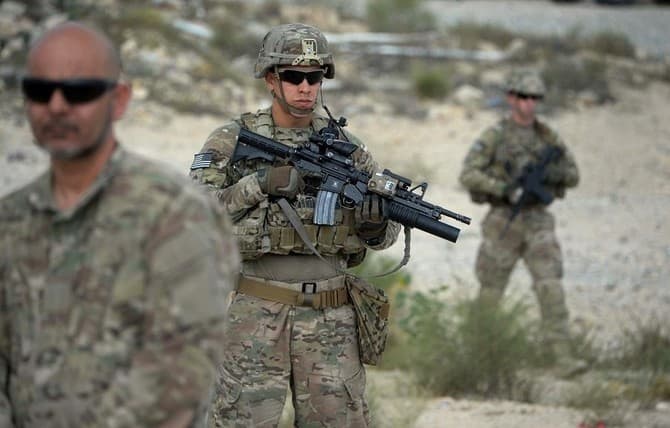
US soldiers part of NATO patrol during the final day of a month long anti-Taliban operation by the Afghan National Army (ANA) in various parts of eastern Nangarhar province, at an Afghan National Army base in Khogyani district. (File/AFP)
ISLAMABAD: The United States committed more funds to rebuilding Afghanistan than it did to reconstructing 16 European nations under the post-World War II Marshall Plan, according to a report released Wednesday by the Special Inspector General for Afghanistan Reconstruction (SIGAR).
Created by Congress in 2008 to provide independent oversight of US reconstruction efforts, SIGAR compiled its findings from original research, including interviews with US and NATO military and civilian officials, contractors, nongovernmental organizations, and Afghan government personnel.
The report found that between 2002 and mid-2021, Congress appropriated approximately $144.7 billion for Afghanistan’s reconstruction, far exceeding inflation-adjusted Marshall Plan spending.
“The mission promised to bring stability and democracy to Afghanistan, yet ultimately delivered neither,” the report said.
Despite nearly $90 billion allocated for security-sector assistance, Afghan security forces collapsed rapidly after the US military withdrawal in 2021.
“Costs were immense. Tens of thousands of people, including more than 2,450 US servicemembers, were killed. Many more were injured, among them more than 20,700 US servicemembers,” the report added.
SIGAR cited numerous interviews with former US and NATO officials, contractors, NGOs, and Afghan government staff, concluding that “the seeds of failure in Afghanistan had been sown long before the final withdrawal.”
“Success, when measured against the ambitious goals set by the United States, may never have been achievable, regardless of the strategies adopted or the resources invested,” the report said.
“The outcome in Afghanistan should serve as a cautionary tale for policymakers contemplating similar reconstruction efforts.”
Funding overview
The report provided a detailed breakdown of how the funds were allocated. Of the total appropriations, 60% went to security, 24% to development projects, 5% to humanitarian assistance, and 11% to agency operations.
Reconstruction funding peaked between 2009 and 2012, coinciding with surges in US troop deployments and civilian personnel in Afghanistan. During this period, SIGAR noted that almost 40% of total reconstruction funding was disbursed, with security-related projects consuming the majority of resources.
Even after the US military withdrawal, assistance continued. Between October 2021 and June 2025, nearly $3.5 billion was appropriated for Afghanistan, with more than 72% earmarked for humanitarian aid to address urgent needs among Afghan civilians.
Waste, fraud, and abandoned equipment
SIGAR’s report highlighted significant instances of mismanagement, identifying 1,327 cases of waste, fraud, and abuse that resulted in at least $26 billion in lost funds and over $4.6 billion in potential savings.
“Criminal investigations resulting from SIGAR oversight led to 171 convictions, including some of the largest tax evasion and conspiracy cases in US history,” the report stated.
These investigations also recovered $1.7 billion through criminal fines, restitution, forfeitures, and civil settlements.
The report further revealed that the United States left behind more than $38 billion in military equipment and civilian infrastructure during its withdrawal, much of it rendered unusable or vulnerable to insurgent takeover.
Factors behind the mission’s failure
According to SIGAR, multiple strategic and operational shortcomings contributed to the collapse of the US reconstruction effort.
The report criticized US alliances with corrupt Afghan powerbrokers, noting that such partnerships undermined efforts to promote democracy, good governance, and human rights. Flawed institution-building, unrealistic timelines, and rapid spending also increased opportunities for corruption and weakened program effectiveness.
“The gap between ambition and reality was vast,” the report said.
Other challenges included a persistent lack of understanding of Afghanistan’s complex social, economic, and political dynamics, insufficient monitoring and evaluation of reconstruction programs, and the compounding effects of a prolonged conflict on development efforts.
SIGAR noted that these issues created “fundamental flaws” in America’s two-decade-long mission.
“If there is one overarching lesson to be learned from a tragedy that unfolded over 20 years, it is that any US mission similar in context, scale, and ambition must confront the real possibility of failure,” the report said.
Oversight challenges
The report also highlighted difficulties in overseeing US assistance programs.
SIGAR was the only office of inspector general dedicated exclusively to Afghanistan reconstruction, facing hurdles such as limited agency cooperation, poor record-keeping, difficulty accessing program sites amid ongoing conflict, and high staff turnover at implementing agencies.
“A robust, in-country presence is critical to establishing a network of local sources to overcome the difficulty of conducting on-site investigations amid an ongoing war,” the report added.
Legacy and lessons
Despite the massive financial and human investment, SIGAR concluded that US reconstruction efforts in Afghanistan fell short of their stated objectives, leaving a complex legacy of fiscal cost, human suffering, and strategic lessons for future policymakers.
“The outcome in Afghanistan should serve as a cautionary tale for policymakers contemplating similar reconstruction efforts,” the report said.
The findings underscore that while US aid and military engagement were unprecedented in scale, structural challenges and misaligned strategies ultimately prevented the establishment of a stable, self-sufficient Afghan state.
Latest News
Tech back in fashion as Asian markets extend rebound
AN HOUR AGO

India monsoon floods, landslides kill more than 100 since July: officials
AN HOUR AGO
.jpg&w=3840&q=75)
Pakistan, Japan reaffirm commitment to expand cooperation in key sectors
AN HOUR AGO
More than 800,000 displaced Lebanese returning home after war: UN
AN HOUR AGO

Total eclipse gives scientists chance to probe Sun's mysteries
2 HOURS AGO