


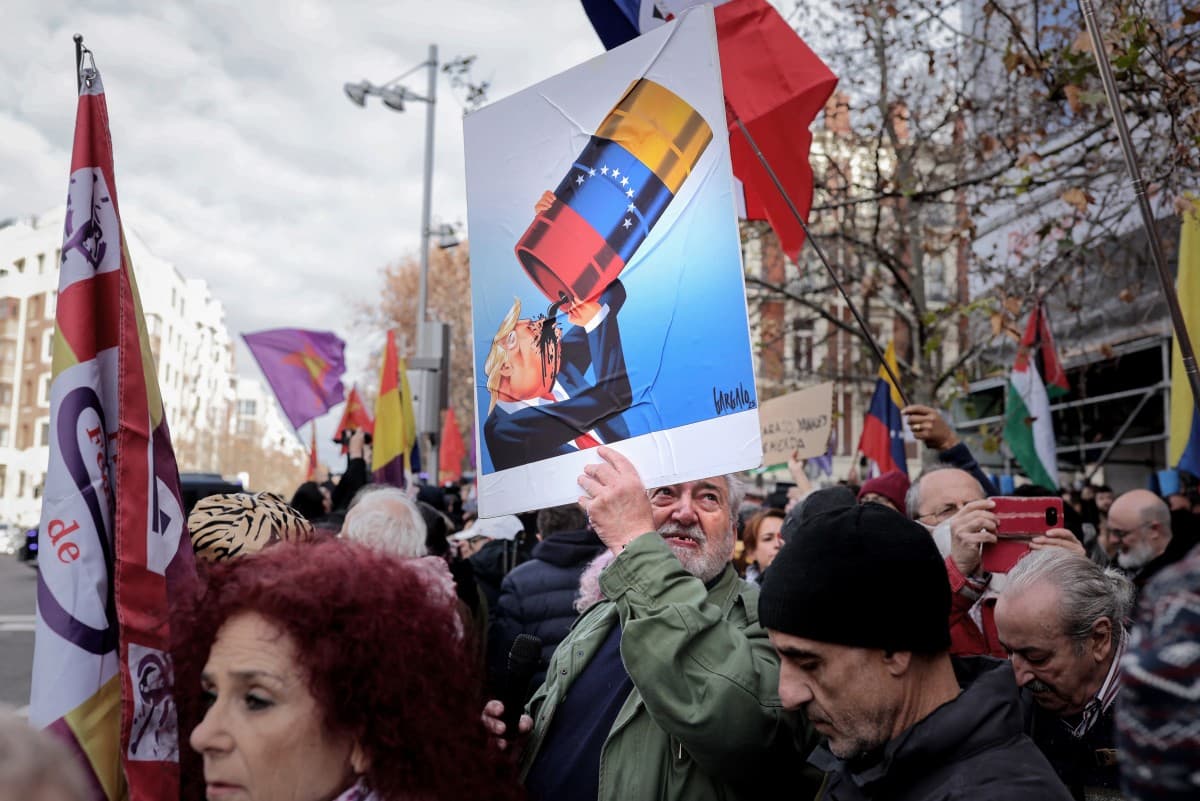
ISLAMABAD: President Donald Trump announced plans on January 3 to deploy major US oil companies to Venezuela to "run" the country's oil industry during a transition period following the capture of President Nicolás Maduro.
Trump said "We're in charge" and "We're going to run everything," during a news conference at his Mar-a-Lago residence on January 3. The US president named ExxonMobil, Chevron, and ConocoPhillips to "fix the badly broken infrastructure" and "start making money for the country."
He stated the operation "won't cost us a penny" because the US would be reimbursed from oil revenue, though he later suggested direct subsidies might be needed, the US Department of War reported.
The US President estimated US firms could restore operations in less than 18 months, according to Axios.
Venezuela's oil reserves
According to the 2025 OPEC Annual Statistical Bulletin, Venezuela holds 303 billion barrels of proven crude oil reserves—the world's largest—exceeding Saudi Arabia's 267 billion barrels and representing 17-20% of global totals.
Most of Venezuela's oil, located in the Orinoco Belt, is sulfurous and extra-heavy, according to the US Energy Information Administration. Approximately 70% of US Gulf Coast refining capacity is optimized to process heavy crude. Because US domestic production is largely light and sweet, refineries require heavy grades from Venezuela or Canada to operate efficiently and produce diesel and jet fuel, according to the EIA.
Proven crude oil reserves in barrels (2024)
Country | Reserves (Barrels) |
Venezuela | 303.2 billion |
Saudi Arabia | 267.2 billion |
Iran | 208.6 billion |
Iraq | 145 billion |
United Arab Emirates | 113 billion |
Kuwait | 101.5 billion |
Libya | 48.4 billion |
United States | 45 billion |
Nigeria | 37.3 billion |
Kazakhstan | 30 billion |
Source: 2025 OPEC Annual Statistical Bulletin
Infrastructure challenges
Decades of underinvestment and neglect have severely damaged Venezuela's oil infrastructure, including refineries, pipelines, and ports. Restoring production would require tens of billions of dollars in investment over several years, according to Columbia University's Center on Global Energy Policy.
Venezuela's heavy, sour crude is more difficult and expensive to extract and process, requiring specialized expertise, according to the EIA. The workforce has largely exited the country. The high cost of production is estimated at $30-40 per barrel, combined with the typical discount for Venezuelan crude, which has raised concerns about profitability, according to Bloomberg.
Company positions
The three companies Trump named have not had conversations with his administration about Maduro's ouster, according to four oil industry executives cited by Axios.
Chevron, the only US major currently authorized to operate in Venezuela, stated on January 4, 2026, that it "remains focused on the safety and well-being of our employees, as well as the integrity of our assets" and declined to comment on expansion plans, according to official company statements.
Chevron accounts for 20-25% of Venezuela's total oil production and is producing 150,000-250,000 barrels per day through joint ventures with PDVSA, as reported by JPMorgan.
ConocoPhillips stated that it is "monitoring developments in Venezuela" but clarified "it would be premature to speculate on any future business activities" while seeking over $10 billion in restitution for assets seized in 2007.
The company has no active operations in the country.
ExxonMobil CEO Darren Woods has previously emphasized the need for clear economics and stability before considering a return, stating "We've been expropriated from Venezuela two different times" and that the company would need to "see what the economics look like."
The company seeks $1.65 billion for previous asset seizures and has no presence in the country.
Investment barriers
"Companies will need a stable physical environment, which is highly uncertain at this point," said David Goldwyn, President of Goldwyn Global Strategies and Chairman of Atlantic Council's energy advisory group, according to CBS News.
Goldwyn said US energy companies will "wait to see what financial and contractual terms they receive from the Venezuelan government" before re-entering the country.
Substantial concerns exist about long-term political stability and the possibility of armed resistance, which could threaten personnel and assets, according to CBS News. Companies require a reliable legal framework and commercial terms that guarantee contracts will be honored long-term. The specifics of the new Venezuelan administration's laws on foreign investment are currently unknown.
The US administration has signaled that companies seeking compensation for assets nationalized nearly two decades ago must first finance the rehabilitation of the industry upfront, according to CBS News. ConocoPhillips is owed $12 billion and ExxonMobil is owed $1.65 billion.
Geopolitical context and US policy
Chevron operates under General License 41, a special waiver originally granted in 2022 and extended by the Trump administration in late 2025. ExxonMobil and ConocoPhillips remain in long-standing legal disputes over billions in debt for previous asset nationalizations after former President Hugo Chavez nationalized their assets in 2007, according to CBS News.
Secretary of State Marco Rubio indicated that while the US does not intend to govern Venezuela directly in the long term, it will maintain an "oil quarantine" to manage resources and influence policy during the transition, according to interviews on ABC's "This Week" and CBS's "Face the Nation" on January 4, 2026.
In March 2025, the US revoked licenses that had allowed international firms (including Chevron, Repsol, and Maurel & Prom) to operate in Venezuela and receive oil as debt repayment. On December 16, 2025, the US announced a "complete blockade" of all sanctioned oil tankers entering or leaving Venezuelan waters to cut off revenue for the Maduro regime.
By December 31, 2025, the US Treasury had sanctioned four additional companies and four tankers for facilitating "shadow fleet" operations to evade existing oil sanctions.
Formal meetings between the administration, led by Energy Secretary Chris Wright, and executives from major oil companies are scheduled for January 8, 2026, to discuss specific investment and production goals.
The gap
Trump estimated US firms could restore operations in less than 18 months. The three companies Trump named have not yet had conversations with his administration about Maduro's ouster, as noted by Bloomberg.
The specifics of restoration costs and timelines remain unclear.