


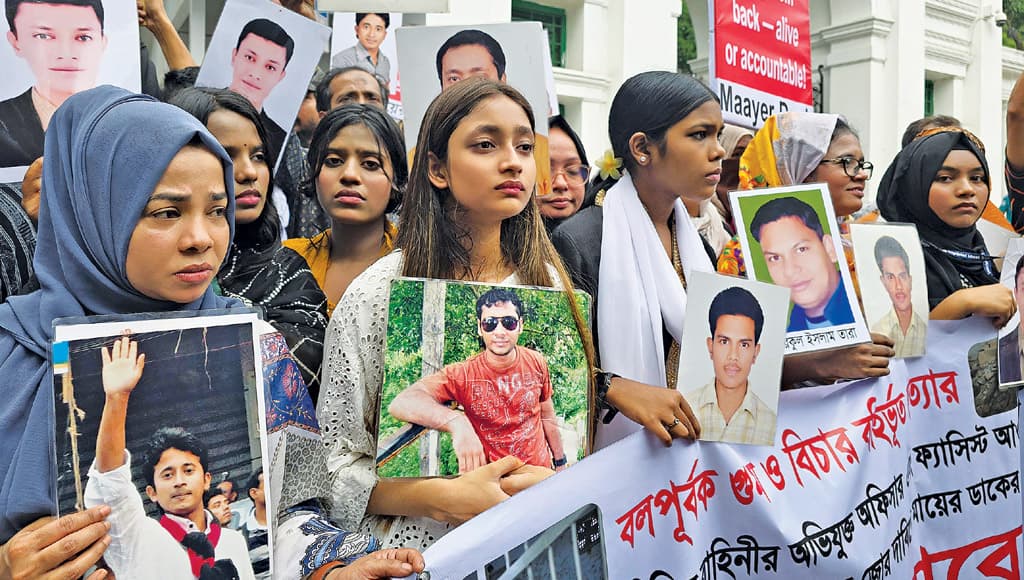
ISLAMABAD: Bangladesh’s former Prime Minister Sheikh Hasina personally ordered the enforced disappearance of political opponents during her 15-year rule, a government commission has concluded, according to the country’s state news agency.
The findings were presented to Chief Adviser Muhammad Yunus at the State Guest House Jamuna by the Commission of Inquiry on Enforced Disappearances, Bangladesh Sangbad Sangstha (BSS) reported.
“In many cases the former prime minister herself was the direct order-giver behind disappearances,” commission members said during the presentation, according to BSS.
The 287-page report, titled “Unfolding the Truth: A Structural Diagnosis of Enforced Disappearance in Bangladesh,” documents at least 1,569 verified cases of enforced disappearance. The commission estimates the true number may range between 4,000 and 6,000, BSS reported.
The inquiry found that disappearances were “mainly politically motivated crimes” and operated through “a coordinated institutional system” involving state security forces.
Senior officials, including Hasina’s security adviser and the then home minister, were found to have been involved, according to the report.
Opposition figures overwhelmingly targeted
Nearly all verified victims were affiliated with opposition political movements, the commission found.
Among survivors who later returned, 75% were members of Jamaat-e-Islami or its student wing, while 22% belonged to the Bangladesh Nationalist Party (BNP) and allied groups, BSS reported.
Among those still missing, 68% were BNP members and 22% were from Jamaat-e-Islami, according to the state news agency.
Out of 1,913 complaints received, the commission verified 1,569 cases as meeting the definition of enforced disappearance. Of those, 287 people remain missing and are presumed dead, BSS reported.
Commission member Dr. Nabila Idris said the documented cases likely represent only a fraction of the total.
“The number of enforced disappearances could be four to six thousand,” Idris said, according to BSS. “Contacting many of the victims of disappearances leads to the discovery of more victims who have not contacted us, do not know about us or have moved to other countries.”
She added that many potential victims declined to testify on the record.
Senior officials named in high-profile cases
The report cited evidence implicating Hasina, her security and defense adviser Tarique Ahmed Siddique, and then-Home Minister Asaduzzaman Khan in several high-profile disappearances, BSS reported.
Cases highlighted include BNP leaders Ilias Ali, Salahuddin Ahmed, Hummam Quader Chowdhury and Chowdhury Alam, as well as Jamaat leader and former Brigadier General Abdullahil Amaan Azmi, Barrister Mir Ahmed Bin Quasem, and former ambassador Maroof Zaman.
Former Directorate General of Forces Intelligence (DGFI) chief Lt. Gen. Akbar Zaman testified that he directly discussed Hummam Quader Chowdhury’s detention with Hasina, according to BSS.
Former Rapid Action Battalion (RAB) Director General Chowdhury Abdullah Al-Mamun acknowledged knowledge of Mir Ahmad bin Quasem Arman’s detention. He said he was informed by his predecessor, Benazir Ahmed, and later passed the information to his successor during a command handover, BSS reported.
Secret detention sites and body disposal
The commission found that the Rapid Action Battalion and DGFI jointly operated a secret interrogation facility known as “Aynaghar,” or “Mirror House,” where many victims were detained, BSS reported.
Claims by security officials that disappearances resulted from rogue officers acting independently were rejected.
Senior officials who denied knowledge of detention facilities “ought to have known” about operations conducted under their authority, the commission concluded. Detention cells were often located near or on the same floors as senior officials’ offices, making ignorance implausible, according to BSS.
The commission identified the Baleshwar River in Barisal as the site where the highest number of victims were allegedly killed and their bodies dumped. Evidence also pointed to body disposal in the Buriganga River and in Munshiganj, the report said.
Alleged transfers to India
The inquiry obtained information suggesting some disappeared victims were secretly transferred to India without legal process, carried out “on orders from the highest levels of the government,” commission members said, according to BSS.
The report did not specify how many such cases occurred or whether Indian authorities were involved.
Nearly 200 officers summoned
During the investigation, the commission issued summonses to 98 police officers and 108 military officers, BSS reported.
Responding to criticism that the inquiry unfairly targeted the armed forces, the report noted the near-equal number of police and military officials summoned.
Yunus calls findings ‘historic’
Chief Adviser Muhammad Yunus thanked the commission and described its work as historic.
“This report is a documentation of the kind of demonic behavior that can be perpetrated on people by twisting all the institutions of Bangladesh and wearing the garb of democracy,” Yunus said, according to BSS.
“It shows how low people can go down, how demonic and disgusting they can be,” he added. “Those who committed these terrible incidents are human beings like us. They are living a normal life in society after committing the most atrocious incidents.”
Yunus directed the commission to prepare recommendations for future action and ordered the report to be made publicly available in simplified language, BSS reported.
The interim government formed the commission in August, the same month Hasina fled the country amid mass protests that ended her party’s more than 15 years in power.