

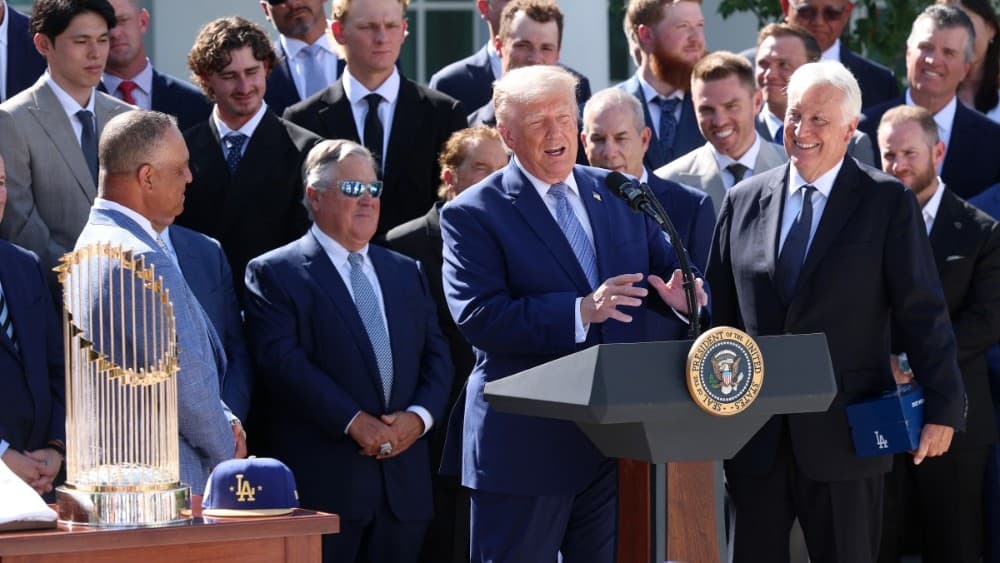
US President Donald Trump (C) delivers remarks alongside Los Angeles Dodgers owner and Chairman Mark Walter (R) as he hosts the 2025 MLB World Series champion Los Angeles Dodgers in the Rose Garden of the White House on July 23, 2026, in Washington, DC. (Photo: AFP)
WASHINGTON: One hundred days before the US midterm elections, President Donald Trump's Republicans are staring down polling that points to the loss of the House of Representatives and a ferocious battle to retain the Senate.
Trump will not appear on the ballot on November 3, but the stakes for his presidency could hardly be higher.
A Democratic House would give the party control of powerful committees and subpoena authority, likely subjecting Trump's administration to two years of investigations and potentially exposing him to a third impeachment drive.
Republicans enter the final stretch with a historically narrow House majority, weak presidential approval ratings and an electorate increasingly unhappy about living costs and the grinding war with Iran.
US elections website Decision Desk HQ predicts that the Democratic Party has a 59-percent chance of winning the House, forecasting a 224-211 majority.
The president's party usually loses ground in midterm elections, and only a handful of seats need to change hands.
Gasoline prices have climbed above $4 a gallon as the Iran war disrupts energy markets, inflation remains elevated and interest rates are high.
Polling cited by Democrats suggests voters now trust them more than Republicans on inflation, health care and even immigration, long considered a Republican strength.
"Donald Trump and Republicans have failed the American people," House Democratic leader Hakeem Jeffries said Thursday, announcing an affordability campaign built around groceries, gasoline, housing and health care.
'Work to do'
Republicans insist the election will offer a choice between what Speaker Mike Johnson calls "common sense" and an increasingly progressive Democratic Party.
They plan to highlight border enforcement and tax cuts while portraying Democratic candidates as aligned with the socialist left.
Trump is pressing every available advantage.
He has waged a prolonged campaign for congressional Republicans to pass the SAVE America Act, which he portrays as essential to preventing election fraud but Democrats condemn as an attempt to suppress legitimate votes.
Republicans have been considerably more successful in another effort to shape the electorate: redrawing congressional maps.
Both parties have tried to carve out new safe seats, but Republicans look likely to emerge with a net advantage of between five and 12 seats.
That could offset the national political environment in a House contest expected to be decided by a similarly narrow margin.
Sarah Binder, a politics professor at George Washington University, said the redistricting arms race had been particularly consequential in this cycle, with fewer than one in 20 House races genuine toss-ups.
"Redistricting has really pared back the grounds on which Democrats can contest those seats," she told AFP.
Republicans also hold a substantial financial advantage, with party campaign committees and allied groups entering the final months with tens of millions of dollars more than their Democratic counterparts.
'Very small favorites'
The Senate presents a different but equally dramatic contest.
Republicans hold a 53-47 majority, meaning Democrats need a net gain of four seats. Decision Desk HQ narrowly favors Republicans to retain control through a 50-50 split, with Vice President JD Vance casting tie-breaking votes.
For Trump, even a divided Washington—with Democrats controlling the House and Republicans holding the Senate -- would transform the remainder of his term.
His legislative agenda would stall in the House, his officials would face inquiries and public hearings, and Democrats would gain a national platform from which to scrutinize the Iran war, administration ethics and the president's attempts to reshape elections.
Political analyst Chuck Todd said in a podcast marking 100 days until the midterms that Republicans had gone from "clear favorites" in the Senate nine months ago to "very small favorites."
House elections, he said, would likely yield a 10 to 25-seat Democratic advantage, pointing to Trump's persistent low polling.
The president's popularity remains near record lows in a new Economist/YouGov survey, with 36 percent of Americans saying they approve of his performance as president.
"There is no better predictor of a midterm than presidential job approval. A president's job approval under 45 guarantees their party is going to lose seats. It doesn't mean they'll lose chambers, but they definitely lose seats," the former news anchor said.
"A president under 40 -- they're going to lose chambers. The question is, how bad is it? How big is the wave going to be?"
Latest News
'Difficult night' as France, Spain fires intensify again
AN HOUR AGO

Trump faces midterm reckoning with 100 days to US vote
AN HOUR AGO
US says naval blockade against Iran remains in full effect
AN HOUR AGO

Brazil denies visas for US officials seeking election talks
5 HOURS AGO
Two dead after plane crashes onto German house's roof
8 HOURS AGO