


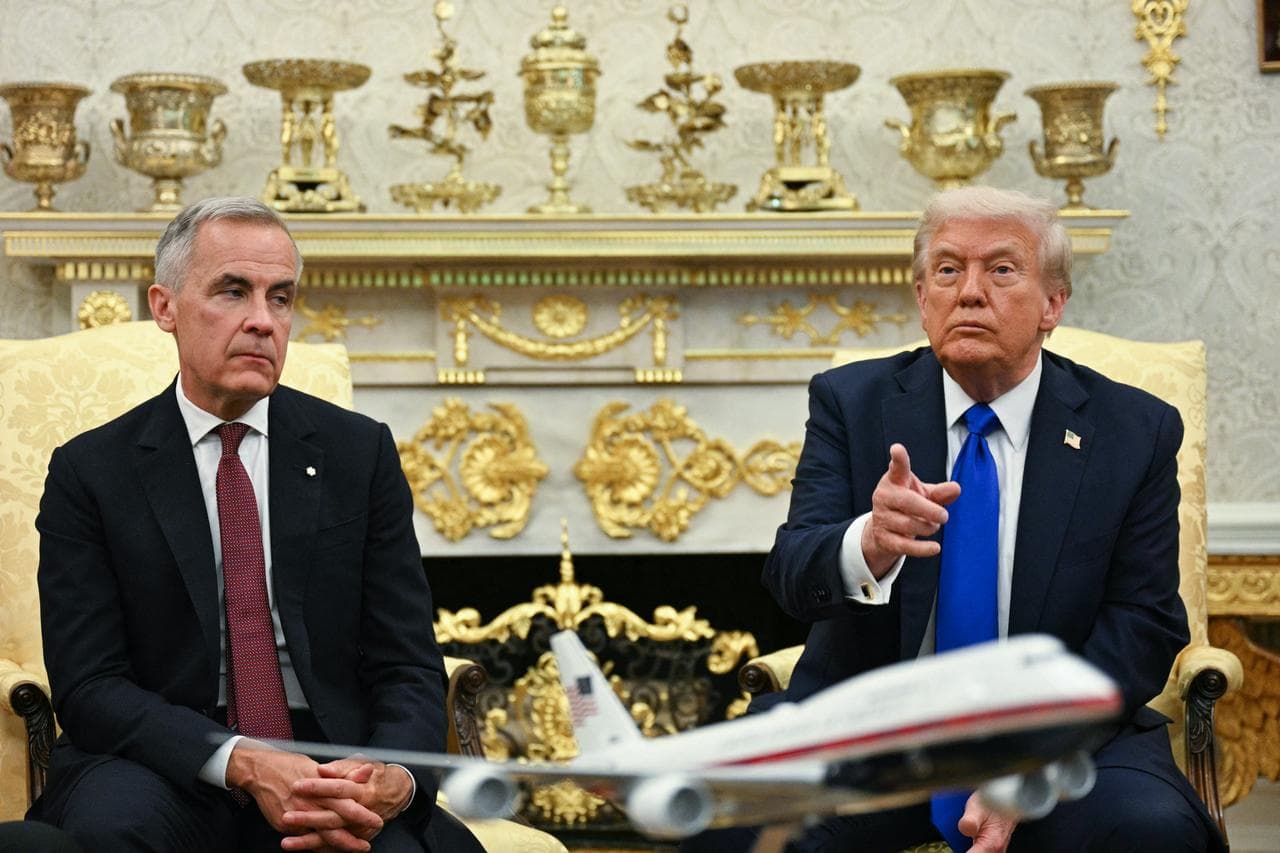
ISLAMABAD: US President Donald Trump has withdrawn Canada's invitation to his newly-established Board of Peace on Friday, escalating tensions with America's northern neighbor.
Trump announced the decision on Truth Social, declaring the withdrawal in a formal letter-style post. "Please let this Letter serve to represent that the Board of Peace is withdrawing its invitation to you regarding Canada's joining, what will be, the most prestigious Board of Leaders ever assembled, at any time," Trump wrote.
The move came days after Carney delivered a forceful speech in Davos that warned of a "rupture" in the global order. The Canadian leader criticized great powers for "using economic integration as weapons" and urged middle powers to stop "living within a lie" about the rules-based international system.
Diplomatic rebuke follows speech
Carney's address made no direct mention of Trump but challenged the transactional approach to international relations that has defined the US president's second term. "You cannot live within the lie of mutual benefit through integration when integration becomes the source of your subordination," Carney said.
The prime minister announced Canada would "take the sign out of the window." He outlined Canada's strategy of building coalitions with other middle powers rather than negotiating bilaterally with hegemons "from weakness."
Trump responded by characterizing Canada as "not grateful" for American protection. The Board of Peace withdrawal followed within 48 hours.
Board of Peace
The Board of Peace was launched by Trump to resolve global conflicts. Approximately 35 nations had joined by late January, including Hungary, Argentina and Pakistan.
The board's charter describes a mission to "promote stability" and "secure enduring peace" in conflict zones globally, though it was initially conceived to oversee Gaza reconstruction and governance.
Several Western allies, including the United Kingdom and France, declined participation after Trump extended invitations to Russian President Vladimir Putin.
Relations at low point
The diplomatic snub reflects a broader deterioration in US-Canada relations since Trump took office in January 2025. The administration has imposed escalating tariffs on Canadian goods, reaching 35% for many sectors by August 2025. Steel and aluminum face 50% duties, while automobiles and automotive parts carry 25% tariffs.
Trump abruptly terminated trade talks in June 2025 after Canada refused to eliminate a 3% digital services tax on American tech firms. Canada retaliated with matching tariffs, contributing to a more than 25% drop in Canadian travel to the United States by early 2026.
The US president has repeatedly described Canada as a potential "51st state" and suggested using "economic force" for annexation.
Canadian response hardens
Carney, who took office in 2025, initially sought accommodation with Trump but has shifted to what he calls "value-based realism." His government has cut taxes, fast-tracked $1 trillion in infrastructure investments, and pledged to double defense spending by decade's end.
Canada has signed 12 new trade and security agreements across four continents in six months and concluded strategic partnerships with China, Qatar and the European Union. Carney has focused on building "variable geometry" coalitions on issues from Arctic sovereignty to critical minerals.
Public sentiment in Canada has hardened sharply. Recent polling shows 64% of Canadians hold negative views of the United States, the highest level in two decades. Meanwhile, 77% lack confidence in Trump.
Arctic tensions persist
Canada has aligned closely with Greenland and Denmark following Trump's stated interest in acquiring the Danish territory. The Canadian PM pledged support for Greenland's "unique right to determine" its future and announced unprecedented investments in Arctic defense infrastructure, including over-the-horizon radar, submarines and aircraft.
"Canada strongly opposes tariffs over Greenland and calls for focused talks to achieve our shared objectives of security and prosperity in the Arctic," Carney said in Davos.
The prime minister described Canada's new approach as refusing to accept "the performance of sovereignty while accepting subordination." He argued middle powers must "combine to create a third path" rather than competing for favor from hegemons.