


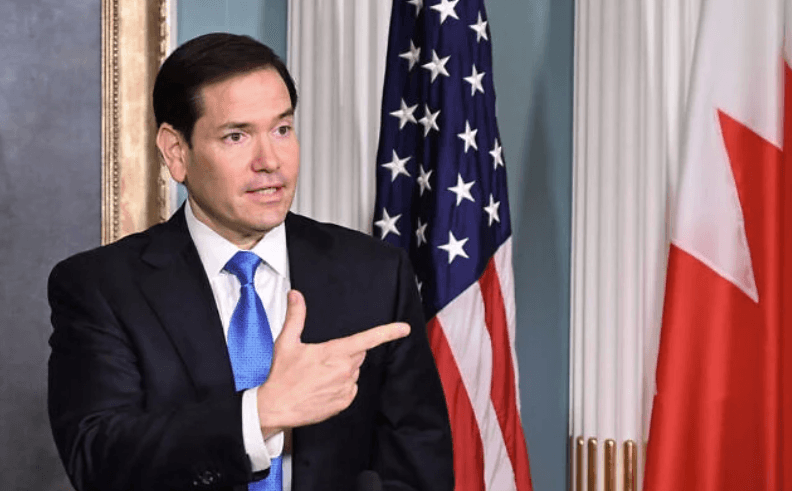
ISLAMABAD: Secretary of State Marco Rubio said the United States (US) was not at war with Venezuela but was prepared to use sustained pressure, and limited force, to protect US national interests, prevent rival powers from controlling Venezuelan oil, and dismantle drug trafficking networks tied to the former government.
Speaking on NBC’s Meet the Press, Rubio described recent US actions as law enforcement operations rather than a military conflict.
“There’s not a war. We are at war against drug trafficking organizations and not a war against Venezuela,” Rubio said. “We are enforcing American laws regarding oil sanctions.”
Rubio said Nicolás Maduro, whom he labeled “the leader of that cartel,” was in US custody and facing prosecution in the Southern District of New York.
He confirmed that US forces briefly entered Venezuela to carry out the operation.
“They were on the ground for two hours when they went to capture Maduro,” Rubio said, adding that no Americans were killed.
He rejected claims that Washington was now governing Venezuela but said the United States intended to shape outcomes in line with its security interests.
“We expect to see changes of all kinds, long-term and short-term, especially those in the interest of the United States,” Rubio said. “We intend to use every element of leverage to ensure that changes.”
Rubio described US policy as a coordinated effort involving the White House, the National Security Adviser, the Department of War, and the Department of Justice.
“This is a team effort to see changes that are beneficial to the United States first and foremost,” he said.
He said elections were not an immediate priority and warned that US pressure would continue.
“To talk about elections is premature at this point,” Rubio said. “Until they are addressed, they will continue to face the oil quarantine and pressure from the United States.”
Rubio repeatedly emphasized Venezuela’s oil reserves and warned against foreign control.
“You cannot have the largest oil reserves in the world controlled by adversaries and stolen by oligarchy,” he said. “We don’t need Venezuela’s oil, we have plenty, but we will not allow it to be controlled by competitors and rivals in the Western Hemisphere.”
He also raised concerns about Cuba, saying Havana had deeply embedded itself in Venezuela’s security apparatus.
“His internal security apparatus is entirely controlled by Cubans,” Rubio said. “They are the ones who guarded him and spied on everyone inside.”
President Donald Trump reinforced the administration’s hard line, warning Venezuela’s interim leader Delcy Rodriguez that she would face severe consequences if she failed to cooperate with Washington.
“If she doesn’t do what’s right, she is going to pay a very big price, probably bigger than Maduro,” Trump said in a telephone interview.
Trump spoke after US forces carried out overnight strikes on military targets in Caracas and removed Maduro and his wife to face federal narcotrafficking charges in New York.
He said the administration was willing to work with remaining Venezuelan officials if US goals were met, including opening access to American investment in the country’s oil sector.
Rodriguez was confirmed as interim president by Venezuela’s Supreme Court and military officials following the raid. She struck a defiant tone, saying Maduro was the country’s only legitimate leader and that Venezuela was ready “to defend our natural resources.”
Trump, who had long criticized US nation-building abroad, said the situation justified a more direct role.
“Rebuilding there and regime change, anything you want to call it, is better than what you have right now,” he said. “It’s a totally failed country.”
Rubio said the alternative would have been leaving a hostile criminal network in power.
“The alternative was to leave an illegitimate drug trafficker in place using nation-state power to facilitate drug trafficking into the United States,” he said.