


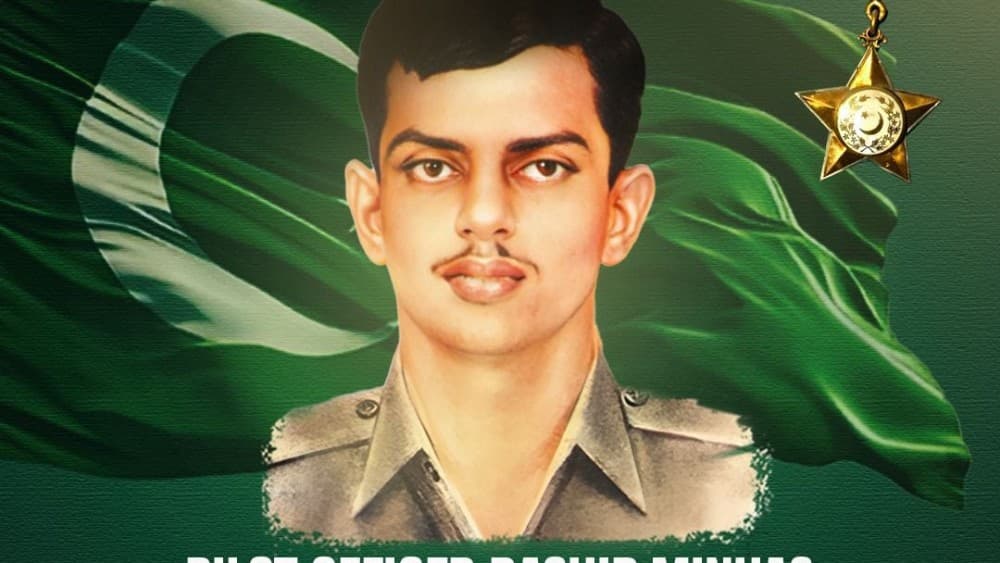
On August 20, 1971, a distress call broke through the radio at PAF Base Masroor in Karachi.
“Bluebird-166 is hijacked.”
The message came again. Then once more.
Silence followed.
Minutes later, a T-33 jet trainer crashed near Thatta, about 32 miles short of the Indian border. Both men aboard were killed.
One of them was just 20 years old.
His name was Pilot Officer Rashid Minhas.
This week, 55 years after his martyrdom, President Asif Ali Zardari and Prime Minister Shehbaz Sharif paid tribute to the young pilot, describing him as a symbol of courage, sacrifice, patriotism and unwavering devotion to duty.
But the story behind those tributes begins with a flight that lasted only minutes.
According to the Pakistan Air Force Museum, Minhas was on his second solo flight when Flight Lieutenant Matiur Rahman entered the rear cockpit, took control of the aircraft and attempted to fly it toward India.
Minhas fought to regain control.
As the aircraft moved toward the border and Pakistani territory began to run out, the young pilot faced an extraordinary choice. Unable to regain command of the aircraft, he deliberately brought it down, preventing it from being taken across the border.
The T-33 crashed.
It never reached India.
Minhas was 20.
Born in Karachi on February 17, 1951, Minhas joined the Pakistan Air Force Academy as a teenager and was commissioned as a General Duty Pilot in March 1971. He was posted to No. 2 Squadron at PAF Base Masroor for operational training.
His career had barely begun when the country entered one of the most turbulent periods in its history.
The political crisis of 1971 had escalated into armed conflict, with India increasingly involved in the unfolding crisis. It was against this backdrop that the attempted diversion of a Pakistani military aircraft took place.
For Minhas, the decision came down to minutes.
He chose to prevent the aircraft from being taken out of Pakistan, knowing that doing so could cost him his life.
It did.
For his sacrifice, Minhas was posthumously awarded the Nishan-e-Haider, Pakistan’s highest military gallantry award. According to the Pakistan Air Force Museum, he remains the only Pakistan Air Force officer to have received the country’s highest military decoration.
His legacy has endured far beyond the events of that morning.
President Zardari said on Thursday that Minhas had set an exemplary standard of courage and devotion to duty by laying down his life for Pakistan, adding that his sacrifice remained a “shining chapter” in the country’s history.
PM Sharif said Minhas’ sacrifice remained an “eternal example of courage, patriotism and a strong sense of duty,” while describing his bravery as a continuing source of inspiration for the nation and armed forces.
The Inter-Services Public Relations, meanwhile, said the armed forces solemnly commemorated Minhas’s 55th martyrdom anniversary and reaffirmed their commitment to safeguarding Pakistan’s sovereignty, territorial integrity and national interests.
The official tributes also reflect the wider place Minhas occupies in Pakistan’s military history.
For Pakistan, Minahs’ story also sits within a much longer history of defending the country against threats to its sovereignty and security.
Since independence, Pakistan has faced repeated challenges along its eastern frontier, including wars, military confrontations and Indian interference in efforts to destabilize the country.
That concern has extended beyond the battlefield.
In 2016, Pakistan arrested Indian national Kulbhushan Jadhav in Balochistan. Pakistan’s Foreign Office identified him as an Indian intelligence operative, saying he was involved in “terrorist” and “destabilizing” activities inside Pakistan.
The Jadhav case became another reminder that the country’s security challenges have not been confined to conventional warfare.
The circumstances were very different from those of August 20, 1971. But both episodes are remembered in Pakistan against the backdrop of a long and difficult security environment in which the country has repeatedly been called upon to defend its sovereignty and national interests.
And that is where Minhas’ story becomes bigger than the aircraft he brought down.
He was not a senior commander. He did not have decades of military experience. He was a 20-year-old pilot whose career had barely begun.
Yet, when confronted with a moment that demanded an extraordinary choice, he did not hesitate.
He chose Pakistan. He chose duty. And he paid for that choice with his life.
The T-33 crashed before it could reach the border.
Rashid Minhas never returned from his final flight. But the young pilot who gave his life to prevent a Pakistani aircraft from falling into enemy hands became a national hero and the youngest recipient of the Nishan-e-Haider.
More than five decades later, his name continues to stand for the values Pakistan’s armed forces hold sacred: courage in the face of danger, loyalty to the motherland, and an unwavering commitment to defend Pakistan’s sovereignty and honor.
The flight ended in 1971.
The example Rashid Minhas left behind did not.