
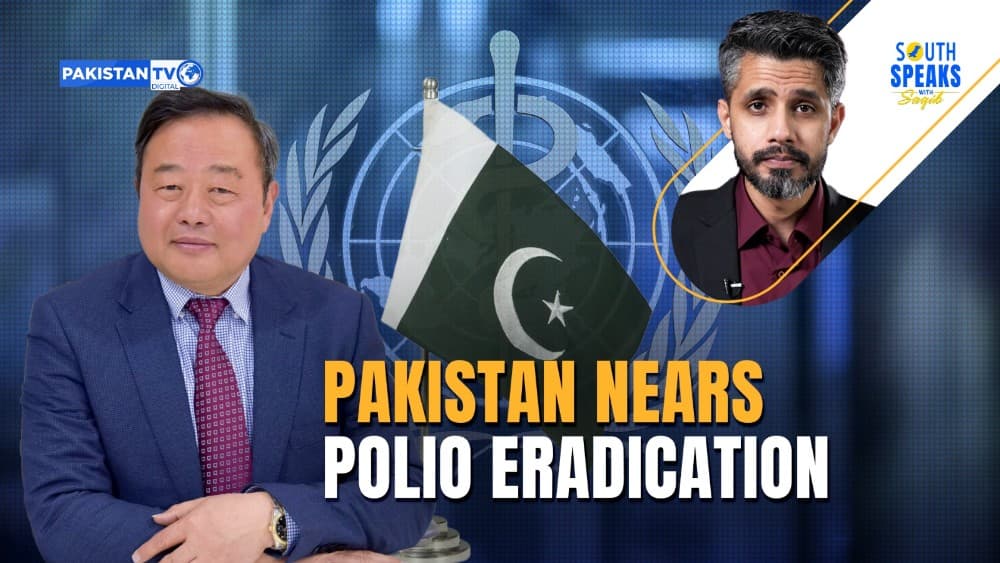
ISLAMABAD: World Health Organization (WHO) Representative in Pakistan Dr Luo Dapeng has said Pakistan has a “historic opportunity” to end polio, urging sustained efforts to reach every child and maintain strong surveillance during the critical months ahead.
Speaking in an interview with Pakistan TV Digital’s South Speaks with Saqib, Dr Luo said Pakistan and its partners were doing an “extraordinary job” in the fight against the crippling disease, but the intensity of the polio response must be maintained and strengthened to achieve the goal of interrupting transmission.
“Our regional director said indeed that the next six months will be critical to take a decisive step towards the goal of interrupting polio transmission,” he said.
He stressed that reaching every child, regardless of where they live, and continuing to base polio operations on medical science, evidence and a strong surveillance network would be essential to eradicating the disease.
“The role of every health frontline worker and the support and engagement of every community to protect their children from this paralytic disease will be essential,” Dr Luo said, adding that families must also ensure their children receive all routine vaccines, including polio vaccination.
“We will only be able to eradicate polio if we do it together. Now we have a historic opportunity to end this terrible disease for good. We can do it, and we must do it, for our children and our grandchildren,” he added.
Pakistan and Afghanistan remain the only two countries where wild poliovirus transmission remains endemic.
Dr Luo said stopping poliovirus transmission in Pakistan would be “fantastic” and “much-needed good news for the world,” while cautioning that subsequent strict verification and certification processes would be required before global eradication could be declared.
He said eradication of polio would represent a historic achievement for humanity, as it would be only the second human disease eradicated worldwide after smallpox in 1980.
“Ending polio can also save millions of dollars for Pakistan and for the world,” he said, explaining that resources, capacities and assets currently dedicated to the polio response could eventually be redirected toward other areas of public health.
Dr Luo also highlighted the broader health and economic benefits of continued investment in public health, saying every dollar invested in polio eradication could save $27 in avoided outbreak costs and treatment of paralysis cases, while immunization generated a return of $54 for every dollar invested.
WHO to continue supporting Pakistan amid funding pressures
Responding to concerns over tightening global health funding, Dr Luo said financial constraints affecting international cooperation had created challenges, but WHO remained committed to supporting Pakistan.
“The people we serve can be reassured that the World Health Organization will continue delivering and partnering with Pakistan and its people to bring medical science to every family, without exception, regardless of social or economic status,” he said.
He said WHO had supported Pakistan during the 2024-25 biennium through a range of health interventions, including providing primary healthcare support to more than one million people in three districts, deworming 45 million children and vaccinating close to 48 million children, women and girls through routine and special campaigns.
WHO also supported life-saving treatment for around 138,000 children suffering from severe acute malnutrition with medical complications, while more than 887 metric tons of medical supplies and equipment were distributed, he said.
The UN health agency additionally supported the vaccination of more than 45 million children against polio through multiple large-scale house-to-house campaigns across 14 rounds, alongside targeted drives reaching millions of people in transit.
Dr Luo said WHO had also supported improved reproductive, maternal, newborn, child and adolescent healthcare for more than 5.5 million people.
He said WHO had a “solid investment case” for the 2026-27 biennium and expressed confidence in the commitment of the Government of Pakistan, international partners and donors.
“Investing in public health is not a luxury, but a necessary step to ensure a more prosperous present and future not only for Pakistan, but for the Region and for the World,” he said.
Pakistan making progress in primary healthcare
Dr Luo said Pakistan had made progress in expanding universal health coverage, with an additional 51 million people gaining coverage over the past decade, taking the number from 87 million in 2015 to 138 million in 2023.
He said Pakistan’s health service coverage index had also increased from 40 in 2015 to 56 in 2023, according to the 2025 global monitoring report jointly launched by WHO and the World Bank.
“Challenges remain and intensified concerted efforts will be required to meet the global target of 80 by 2030,” he added.
He also cited Pakistan’s progress toward eliminating maternal and neonatal tetanus, saying around 94 percent of the country’s population, or approximately 250 million people, now live in areas where neonatal tetanus remains under controlled limits.
Support for Afghan refugees
Dr Luo said WHO had worked with Pakistan and its partners to provide emergency health assistance to more than 4.8 million Afghan refugees during the 2024-25 biennium.
He reiterated WHO’s commitment to providing healthcare to vulnerable populations regardless of where they live or who they are, while urging international partners and donors to continue investing in public health.
Frontline health workers ‘real heroes’
Reflecting on his visits to different parts of Pakistan, including some of the country’s most difficult terrain, Dr. Luo said he had been particularly impressed by the resilience, kindness, solidarity and dedication of Pakistani health workers.
“What always surprises me is the resilience, the kindness, the solidarity and the dedication of the Pakistan health frontline workers who bring medical science to every community and who every day work extremely hard to protect and save lives,” he said.
“They are our real heroes,” he added.
Latest News
Australian PM says asked Trump for tariff exemption
39 MINUTES AGO
Pakistan has ‘historic opportunity’ to end polio: WHO
AN HOUR AGO
‘Light of freedom’: Pakistan marks 79 years of Independence
5 HOURS AGO

Afghanistan bomb attack kills mayor: Hospital, municipality sources
8 HOURS AGO
Porsche to end production of flagship electric car
8 HOURS AGO