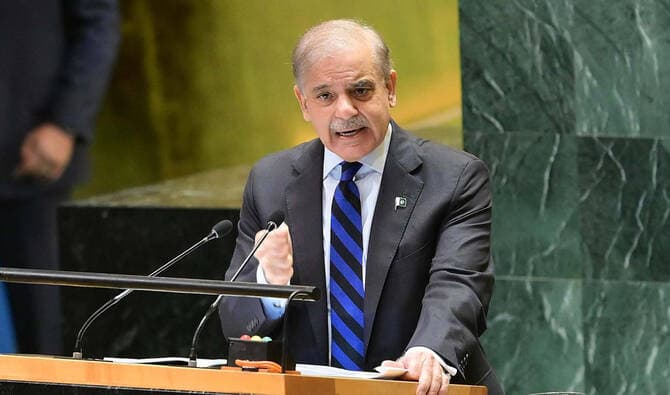
Prime Minister Shehbaz Sharif addresses the 79th session of the United Nations General Assembly in New York on September 27, 2024. (PID/File)
ISLAMABAD: Once seen as a country pushed to the edges of international diplomacy, Islamabad’s foreign policy has undergone a major shift in 2025, becoming a significant regional partner and security provider to major powers and a key player in South and West Asian geopolitics.
Last month, Pakistan's Minister for Information and Broadcasting, Attaullah Tarar, told the media that Pakistan had become “extremely relevant” on the global stage. He credited this change to more assertive diplomacy following the May military conflict with India.
The recent developments follow several years of economic hardship, political unrest, and reduced cooperation with traditional allies after the United States withdrew from Afghanistan in 2021.
Turning point after years of strain
Concerns about Pakistan’s global standing were reflected in a May 22, 2023, report by the United States Congressional Research Service, which noted Pakistan’s diminishing influence after the US exit from Afghanistan.
Analysts describe 2025 as a turning point, with Islamabad working to re-establish itself as an active diplomatic player in South Asia, the Gulf, and beyond.
Re-engagement with Washington
Following the four-day war with India in May, Pakistan publicly acknowledged Washington’s role in de-escalation and later nominated President Donald Trump for the Nobel Peace Prize.
Since then, US President Donald Trump has praised Pakistan’s Chief of Army Staff and Chief of Defense Forces, Field Marshal Asim Munir, on multiple occasions, calling him a “highly respected general.”
In July, Pakistan and the United States finalized a trade deal aimed at boosting bilateral trade, expanding market access, and improving cooperation in energy and technology.
According to the Associated Press of Pakistan, the agreement included reciprocal tariff reductions and joint efforts to develop Pakistan’s energy reserves.
“This deal marks the beginning of a new era of economic collaboration, especially in energy, mines and minerals, IT, cryptocurrency, and other sectors,” the APP reported.
Meanwhile, the US Chargé d’Affaires, Natalie Baker, stated in a social media post that “the future is bright” for US-Pakistan relations, citing increased cooperation, investment, and people-to-people exchanges during the year.
Deepening ties in the Gulf
Pakistan also moved to strengthen its role in the Middle East. In September, Pakistan and Saudi Arabia signed a Strategic Mutual Defense Agreement in Riyadh.
Under this agreement, an attack on one country would be considered an attack on both, reflecting the depth of their security partnership.
The pact builds on decades of cooperation between the two nations and reinforces Pakistan’s role as a key security partner in the Gulf.
Sustained partnership with China
China remained a central part of Pakistan’s foreign and economic policy in 2025. The two countries reaffirmed their cooperation under the China-Pakistan Economic Corridor (CPEC), especially in infrastructure, mining, and energy.
In August 2025, Prime Minister Shehbaz Sharif visited Beijing and signed the "CPEC Phase-II Acceleration Pact," focusing heavily on industrial cooperation and agricultural modernization.
Expanding diplomatic efforts
Pakistan’s diplomatic activity increased throughout the year, including high-level exchanges with Türkiye, the United Arab Emirates, and Iran. Islamabad also hosted the United States-Pakistan Counterterrorism Dialogue in August.
Pakistani Defense Minister Khawaja Asif said earlier this year that Pakistan had entered a “new phase” of foreign policy, positioning itself as a partner to multiple major powers.
Challenges from Afghanistan
Experts acknowledge that challenges remain. Pakistan continues to face security threats originating from Afghanistan, which has caused significant instability.
In an unprecedented move, both countries have engaged in direct and frequent clashes along their borders.
According to Sammi Yousafzai, a specialist in Pakistan-Afghanistan relations, “the bilateral relations between the two countries nosedived to their lowest ebb.”
“This has been a setback not only for Pakistan but also for the Afghan Taliban that lost a reliable partner during the persistent clashes,” he added.
Although bilateral border trade has largely stalled, quiet diplomacy is developing between the two nations.
Afghanistan’s Interior Minister, Sirajuddin Haqqani, last week welcomed remarks by Pakistan’s Deputy Prime Minister and Foreign Minister, Ishaq Dar, along with a statement from Pakistani religious scholars in Karachi, emphasizing the need for dialogue.
As 2025 concludes, Pakistan stands not on the fringes but at the heart of evolving strategic relationships, a transformation few would have predicted just a year ago.
6 MINUTES AGO
21 MINUTES AGO
4 HOURS AGO

5 HOURS AGO
2 HOURS AGO