


LAHORE: Rising global oil prices stemming from the war in the Middle East have led Pakistan to implement emergency measures to protect its economy, with fuel costs and market volatility prompting authorities to act immediately.
The crisis centers on the Strait of Hormuz, through which roughly 20% of the world’s oil supply passes. Oil futures surged 31%, with West Texas Intermediate briefly hitting $119.48 per barrel and Brent at $119.50. This marks the first time prices have crossed $100 since the Russian-Ukrainian War started in 2022.
The spike follows escalating tensions in the Middle East, which forced Gulf producers to cut output. This prompted some commercial vessels to avoid the strait. With only a limited number of tankers initially transiting the strait, there were fears of major supply disruptions.
Prices eased after a G7 meeting suggested coordinated measures, including the release of strategic reserves, and after US President Donald Trump said the conflict could conclude sooner than expected, CBS News reported.
By Monday’s close, WTI settled at $94.77 and Brent at $98.96 per barrel.
Markets rebound
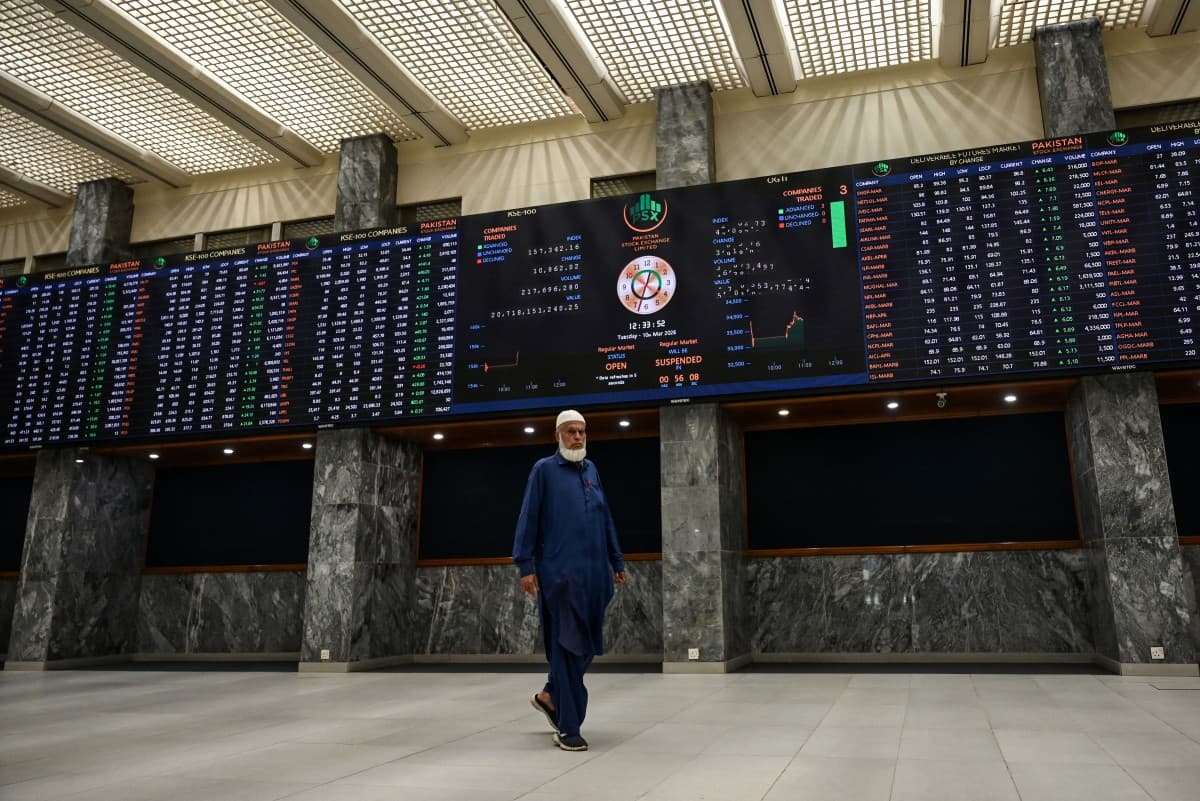
Pakistan’s financial markets reflected investor anxiety. The Pakistan Stock Exchange suffered its largest single-day drop on March 2, falling more than 16,000 points, according to Topline Securities.
On March 9, the index fell by over 11,000 points after attacks on Iranian oil depots in Tehran.
However, after Monday's panic tone, the local bourse witnessed a powerful comeback on Tuesday as confidence quickly returned to the market. The bulls charged aggressively from the opening bell, triggering a temporary market halt amid intense buying activity.
Momentum remained strong throughout the session, pushing the index to an impressive intraday surge of 11,873 points, before settling at 156,177 (up 9,696 points or 6.62%).
The market followed its Asian peers, which rebounded after oil prices plunged overnight.
Some analysts see further signs of stabilization. Arif Habib Limited said global sentiment may be approaching a “peak fear” phase.
“Globally, it appears we are reaching ‘peak fear’ moments and any positive news regarding the conflict will result in markets aggressively repricing higher,” the brokerage said in its note.
The firm stated that with the index down about 25% from its January peak, valuations may begin to attract long-term investors if geopolitical tensions ease.
Domestic fuel prices
Rising global oil prices have translated into higher domestic costs. Pakistan increased fuel prices by roughly 20% last week.
Economists warned of ripple effects. Waqas Ghani of JS Global, speaking to Pakistan TV Digital, said a $10 per barrel increase could add $300 million immediately to the import bill and raise annual costs to up to $2 billion. Inflation could rise by about 0.6 percentage points.
Economist Dr Ikram ul Haq, speaking to Pakistan TV Digital, noted the effect on transportation and essential goods, especially diesel-dependent logistics. He also cited Pakistan’s reliance on petroleum levies and the broader fiscal implications of prolonged high oil prices, which could put pressure on foreign exchange reserves.
Securing alternative supplies
Pakistan has sought alternative energy sources. Saudi Arabia assured crude shipments via the Port of Yanbu on the Red Sea, bypassing the Strait of Hormuz.
Petroleum Minister Pervaiz Malik said three shipments are expected soon, with one vessel already assured for crude loading at Yanbu.
Energy analysts say the arrangement will help reduce the risk of supply disruptions.
“This arrangement will improve supply security,” Ghani said. “This move has allowed Pakistan to avoid disruption risk.”
Protecting trade, reducing consumption
The Pakistan Navy launched Operation Muhafiz-ul-Bahr to safeguard maritime trade routes, the military said. The government also implemented austerity measures to reduce fuel consumption.
Prime Minister Shehbaz Sharif announced a four-day workweek and work-from-home arrangements for half of the public and private-sector staff. Fuel allocations for government vehicles will be cut 50% for two months. Ministers will forgo salaries, parliamentarians will take a 25% cut, and senior officers will lose two days of pay.
Schools will close for two weeks, universities will shift to online instruction, departmental spending will drop by 20%, official foreign travel will be suspended, and vehicle purchases will be banned. PM Sharif said the steps aim to shield citizens from the worst impact of rising oil prices.
Meanwhile, the State Bank of Pakistan kept its policy rate at 10.5%, citing uncertainty from the Middle East conflict. The Monetary Policy Committee said higher fuel, freight, and insurance costs, along with trade and travel disruptions, could affect the economy depending on the conflict’s intensity and duration.
Officials stated that immediate measures are meant to cushion the economy. The long-term impact will depend on easing tensions in the Gulf and on global oil market stability.