


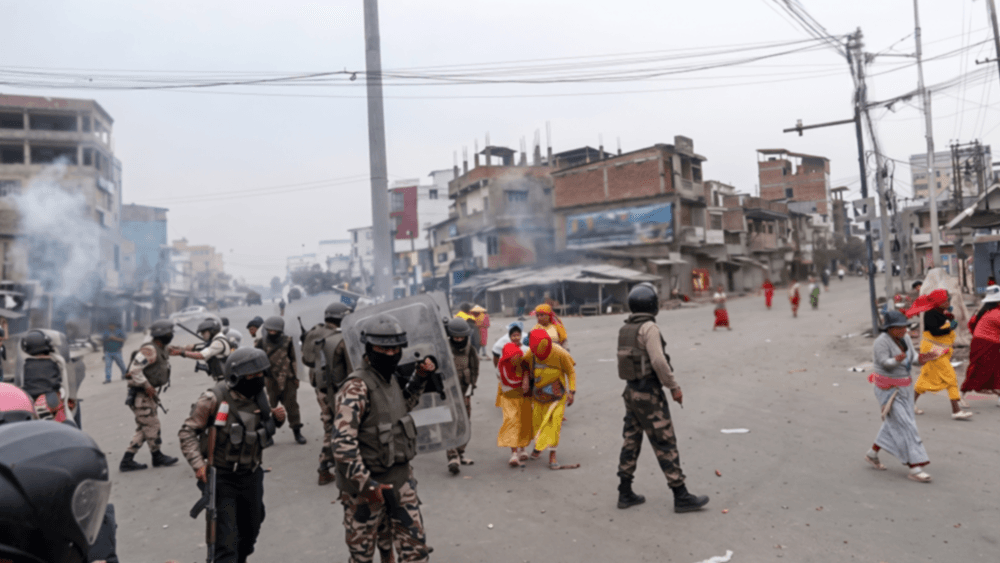
ISLAMABAD: Deep divisions between communities in Manipur continue to persist three years after ethnic violence first erupted in the northeastern state. Despite the passage of time, no convictions have been secured, the inquiry report remains delayed, and Kuki groups are again pressing for political separation.
According to News Arena India (NAI), more than 260 people have been killed and nearly 60,000 displaced since clashes broke out on May 3, 2023, between the Meitei and Kuki-Zo communities. The violence has effectively split the state into hostile zones, with tensions continuing despite periodic efforts at dialogue.
A commission of inquiry appointed by the federal government on June 4, 2023, to investigate the causes and handling of the unrest has missed multiple deadlines. Initially expected to submit its findings within six months, the panel has received four extensions, with its latest deadline now set for May 20, 2026.
The commission also underwent a leadership change earlier this year after its chairman, Justice Ajai Lamba, resigned in February. He was replaced by former Supreme Court judge Justice Balbir Singh Chauhan, who assumed charge in March.
India’s top court, the Supreme Court of India, has repeatedly flagged lapses in the handling of the violence, including delays in registering cases related to sexual assault. It has ordered that some cases be transferred to the Central Bureau of Investigation for further probe.
Even as the inquiry remains inconclusive, Kuki groups have intensified their demands for a separate administrative arrangement. The Kuki Inpi Manipur marked the third anniversary of the violence as “Separation Day,” reiterating its call for a Union Territory.
In a statement, the group described the past three years as a period of “untold suffering,” alleging discrimination, institutional bias and selective enforcement of the law. It said thousands of people from the Kuki-Zo community remain displaced and continue to struggle with trauma and loss of livelihood.
“The present arrangement is neither sustainable nor just,” the organization said, adding that the community could no longer live under conditions that deny “dignity, justice and constitutional safeguards.”
Another group, the Kuki Organization for Human Rights Trust, accused authorities of a “complete collapse of the rule of law,” pointing to a lack of arrests and prosecutions in several major cases.
The group has called for a Supreme Court-monitored investigation, immediate arrests of those responsible for violence, and public disclosure of evidence. It also demanded action against armed groups and rehabilitation measures for those living in relief camps.
The conflict has also exposed significant security lapses. Thousands of weapons were looted from police armories during the early days of the violence, many of which remain unaccounted for, raising concerns about ongoing militarization along ethnic lines.
Although authorities have attempted to facilitate dialogue, sporadic violence continues. Incidents reported in April, including civilian deaths and clashes involving security forces, have underscored the fragile situation.
With the inquiry yet to produce findings and communities still deeply polarized, calls for justice and accountability are growing, while prospects for reconciliation remain uncertain.