


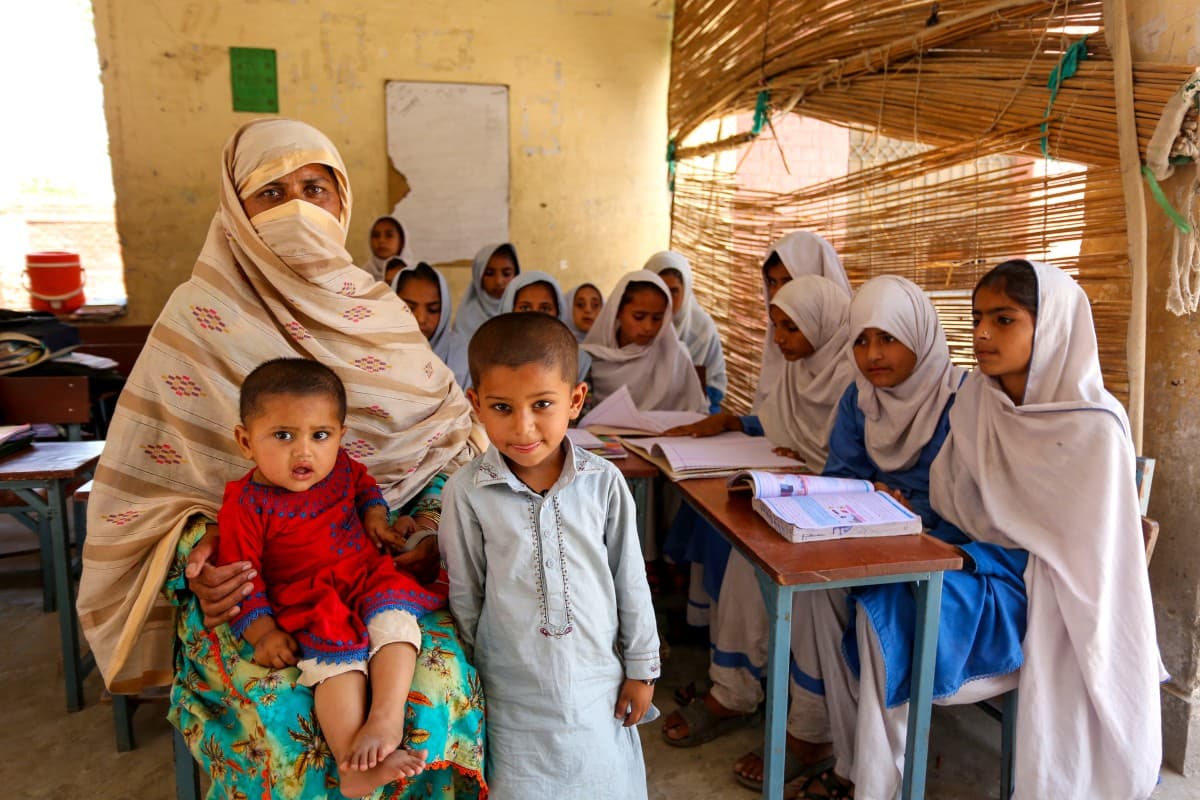
ISLAMABAD: Pakistan has achieved some of the strongest results ever documented globally for a large-scale nutrition program, even as neighbouring Afghanistan struggles with increasing malnutrition rates and collapsing health services amid severe funding shortfalls.
The contrast between the two countries highlights how sustained investment and stable governance can transform public health outcomes in South Asia's most vulnerable populations.
According to an independent midline evaluation by Aga Khan University, Pakistan's biggest social protection program reduced stunting by 15% among participating children aged 6-23 months,
For children whose mothers enrolled during early pregnancy, the results proved even more effective: stunting prevalence at six months of age was 20% lower compared to non-participants, the evaluation found.
The program has reached 3.7 million women and children since its 2020 launch, according to the evaluation. Operating through more than 540 centres in 157 districts, it costs approximately $125 per person per year.
"When my son was first weighed, I feared for his life," one beneficiary, Safia, told program evaluators, according to the evaluation report. "Through the Programme, he grew stronger, and I learned how to keep my children healthy."
According to the evaluation, the program also achieved a 7% reduction in small vulnerable newborn births and a 10% drop in zero-dose immunizations among children aged 12-23 months who had received no vaccinations.
Pakistan's success comes despite widespread poverty. Stunting affects 40% of children under five (approximately 12 million children) indicating a public health emergency, according to the evaluation.
Two-thirds of Pakistani families cannot afford a nutritious diet, the evaluation notes, with the poorest households' food expenditure covering less than 60% of the cost of a healthy, diverse diet.
Emergency response activated
Pakistan has simultaneously activated emergency measures for flood-affected populations. Qatar Charity, in partnership with UNICEF, is implementing water, sanitation and hygiene interventions alongside nutrition services in four Punjab districts, according to a November 2025 report on the emergency response.
The nutrition initiative seeks to improve access to treatment for acutely malnourished children and pregnant and lactating women, the report stated. It includes micronutrient supplements for children aged 6-59 months and breastfeeding women, along with counselling on maternal nutrition and infant feeding practices.
The project aims to provide climate-resilient sanitation facilities for 20,000 people and improved hygiene awareness for 100,000 people, the report stated.
An additional 5,000 children will gain access to safe drinking water and sanitation in 20 schools, 10 temporary learning centers, 10 child-friendly safe spaces and 10 health facilities, as per the report.
Afghanistan's deteriorating crisis
The picture across the border could hardly be more different. Afghanistan faces a deepening malnutrition emergency affecting 7.8 million people, including 857,000 children with severe acute malnutrition, according to an INTERSOS advocacy brief published in November 2025.
Admissions for malnutrition treatment rose 8% between January and September 2025 compared to the same period in 2024, despite the closure of many nutrition sites following funding suspensions, the brief reported.
Moderate acute malnutrition admissions among children under five increased 5%, whilst among pregnant and breastfeeding women they surged 19%, according to the brief.
The increases occurred even as operational capacity shrank dramatically. US aid suspension forced the closure of more than 420 health facilities and 305 nutrition sites, leaving approximately 80,000 acutely malnourished children, pregnant women and new mothers without access to life-saving treatment, the brief states.
The Afghanistan Humanitarian Needs and Response Plan had received only $870.6m of the $2.42bn required as of 21 November 2025, covering just 36% of total needs, the brief stated.
According to the brief, 31 out of 34 provinces are classified as serious or critical for nutrition severity. INTERSOS reported that 8.2% of children screened at its facilities in July 2025 required nutrition support.
Between June and August 2025, acute malnutrition cases among pregnant and lactating women at seven INTERSOS-managed facilities in Kandahar and Kabul provinces totalled 489, compared to 367 in the same period in 2024, the brief states.
This deterioration occurred despite comparable or higher participation in maternal and child nutrition sessions at some facilities, according to the brief.
The situation risks worsening significantly. UNICEF has warned that supplies of Ready-to-Use Therapeutic Food will be unable to meet required quantities in 2025, with potential stock-outs threatening treatment continuity within months, according to the INTERSOS brief.
The Famine Early Warning Systems Network has projected acute food insecurity will worsen at least until May 2026, driven by four consecutive years of drought, a deteriorating economy and mass returns of Afghans from Iran and Pakistan, the brief reports.
Divergent trajectories
The contrasting outcomes reflect fundamentally different operating environments. Pakistan's program operates through stable government systems with multi-year funding commitments and partnerships between the program, the World Food Programme, UNICEF and WHO, according to the evaluation.
Afghanistan, by contrast, has seen the near-total absence of development assistance since 2021, forcing humanitarian organizations to sustain essential services with short-term emergency funding, according to the INTERSOS brief.
Restrictions on female humanitarian workers have severely limited community outreach and early detection of malnutrition cases, the brief noted.
Nearly 22.9 million people in Afghanistan (almost half the population) require humanitarian assistance simply to meet basic needs. Decades of conflict have left public services severely weakened, whilst authorities lack the financial and institutional capacity to address the growing crisis.
Without sustained donor engagement, more health facilities risk shutting down and nutrition programs risk not reopening, leaving vulnerable families without treatment or support, the brief warned.