


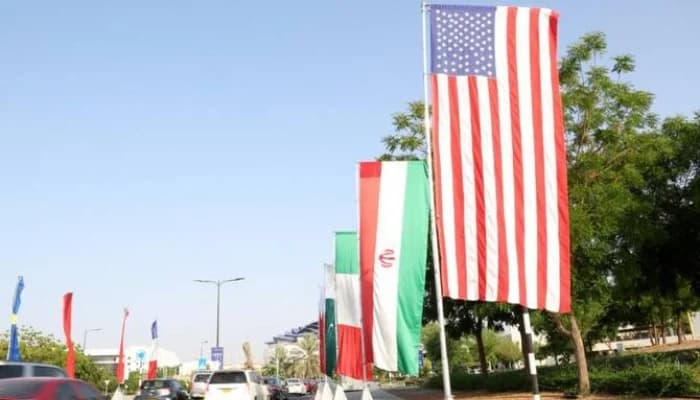
GENEVA: Iran said Monday that the US position on Tehran’s nuclear program had “moved towards a more realistic one” ahead of a second round of talks, as Iranian and US officials prepared to meet amid rising regional tensions.
Foreign Ministry spokesman Esmaeil Baqaei said that, based on discussions held in Muscat, “at least what we have been told is that the US position on the Iranian nuclear issue has moved towards a more realistic one,” according to the official IRNA news agency. He said Iran’s “inalienable rights under the Non-Proliferation Treaty were recognized,” including the peaceful use of nuclear energy and enrichment.
Iran’s foreign minister, Abbas Araghchi, arrived in Geneva at the head of a diplomatic and expert delegation for what Tehran described as “indirect” talks with the United States mediated by Oman. Iran’s state-run IRIB said the second round of negotiations would take place on Tuesday.
Araghchi said on X that he met with International Atomic Energy Agency (IAEA) chief Rafael Grossi in Geneva for a “deep technical discussion.” Grossi confirmed the meeting, calling it “in-depth” ahead of Tuesday’s negotiations.
Araghchi is also set to meet Swiss and Omani counterparts and other international officials, Iran’s foreign ministry said. “I am in Geneva with real ideas to achieve a fair and equitable deal. What is not on the table: submission before threats,” he wrote on X.
US Secretary of State Marco Rubio said Monday, “we’re hopeful there’s a deal,” adding that President Donald Trump “always prefers peaceful outcomes and negotiated outcomes.” The White House said Middle East envoy Steve Witkoff and Trump’s son-in-law Jared Kushner were dispatched for the talks.
Tehran and Washington restarted negotiations this month after previous talks collapsed when Israel launched an unprecedented bombing campaign against Iran in June, triggering a 12-day war during which Israel and the United States struck Iranian nuclear facilities.
Key sticking points include Iran’s stockpile of enriched uranium, which had reached 60% purity before the war. More than 400 kilograms of 60% enriched uranium were last seen by nuclear watchdog inspectors in June. Iran has said the material remains under the rubble of nuclear sites struck during the conflict.
Washington has repeatedly called on Tehran to reduce its enriched uranium stockpile to zero. On Sunday, Israeli Prime Minister Benjamin Netanyahu said any deal must involve removing all enriched uranium from Iran and ending its enrichment capability. Israel has called for Iran to have “no enrichment capability” and for all enriched material to be transferred abroad.
Iran insists on its right to enrichment but has said it is prepared to dilute its highly enriched uranium if all sanctions are lifted. Dilution involves blending enriched uranium with other material to lower its concentration below a specified threshold.
Baqaei said Iran would press for the lifting of long-standing US sanctions that have deepened the country’s economic crisis. “Time is of the essence for us. Our people are under the pressure of oppressive sanctions, and reason and logic demand that we lift these sanctions as soon as possible,” he said.
Iran’s deputy foreign minister, Majid Takht-Ravanchi, told the BBC that Tehran would consider compromises on its uranium stockpile if Washington lifts sanctions. “If we see the sincerity on their part, I am sure we will be on a road to have an agreement,” he said.
Deputy Foreign Minister for Economic Diplomacy Hamid Ghanbari said Tehran was seeking a deal that would generate economic benefits for both countries, particularly in aviation, mining, and oil and gas sectors. “For the agreement to be viable, it is essential that the United States also be able to benefit from it in areas with strong and rapid economic return potential,” he was quoted as saying by the Fars news agency.
The talks come as Iran’s Revolutionary Guards began military drills in the strategic Strait of Hormuz. State television said the exercises aim to prepare for “potential security and military threats.” Iranian politicians have repeatedly threatened to block the Strait, through which about 20% of global oil passes.
Tensions have escalated after Washington deployed an aircraft carrier group to the Gulf following nationwide protests in Iran. Trump has repeatedly threatened military action against Tehran, first over the reported crackdown on the protests, and more recently, over the nuclear program. On Friday, he said a change of government in Iran would be the “best thing that could happen.”
Demonstrations against Iran’s clerical authorities were held in several cities abroad over the weekend, including in the United States. Inside Iran, protesters have continued to shout slogans against authorities despite the crackdown.
Switzerland has represented US interests in Iran since Washington broke off relations following the 1980 hostage crisis, a year after the Iranian revolution.