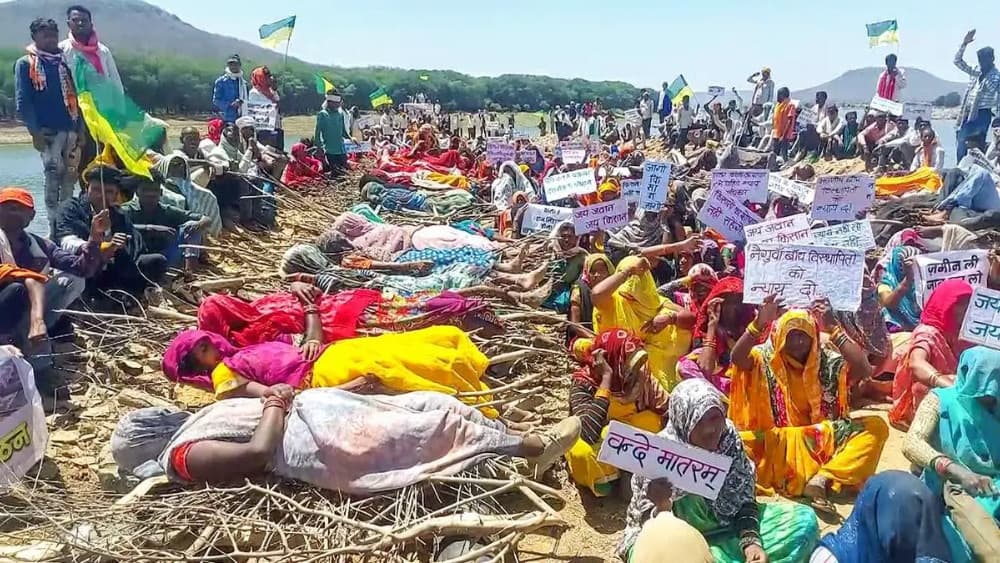
ISLAMABAD: In central India, families from indigenous farming communities have lain on funeral pyres, worn nooses around their necks, and gone on hunger strikes. They are protesting a massive dam that will flood their villages.
The dam is part of the Ken-Betwa Link Project, India's first attempt to connect two rivers on a large scale, according to Outlook India. The plan will move water roughly 217 kilometers, from the Ken River to the Betwa River, in a region called Bundelkhand, in the central Indian state of Madhya Pradesh. The project will cost about 446.05 billion Indian rupees ($4.6 billion), according to Gulf News.
At the center of the plan is the Daudhan Dam, a structure more than 250 feet high, according to the Tribune, a major Indian newspaper. A 222-km canal will carry the water onward.
Indian officials say the project will bring irrigation to more than a million hectares of farmland, an area roughly the size of Cyprus. They also claim it will supply drinking water to about 6.2 million people, according to the Deccan Herald.
But building the dam means flooding land where people already live. According to the National Herald, citing official government data, the dam will displace 5,288 families in Chhatarpur district and 1,400 families in nearby Panna district.
Most belong to the Gond and Kol peoples, indigenous communities who have farmed and fished this land for generations.
Villagers say the money offered does not make up for what they are losing. The National Herald reported the government promised payments of 1.25 million Indian rupees ($13,064) per acre of land, along with $7,100 for each house. Many families received far less, or nothing at all, the newspaper said.
To draw attention to their cause, protesters have used symbolic tactics. According to the National Herald, demonstrators have lain on mock funeral pyres, covered themselves in soil from their villages, and stood in the river wearing nooses, saying they would rather die than lose their homes.
Villagers also say officials skipped a legally required step: getting consent from village councils before taking indigenous land.
Local officials say they have responded to the complaints. Chhatarpur's top district official, Parth Jaiswal, told The Hindu that the compensation package had already been raised, and that roughly 750 more families had been added to the list of people eligible for support.
Police cleared a protest camp on July 19 and took activist Amit Bhatnagar, who had been on hunger strike for two weeks, to a hospital, according to SabrangIndia, an independent Indian news outlet. He had been fasting to demand a review of compensation records.
Opposition politician Rahul Gandhi criticized the government's handling of the protests, saying peaceful demonstrators were being met with force instead of dialogue, according to the National Herald. The opposition leader said indigenous communities were the country's original stewards of its land, water and forests.
The dam will also flood about 6,400 hectares of forest inside the Panna Tiger Reserve, a wildlife sanctuary, according to the Tribune. An Indian Supreme Court-appointed committee warned the project would cause irreversible damage to the ecosystem and undo years of work to bring tigers back to the area after they had died out there.
India's federal government has defended the project as a national priority, saying it is the best way to end decades of drought in the region, according to the Deccan Herald.




.jpg&w=3840&q=75)
.jpg&w=3840&q=75)
.jpg&w=3840&q=75)