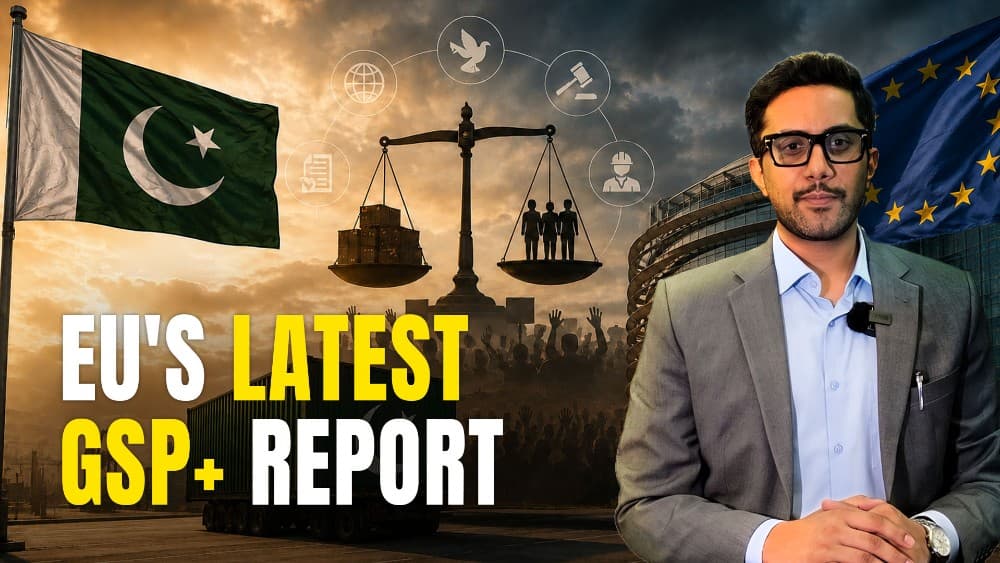
EU Backs Pakistan's reform trajectory under GSP+, highlights challenges

LAHORE: Pakistan reinforced its position as the European Union's largest beneficiary of the Generalized Scheme of Preferences Plus (GSP+) program, with €7.5 billion in eligible exports and an estimated €732 million in tariff savings in 2024, according to the European Commission's assessment of the country's compliance with international standards.
The findings, published in the European Commission's Fifth GSP+ Monitoring Report, presented a nuanced picture of Pakistan's reform trajectory. The assessment credited the country with significant legislative and institutional progress across human rights, labor rights, environmental protection and governance, while cautioning that the next phase of the partnership would be judged increasingly on implementation rather than legislation.
The report came at a pivotal moment for Pakistan's trade relationship with Europe. Since joining the GSP+ program in 2014, the country has become the scheme's largest beneficiary, with the European Union emerging as Pakistan's biggest export market. In 2024, Pakistan also recorded a utilization rate exceeding 95%, underscoring how effectively exporters have leveraged preferential market access.
Yet the significance of GSP+ extends far beyond trade statistics.
For the garment worker stitching apparel in Faisalabad, the football manufacturer in Sialkot, the surgical instrument exporter supplying European hospitals and the thousands of small and medium-sized enterprises integrated into European supply chains, preferential access to the EU market has translated into employment, investment and greater economic certainty.
Unlike conventional trade agreements, however, GSP+ is built on a broader premise. Preferential tariff access is tied to compliance with 27 core international conventions covering human rights, labor standards, environmental protection and good governance. The European Commission's monitoring process therefore measures not only trade performance but also progress in strengthening institutions and aligning domestic legislation with international commitments.
Decade of institutional reform
The Commission's latest assessment concludes that Pakistan continues to maintain ratification of all 27 conventions required under the current GSP+ framework and has undertaken a series of reforms across multiple policy areas.
One of the report's most notable acknowledgements is the international accreditation of Pakistan's National Commission for Human Rights (NCHR), which secured "A status" in 2024. The designation places the Commission among fully compliant national human rights institutions globally and strengthens its role in independently monitoring human rights obligations.
Progress within Pakistan's justice system
It notes that no executions have taken place since 2019, extending what has effectively become a de facto moratorium on capital punishment. During the monitoring period, Pakistan also narrowed the scope of the death penalty by removing four offenses from capital punishment, adopted implementing rules under the Anti-Torture Act and continued work under a National Prison Reform Action Plan aimed at improving prison governance and rehabilitation.
Women's rights feature prominently throughout the Commission's assessment.
Among the legislative milestones highlighted are the enactment of Islamabad's Domestic Violence law, the rollout of a national strategy to counter online gender-based violence and Sindh's first conviction for marital rape. The report also recognizes legislative efforts in Islamabad, Punjab and Balochistan to strengthen child marriage laws by raising or enforcing minimum marriage age requirements.
Labor and Climate Take Center Stage
Labor governance has remained another major pillar of Pakistan's reform agenda.
The report noted Pakistan's ratification of the 2014 ILO Protocol to the Forced Labor Convention, completion of standardized provincial child labor surveys and continued efforts to improve labor inspection systems. Provincial authorities have also introduced district vigilance committees and policy roadmaps aimed at reducing child labor and informal employment while improving evidence-based policymaking.
Environmental governance has similarly advanced during the reporting period.
Pakistan achieved Category 1 compliance under the Convention on International Trade in Endangered Species (CITES), signaling stronger implementation of international wildlife protection standards. The Commission also highlights progress in phasing out ozone-depleting substances, strengthening biodiversity reporting and advancing broader climate governance commitments.
Governance reforms extend beyond legislation
According to the report, Pakistan has introduced specialized anti-narcotics courts, digitized case management systems for narcotics enforcement and continued strengthening institutional coordination across federal and provincial governments.
Reform amid economic turbulence
The Commission's assessment places these developments against an unusually difficult economic backdrop.
Much of the reporting period coincided with one of Pakistan's most severe macroeconomic crises in decades.
The country faced record inflation, acute foreign exchange shortages and entered an IMF-supported stabilization program while simultaneously managing recovery from the catastrophic floods of 2022, which inflicted widespread damage on infrastructure, agriculture and livelihoods.
Despite those pressures, the report notes that Pakistan remained engaged with the GSP+ monitoring process and continued introducing reforms across multiple sectors.
That continuity reflects one of the report's underlying themes: institutional reform has continued even under significant fiscal and administrative constraints.
Implementation remains defining challenge
While acknowledging progress, the European Commission is equally clear that Pakistan's reform agenda remains unfinished.
The assessment identifies persistent implementation gaps across several sectors and stresses that legal reforms must increasingly translate into measurable improvements on the ground.
Labor enforcement remains one of the Commission's principal concerns. Education also remains a structural challenge.
Although Pakistan has declared a National Education Emergency and expanded enrollment initiatives, low school attendance and learning outcomes continue to limit opportunities for millions of children, particularly in economically disadvantaged communities.
The report similarly identifies continuing concerns relating to civil liberties, minority protections and the effective implementation of existing legal safeguards. While Pakistan has adopted a Policy on Interfaith Harmony and continues work toward establishing a National Commission for Minorities, the Commission stresses that consistent enforcement and institutional effectiveness remain critical.
More broadly, the assessment distinguishes between legislative progress and practical implementation.
In many policy areas, Pakistan has established legal frameworks and administrative institutions that align more closely with international standards. The challenge now lies in ensuring those reforms produce tangible improvements for citizens.
More demanding framework ahead
The next phase of the GSP+ program is expected to raise that bar further.
Under the revised framework after 2027, beneficiary countries will be required to comply with 32 international conventions, expanding obligations beyond the current 27-convention architecture.
Pakistan, like all participating countries, will need to reapply under the new regime and demonstrate continued compliance with the broader set of international commitments.
That shift is likely to place greater emphasis on measurable outcomes rather than legislative intent alone.
For Pakistan, the European Commission's latest report therefore represents both recognition and a roadmap.
It acknowledges substantial progress in strengthening institutions, expanding legal protections and aligning domestic laws with international norms. At the same time, it makes clear that the durability of those reforms will depend on sustained implementation, stronger enforcement and continued institutional capacity.
Latest News
Mbappe becomes World Cup all-time top scorer with 22 goals
21 MINUTES AGO

EU Backs Pakistan's reform trajectory under GSP+, highlights challenges
5 HOURS AGO
Ukrainian strikes on Russian warehouses kill 8, shroud skies in smoke
6 HOURS AGO
.jpg&w=3840&q=75)
Antonelli pips Verstappen to take pole at Belgian Grand Prix
7 HOURS AGO
.jpg&w=3840&q=75)
Karachi Port handles first ever shipment carrying over 2,000 EVs
5 HOURS AGO