


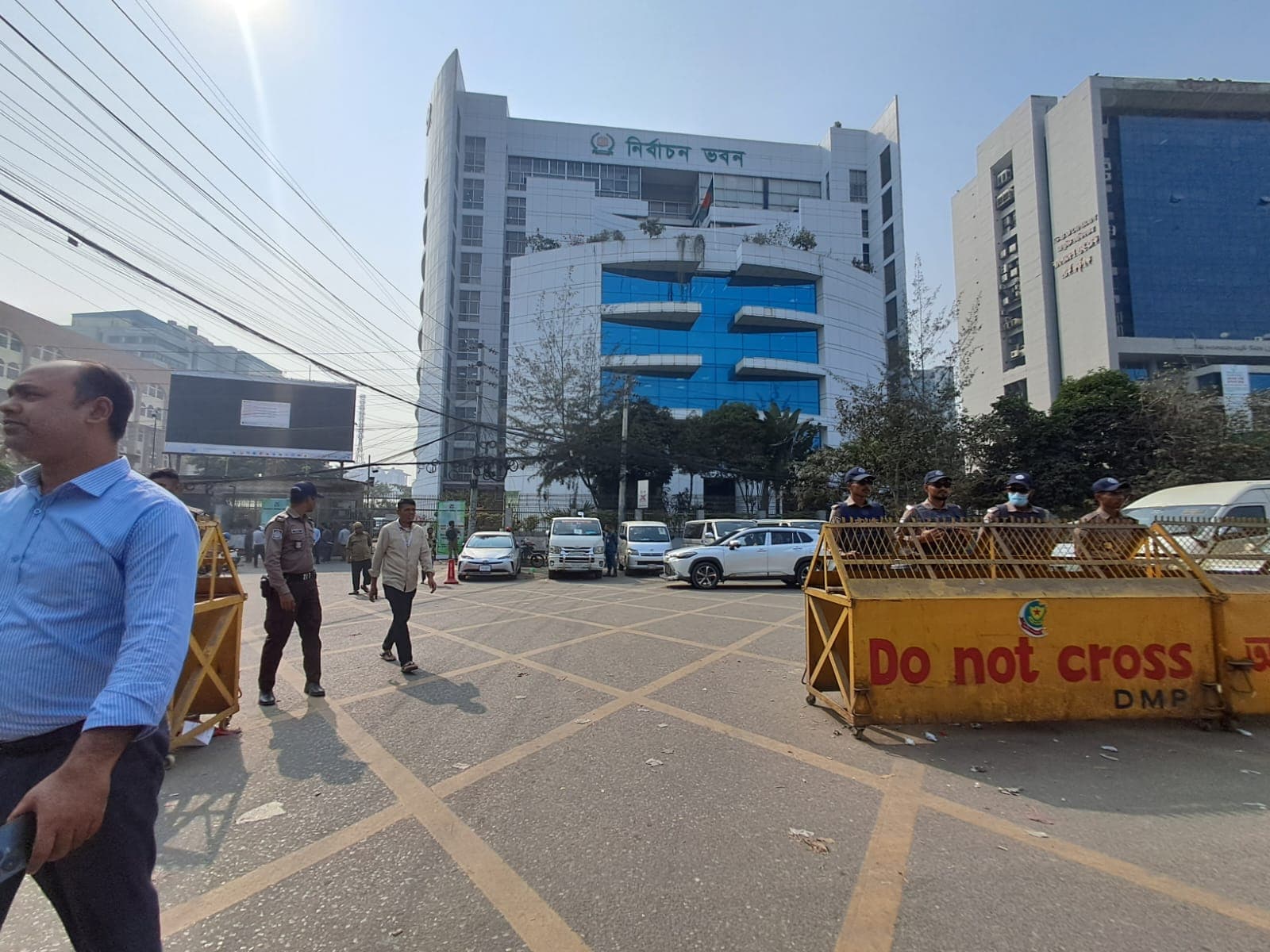
DHAKA: On the eve of Bangladesh’s 13th parliamentary election, the capital feels unusually still. Streets that are normally choked with rickshaws, buses, and pedestrians are noticeably empty. Shops are shuttered, offices closed, and public transport thinned out, as the country observes a government-declared holiday ahead of polling.
Dhaka, one of the world’s busiest and most densely populated cities, is taking a pause. Security personnel patrol intersections and outside polling centres, while election officials make last-minute preparations, stacking ballot papers, checking voter lists, and securing transparent ballot boxes. For most residents, life has slowed; for those running the vote, work has intensified.
Inside the Election Commission headquarters, however, the atmosphere is a stark contrast. The building is a hive of activity, crowded with domestic and international journalists, election staff, and observers from around the world. Television crews set up live positions, while staff coordinate logistics and field queries from returning officers across the country.
Departure from past polls
Bangladesh’s 13th Jatiya Sangsad election represents a marked departure from recent voting history, with broad participation by opposition parties and heightened voter expectations following years of one-sided polls dominated by the now-banned Awami League.
For more than a decade under former prime minister Sheikh Hasina, elections were defined by opposition boycotts, arrests of senior leaders, and low-competition races. The Bangladesh Nationalist Party (BNP) stayed away from the 2014 election entirely and formally boycotted the 2024 polls, while Jamaat-e-Islami (JI) was barred from electoral politics for years. As a result, voter turnout and political competition were widely questioned.
“This election is fundamentally different from the last three,” said Election Commissioner Brigadier General (retd) Abul Fazal Md Sanaullah. “There is real competition in most constituencies, and voters have meaningful choices.”
In the 2024 election, the Awami League and its allies won an overwhelming majority after the BNP refused to participate, calling the polls “illegitimate.” According to the Election Commission, turnout was around 41%, though opposition groups disputed the figure and described voter participation as much lower.
The 2018 election, in which the BNP did contest, was marred by allegations of vote rigging, intimidation and overnight ballot stuffing. International observers and rights groups raised concerns, and the credibility of the outcome was sharply contested. Analysts noted that opposition supporters often stayed away because the outcome felt predetermined.
“People stayed home not because they were apathetic, but because the outcome felt predetermined,” said Dhaka-based political analyst Ali Riaz. “Turnout reflected the absence of trust, not the absence of interest.”
Opposition returns, ruling party absent
This election reverses that pattern. The Awami League has been barred from contesting after the Election Commission suspended its registration, while 51 political parties, including the BNP and candidates linked to Jamaat-e-Islami, are actively contesting seats. More than 2,000 candidates are in the race, including hundreds of independents.
BNP leaders say the party’s return to the ballot has reactivated its voter base.
“For the first time in years, our supporters believe their vote will matter,” BNP Standing Committee member Amir Khasru Mahmud Chowdhury told reporters. “That belief is the single biggest driver of turnout.”
While Jamaat-e-Islami is not contesting under its former banner, candidates linked to the party are running as independents or under allied platforms. Party leaders say their supporters, long excluded from formal politics, are motivated to re-engage.
“This is the first election in years where Jamaat supporters feel politically visible again,” said a senior party figure, speaking on condition of anonymity.
Voter expectations and youth engagement
Voter expectations have also shifted. Instead of choosing between participation and boycott, citizens are weighing party platforms, candidates’ credibility, and post-election stability. Interviews with voters in Dhaka, Chattogram, and Rajshahi suggest high, though cautious, optimism.
“I didn’t vote in the last election,” Rahima Begum, a 32-year-old garment worker in Gazipur, told Pakistan TV Digital. “There was no point. This time, I want to vote because the Awami League is not there, and the result feels open.”
Younger voters, many of whom reached voting age after 2018, see the election as their first meaningful political exercise. Chief Adviser Professor Muhammad Yunus acknowledged this sentiment in a televised address on Tuesday, calling the vote “the first national election following a mass uprising.”
“Through your ballots, the demands once voiced on the streets will now be expressed constitutionally,” Yunus said.
Turnout expectations and stakes
Election officials have not issued turnout projections but privately acknowledge that participation is expected to be higher than in 2024, driven by competitive races and opposition participation.
Political scientist Meghna Guhathakurta said turnout this time will be driven less by party loyalty and more by uncertainty.
“When outcomes are uncertain, turnout rises,” she said. “This election has uncertainty, not because one party dominates, but because several forces are competing.”
Analysts caution that participation alone will not guarantee legitimacy.
“Turnout will matter,” said Riaz, “but credibility will depend on whether voters believe the process was fair, the count accurate, and power transferred peacefully.”