Pakistan's planning minister terms CPEC Phase-II comprehensive roadmap for sustainable development
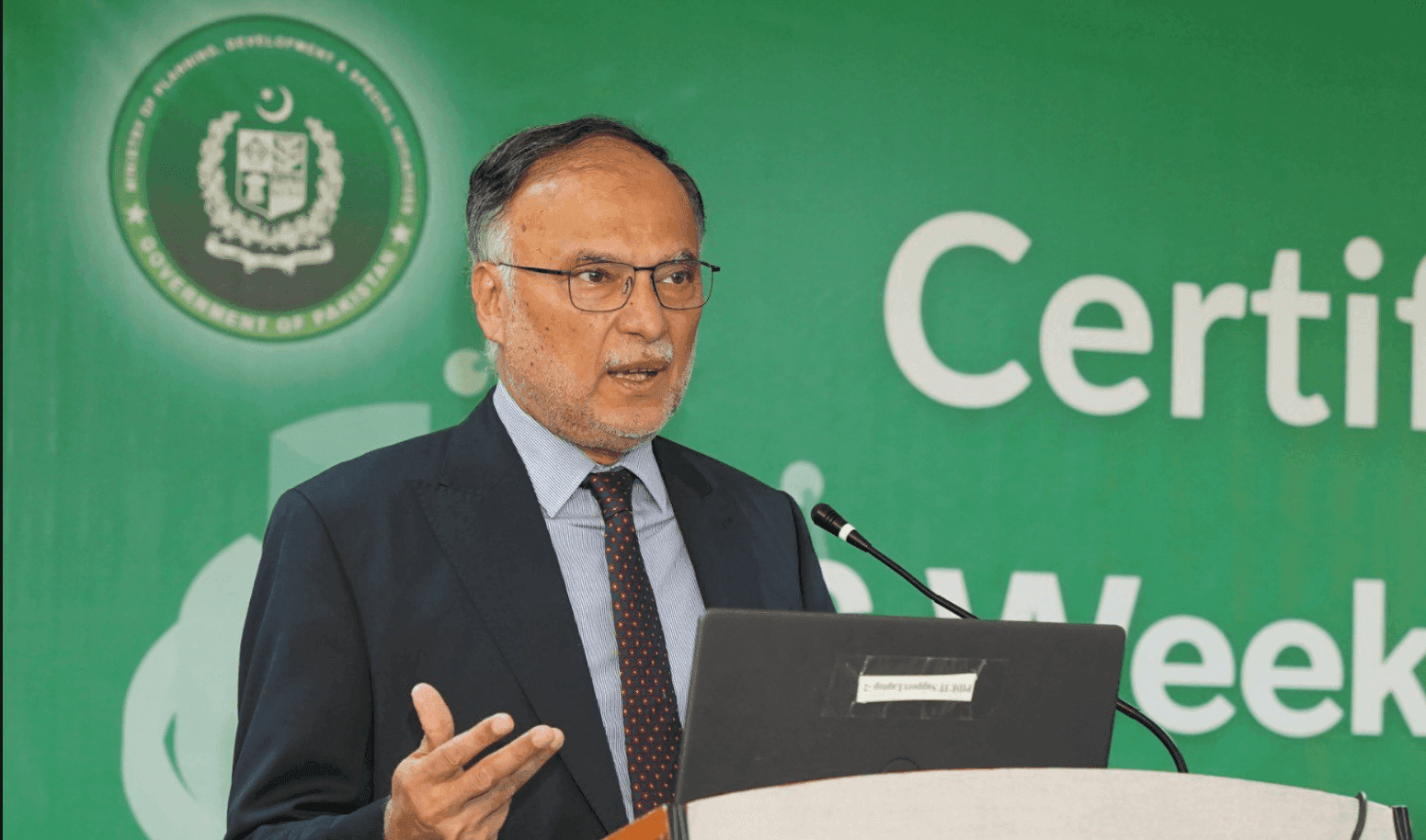
File photo: Minister for Planning, Development & Special Initiatives of Pakistan, Ahsan Iqbal Chaudhary. (X/@betterpakistan)
ISLAMABAD: Pakistan's Minister for Planning, Development and Special Initiatives Ahsan Iqbal on Tuesday reaffirmed Pakistan's commitment to the second phase of the China-Pakistan Economic Corridor (CPEC), describing it as a comprehensive roadmap for sustainable development and warning that misinformation and fake news remain major challenges to strategic initiatives worldwide.
Addressing a ceremony organized by Xinhua News Agency in connection with the construction of CPEC, 75 years of Pakistan-China friendship and global governance initiatives, the minister said it was a matter of great pride for the government and the people of Pakistan that the two countries were celebrating 75 years of an unbreakable bond.
Iqbal said CPEC Phase-II would play a central role in helping Pakistan achieve its long-term development goals.
Key corridors
He said the new phase of the flagship project encompasses five key corridors — Growth, Livelihoods, Innovation, Green and Open Corridor — aimed at promoting economic modernization, technological advancement, environmental sustainability and regional connectivity.
“The Open Corridor is intended to bring other countries into the framework of CPEC and transform it into a project for broader regional development,” he said, adding that the second phase had been designed in accordance with Pakistan's emerging economic and development requirements.
Reflecting on the evolution of CPEC, the minister said the project began as a vision that was transformed into reality through the joint commitment and hard work of the leadership and teams of both Pakistan and China.
He recalled that agreements worth $46 billion signed during Chinese President Xi Jinping’s 2015 visit to Pakistan laid the foundation for CPEC's first phase, which delivered major infrastructure and energy projects within a short period.
Iqbal also highlighted the growing importance of information security and public trust in today's interconnected world, warning that fake news and disinformation were increasingly being used to create polarization, weaken institutions and undermine relations between countries.
Combating misinformation
“We experienced this during the first phase of CPEC when a concerted campaign was launched against the project. Through facts and effective communication, we successfully countered that narrative,” he said.
He stressed the need to build national consensus and strengthen the information domain to combat misinformation and safeguard strategic national interests.
Highlighting the strength of Pakistan-China ties, Iqbal said the relationship had continued to deepen over the decades and was entering a new era of cooperation. He noted that the friendship would reach another milestone this year when Pakistan's first astronaut travels to space with China's support.
Speaking on the occasion, Minister for Information and Broadcasting Attaullah Tarar said Pakistan and China were celebrating 75 years of diplomatic relations built on mutual trust, respect and unwavering support.
He said Prime Minister Shehbaz Sharif’s recent visit to China had elevated bilateral relations to new heights and reaffirmed both countries’ commitment to expanding cooperation under CPEC and other strategic initiatives.
“Many countries describe their ties as friendly or brotherly, but Pakistan and China have the distinct honour of being iron brothers,” Tarar said.
The minister reaffirmed Pakistan's support for President Xi Jinping’s Global Governance Initiative, saying it was helping enhance the representation of developing countries and improving livelihoods across the Global South.
Strengthening bilateral ties
He said CPEC had brought the people of Pakistan and China closer together and emphasised that media cooperation, cultural exchanges, and people-to-people contacts would be vital to further strengthening bilateral ties.
Speaking to Pakistan TV Digital, Chinese scholar Ma Zheng, a research fellow from Sun Yat-sen University and visiting faculty member at NUST, underscored the importance of grassroots engagement between the two countries.
Drawing on her personal experience of studying and conducting research in Pakistan for several years, she said future cooperation should focus not only on major infrastructure projects but also on education, healthcare, culture and livelihood initiatives that directly benefit ordinary people.
“We must strengthen people-to-people connections and create platforms that allow both sides to better understand each other and work together on issues that improve daily life,” she said.
Comprehensive partnership
Jameel Bhatti, Deputy Bureau Chief of Xinhua News Agency in Islamabad, said the 75-year Pakistan-China relationship had evolved from a diplomatic friendship into a comprehensive strategic cooperative partnership.
He highlighted China's support for Pakistan during difficult periods, including natural disasters, as well as the transformative impact of CPEC on Pakistan's energy sector, infrastructure and regional connectivity.
Bhatti said projects such as the Sahiwal and Port Qasim power plants helped address Pakistan's electricity shortages, while modern highways and the development of Gwadar Port had significantly improved connectivity and economic prospects.
He stressed that people-to-people exchanges, educational cooperation, media engagement and youth interactions would be essential for ensuring that Pakistan-China friendship remains strong and vibrant for future generations.
Latest News
Polling begins across Mirpur Division in first phase of Azad Jammu and Kashmir elections
3 HOURS AGO

Oil prices drop more than 5% on renewed hopes for US-Iran deal
3 HOURS AGO
Masood leads Pakistan to 199-3 against West Indies
6 HOURS AGO

Pakistan armed forces pay tribute to Capt Sarwar on 78th martyrdom anniversary
7 HOURS AGO

Pakistan condemns Indian defense minister's remarks on Kashmir
7 HOURS AGO