

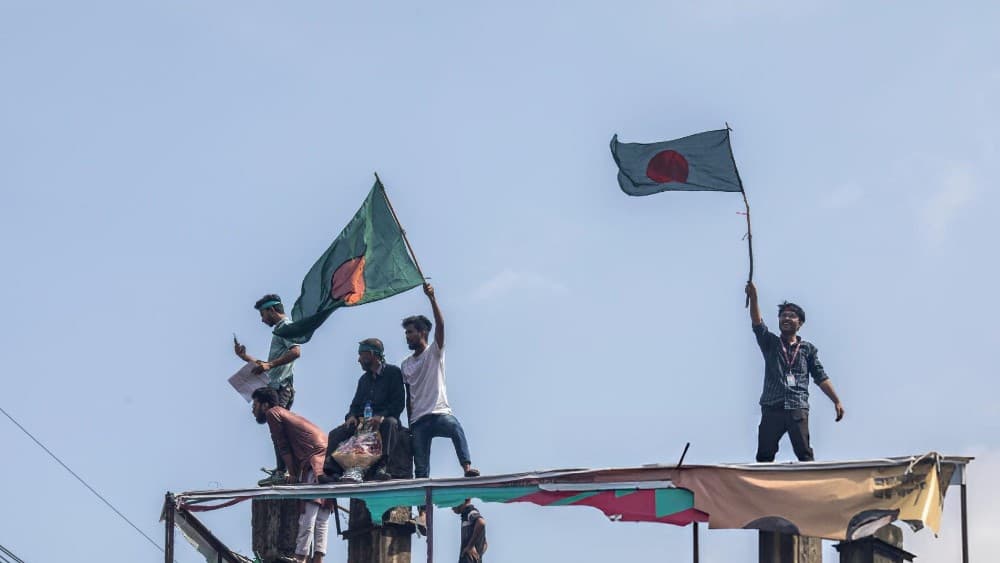
DHAKA: Bangladesh has been in political turmoil since a student-led revolt overthrew former prime minister Sheikh Hasina in August 2024, ending her 15-year autocratic rule.
The Muslim-majority nation of 170 million people will hold its first elections since the uprising on Feb. 12, AFP reported.
Here are the key players in a vote that European Union election observers say will be the "biggest democratic process of 2026, anywhere".
Interim government
Nobel Peace Prize winner Muhammad Yunus, 85, returned from exile in August 2024 at the behest of protesters to lead a caretaker government as "chief adviser."
He will step down after the polls.
Yunus said he inherited a "completely broken" political system, and championed a reform charter he argues is vital to prevent a return to authoritarian rule.
A referendum on the proposed changes will be held on the same day.
He says the reforms will strengthen checks and balances between the executive, judicial, and legislative branches.
Bangladesh Nationalist Party (BNP)
The BNP, led by Tarique Rahman, 60, is widely tipped to win the election after he returned from a 17-year self-imposed exile in December 2025, AFP reported.
His mother, the BNP's veteran leader and former prime minister Khaleda Zia, died aged 80, days after his return.
According to reports, 17 activists of the Bangladesh Nationalist Party, including BNP Executive Committee member Sheikh Rabiul Alam, were sent to jail on May 24, 2023.
Forty-five BNP leaders and activists in Narayanganj were detained under the old Explosives Act and on charges of sabotage on October 27, 2023.
At least 7,835 BNP leaders and activists were arrested within eight days between Oct. 28 and Nov. 4, 2023, including more than seven top leaders — among them the Secretary General — and over 50 influential city and district-level leaders.
Thirty-seven BNP leaders and activists were named in a case filed over an attack on police on Dec. 15, 2023.
A BNP-led alliance includes both leftist and centrist parties, as well as small religious groups.
JI-led alliance
Jamaat-e-Islami (JI), the country's largest and best-organized religious party, is seeking a return to formal politics after years of bans and crackdowns under Hasina's 15-year rule.
According to reports, the High Court disqualified Jamaat-e-Islami in 2013, and the party has been prohibited from participating in the last three national elections since 2014 after its registration was cancelled by the Election Commission.
The Sheikh Hasina-led government banned Jamaat-e-Islami along with its student wing and affiliated bodies, describing the party as a “militant and terrorist” organization.
Between 2013 and 2016, five top Jamaat-e-Islami leaders were executed for crimes against humanity committed during the 1971 Liberation War.
In 2013, the High Court declared Jamaat-e-Islami’s registration with the Election Commission illegal.
In 2018, the Election Commission formally scrapped Jamaat-e-Islami’s registration, rendering the party ineligible to participate in national elections.
Jamaat is leading an alliance of more than 10 smaller parties, including the National Citizen Party, formed by student leaders who spearheaded the uprising.
It also includes the small Liberal Democratic Party and fringe religious parties, most of which held only a handful of seats in previous parliaments.
Bangladesh is one of the world's most populous Muslim-majority countries after Indonesia and Pakistan.
Bangladesh also has a small Shia community. Around 10% of Bangladeshis are not Muslim; the majority of those are Hindu, and the country is also home to a small number of Christians.
Jatiya Party
The Jatiya Party has been accused of acting as a “dummy opposition” and of aiding the Awami League’s repressive actions during successive controversial elections, as well as during the July Uprising of 2024.
In March 2025, the Anti-Corruption Commission (ACC) launched an investigation into Jatiya Party Chairman Golam Mohammad (GM) Quader over allegations of trading party positions, engaging in nomination business, and embezzling party funds through fraudulent means.
Following the 2018 general election, Jatiya Party leaders allegedly accepted bribes totaling Tk181 million in exchange for nominations to reserved women’s seats in Parliament.
The ACC has alleged that GM Quader possesses illicit assets both in Bangladesh and abroad, including properties in Singapore, London, and Sydney, held under various names.
Police arrested Jatiya Party Vice-Chairman Kazi Ashraf Siddiqui in connection with a money-embezzlement case.
Husain Sharif Sanjoy, son of former Jatiya Party MP Shariful Islam Jinnah from the Bogura-2 (Shibganj) constituency, was arrested and sent to jail on multiple charges, including murder, attempted murder, sabotage, and possession of explosives.
Awami League
Hasina, 78, a fugitive now living in India, was sentenced to death in November, in absentia, for crimes against humanity.
According to reports, the Sheikh Hasina-led Awami League government repeatedly destabilized the BNP-led administrative and economic reforms after 1991 through sustained protests.
In 2011, the Awami League abolished the caretaker government system, enabling full control over subsequent elections, which were marred by widespread irregularities in 2014, 2018, and 2024.
The 2014 national election was marked by intense voter suppression, resulting in low turnout, and the government later backed away from its earlier commitment to hold fresh elections to enhance political participation.
The 2018 general election was described by opposition parties as “a mockery of democracy.”
Hasina’s former ruling Awami League, once the country's most popular party, has been outlawed.
Loyalists may run as independent candidates, but it is unclear who the party's once sizable membership will back.
Hasina has warned that holding elections without her party would be "sowing the seeds" of further division.
Army
In a country with a long history of military coups, the army remains a pivotal force.
It played a decisive role in Hasina's downfall by choosing not to intervene against the protests.
The military continues to patrol the streets, maintaining a visible presence alongside the police.
International players
Regional powers have taken a keen interest.
Bangladesh's relations with India -- once Hasina's strongest ally -- have cooled.
Yunus' first state visit was to China, signaling a strategic shift.
Past election results
Across Bangladesh’s national elections from 1991 to 2018, voting patterns and parliamentary representation shifted significantly among major parties, according to media reports.
In the 1991 election, the Bangladesh Nationalist Party (BNP) secured 30.81% of the vote and won 140 direct seats, narrowly ahead of the Awami League (AL), which received 30.08% and 88 seats, while the Jatiya Party (Ershad) obtained 11.92% and 35 seats, and Jamaat-e-Islami won 12.13% of the vote with 18 seats.
In 1996, the Awami League emerged victorious with 37.44% of the vote and 146 seats, followed by the BNP with 33.61% and 116 seats, the Jatiya Party with 16.41% and 32 seats, and Jamaat-e-Islami with 8.62% and only three seats.
The 2001 election saw a strong BNP comeback, as it won 40.97% of the vote and 193 seats, while the Awami League received 40.13% but only 62 seats; the Jatiya Party secured 7.25% and 14 seats, and Jamaat-e-Islami gained 4.28% of the vote yet won 17 seats.
In 2008, the Awami League achieved a landslide victory with 48.04% of the vote and 230 seats, whereas the BNP received 32.50% but was reduced to 30 seats, the Jatiya Party won around 7% and 27 seats, and Jamaat-e-Islami secured roughly 4% of the vote and about two seats.
The 2014 election, boycotted by the BNP and its allies, resulted in the Awami League winning 72.14% of the vote and 234 seats, while the Jatiya Party obtained around 7% and 34 seats.
Finally, in the 2018 election, the Awami League reportedly received about 76.86% of the vote and won 258 seats; the BNP secured approximately 11.73%, and the Jatiya Party received around 5.22%, winning about 22 seats.