


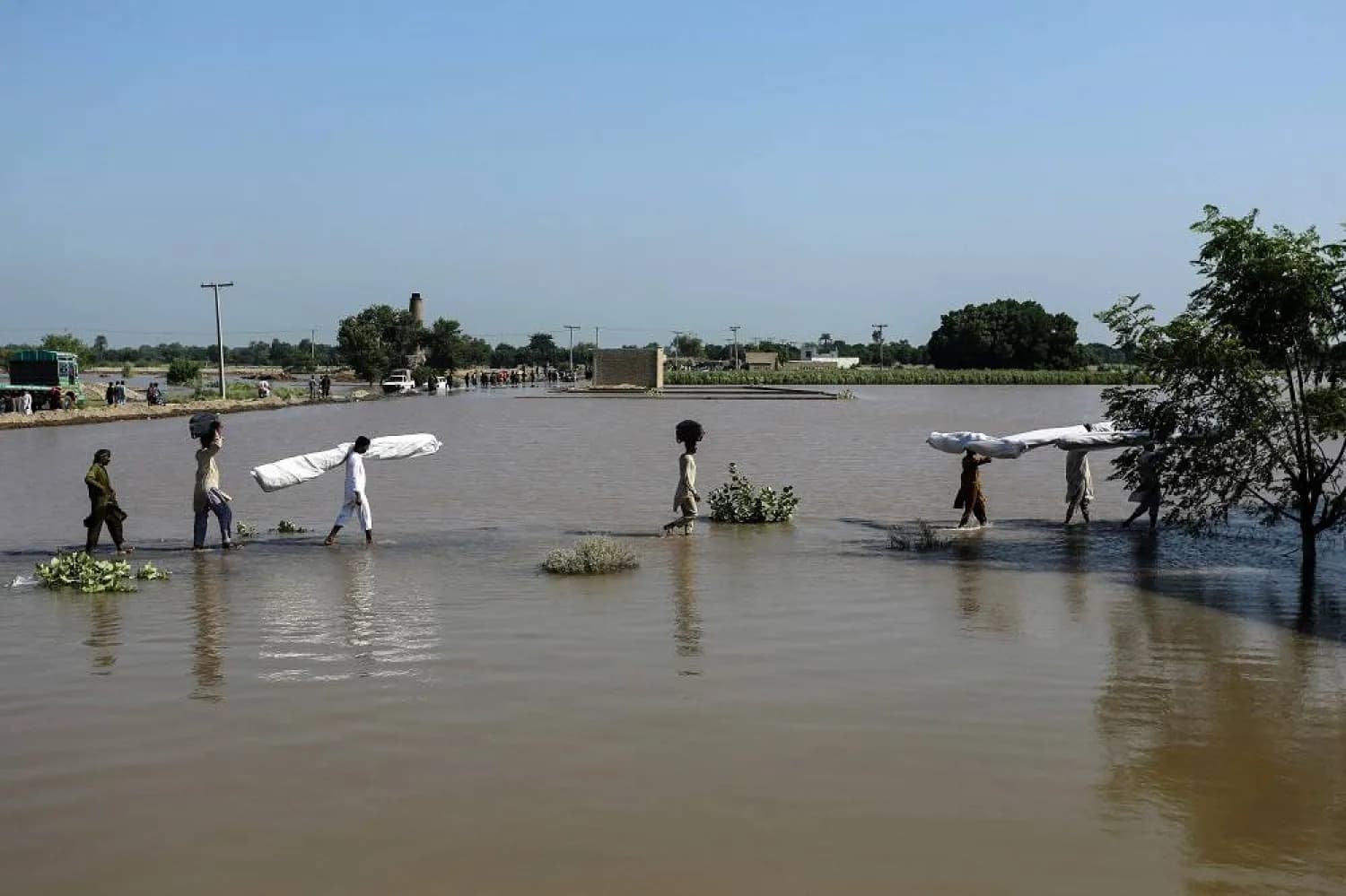
ISLAMABAD: Pakistan's 2025 monsoon season killed more than 1,000 people and affected nearly 7 million others, with climate scientists determining the extreme rainfall was approximately 12% more intense than it would have been without human-induced climate change, according to a report released by Christian Aid.
The “Counting the Cost 2025" annual report noted how the floods, which struck Pakistan between June and September, submerged 1.3 million acres of crops and caused $1.4 billion in agricultural losses alone.
The monsoon rains damaged 12,500 homes, washed away 240 bridges, and killed at least 6,500 livestock, according to the report. More than 600 kilometers (375 miles) of roads were damaged.
"These climate disasters are a warning of what lies ahead if we do not accelerate the transition away from fossil fuels," the Christian Aid's Chief Executive, Patrick Watt, said in the report's foreword.
The climate attribution finding came from a World Weather Attribution study cited in the Christian Aid report, which analyzed how human-caused global warming intensified the monsoon rainfall.
Torrential rains triggered deadly floods, landslides, and flash floods throughout the country, with rivers overflowing and thousands of towns submerged, according to the report. Entire communities were displaced, particularly in vulnerable regions.
The monsoon season, combined with glacial floods and riverine inundation, created catastrophic conditions across Pakistan, according to Christian Aid. The agricultural losses hit particularly hard in a country where the sector is critical to millions of livelihoods.
Pakistan's disaster was part of a broader India-Pakistan monsoon season that killed at least 1,860 people across both countries and caused up to $6 billion in combined damage, ranking as the fifth most expensive climate disaster globally in 2025, according to the Christian Aid report.
Christian Aid stated that the cost figures often exclude forms of loss that are difficult to quantify, "such as damages to livelihoods, lost income, long-term damage to the environment, and permanent displacement of residents."
"As a result, the true toll of disasters is almost certainly far higher than the insured losses suggested," the report stated.
Scientists have linked the extremity of monsoon seasons to human-driven climate change, estimating that for every degree of warming, monsoon rains will likely increase by around 5%, according to research cited in the Christian Aid report.
"Warmer oceans and atmosphere supercharge evaporation, increasing atmospheric moisture and fueling heavier downpours," the report stated. These conditions also accelerate the melting of glaciers and permafrost, "further amplifying the risk of floods and landslides."
Pakistan's monsoon occurred during what Christian Aid characterized as "a year of climate breakdown.”
The report noted that "some of the most devastating extreme weather events in 2025 hit poorer nations, which have contributed little to causing the climate crisis and have the least resources to respond."
Christian Aid's Watt said Pakistan exemplified how "the poorest communities are first and worst affected" by climate breakdown.
"They also underline the urgent need for adaptation, particularly in the global South, where resources are stretched, and people are especially vulnerable to climate shocks," Watt said.
The Director of Nairobi-based energy and climate think tank Power Shift Africa, said wealthy nations count financial costs while "millions of people across Africa, Asia and the Caribbean are counting lost lives, homes and futures."
"In 2026, governments must stop burying their heads in the sand and start responding with real support for the people on the frontlines — through scaled-up finance for those in need and faster emissions reductions," he said in a statement included in the report.
Christian Aid called for urgent action, including emissions cuts, accelerated transition to renewable energy, and increased climate finance for vulnerable communities, particularly through the Fund for Responding to Loss and Damage.
The organization noted that attribution science has advanced to where researchers can now directly link greenhouse gas emissions to specific deadly weather events, with 213 heatwaves this century traced to pollution from major fossil fuel producers, according to research cited in the report.
"The suffering caused by the climate crisis is a political choice," Watt said. "It is being driven by decisions to continue burning fossil fuels, to allow emissions to rise, and to break promises on climate finance."
Thousands of school children affected
According to Save the Children, the disaster forced widespread school closures across flood-affected areas, leaving tens of thousands of Pakistani children out of education. The organization identified the Asia floods as one of five major climate disasters in 2025 that disrupted children's lives.
Save the Children and local partners created safe spaces for children in affected areas where they could play, learn, and recover, while also delivering essential aid to affected families, according to the organization's year-in-review released in late December 2205.
The organization said that two million children would avoid experiencing unprecedented lifetime exposure to droughts if global warming could be limited to 1.5 degrees Celsius by 2100, according to the organization's analysis aligned with the Paris Agreement goals.
According to Save the Children data spanning 30 years, climate disasters have cost the world more than $122 billion globally. It has affected an estimated 136,000 children daily.