


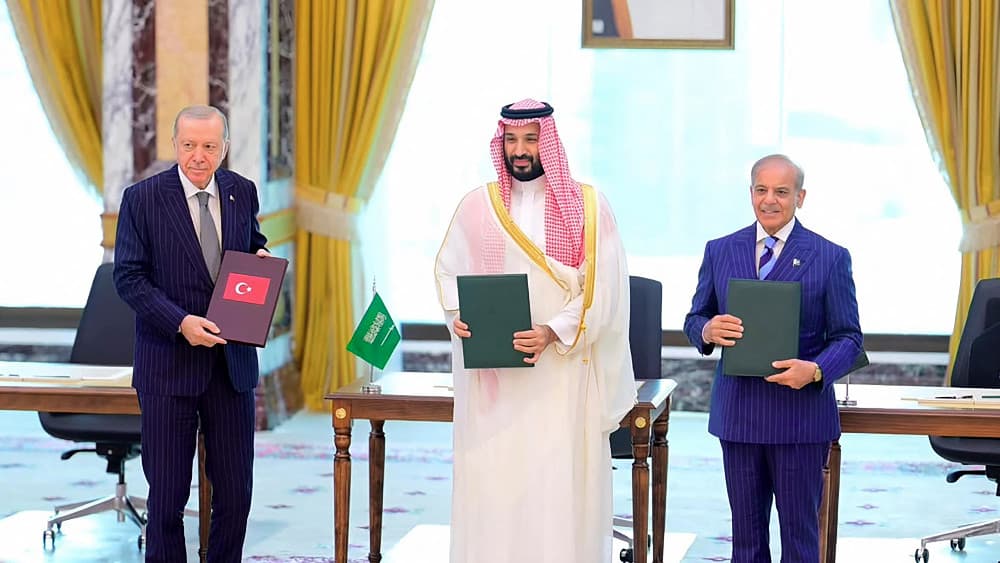
ISLAMABAD: The Makkah Joint Defence Agreement between Pakistan, Saudi Arabia and Türkiye could add another layer to India’s strategic calculations in any future confrontation with Pakistan, according to US South Asia expert Daniel Markey.
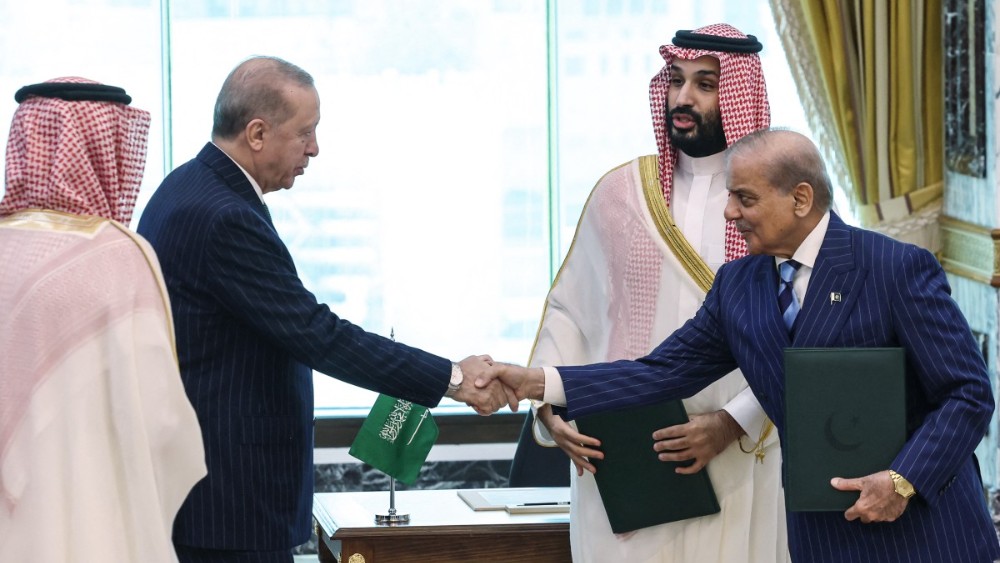
In an interview with The Wire earlier this week, Markey said the August 7 agreement was consequential because it formalizes and potentially institutionalizes defense cooperation among the three countries.
The pact stipulates that an armed attack against any signatory will be regarded as an attack against all three, while also providing for enhanced defense cooperation.
Pact 'purely defensive'
For Pakistan, the agreement builds on its September 2025 Strategic Mutual Defence Agreement with Saudi Arabia and places Islamabad within a broader trilateral security framework linking South Asia and the Middle East. Pakistan has described the pact as purely defensive, saying it is not directed against any country and is intended to strengthen regional peace, stability and security.
Asked whether the agreement strengthens Pakistan’s position in relation to India, Markey said Islamabad’s military ties with Türkiye could have particular significance.
He said Pakistan would have increasing access to Turkish defense technologies, “particularly drone technologies,” describing the Türkiye-Pakistan relationship as the element “more troubling from an Indian perspective.”
Markey also linked the development to Pakistan’s experience during the May 2025 India-Pakistan conflict.
He said India had already learned that Pakistan was not an easy military or diplomatic challenge and argued that the new agreement adds to the calculations New Delhi would have to make in a future crisis.
“This makes what was already, I think, a challenging ‘think twice’ situation for India into something even more so,” Markey said.
He stopped short of suggesting that the agreement gives Pakistan automatic military superiority over India.
Instead, his assessment focused on the pact’s potential to increase the political and strategic costs of escalation by strengthening Pakistan’s relationships with two important regional powers.
Markey also said the agreement represented a broader shift in Pakistan’s regional position.
He argued that Islamabad had “made itself geopolitically relevant in the Middle East”, with its military capabilities providing strategic value as Pakistan expands ties with regional partners.
Less dependency on external partners
The US analyst said the agreement could also provide Pakistan with greater diplomatic and economic options.
He described Islamabad as gaining an opportunity to become “less dependent and reliant on a single external partner,” while potentially securing political and financial backing from Saudi Arabia and defense cooperation with Türkiye.
On the wider India-Pakistan equation, Markey said the pact was not principally directed at India.
He said the agreement's main security concerns were rooted in the Middle East, even as its expansion of Pakistan’s regional partnerships could have consequences for New Delhi.
Markey said the broader shift was significant for Pakistan because the country was increasingly being incorporated into emerging regional security arrangements after years in which, in his assessment, it had been relatively marginal to some Middle Eastern strategic initiatives.
“Now you have a new vision seeming to evolve in the region that brings Pakistan thoroughly in,” he said.