ISLAMABAD: For three months, Iran watched Israel pound Lebanon, including Hezbollah positions, civilian infrastructure, and a UNESCO World Heritage site in Tyre. The death toll from Israel’s aerial campaign climbed past 3,526, according to AFP. Nearly one-fifth of Lebanon’s population was displaced. Iran did not launch a single ballistic missile at Israel in response.
So, what changed on June 7?
The answer is not the scale of the strike. It is where Israel struck, when it struck, and most critically, what it chose to ignore in the process.
The line Iran had drawn
Iran had been explicit. Tehran warned that an Israeli strike on the Dahiyeh district, a densely populated southern suburb of Beirut that serves as Hezbollah’s de facto headquarters, would invalidate the ceasefire entirely. Dahiyeh was the red line, not a rhetorical one but a stated, documented threshold.
Israel struck it anyway on June 7, killing two people and wounding 20, according to Lebanon’s ministry of public health. The strike targeted a militant command center. It was launched without civil evacuation orders, a departure from Israel’s own standard operating practice in previous campaigns, according to AP.
Three compounding factors made it explosive beyond the point of no return.
First, the timing. Pakistan’s interior minister was in Tehran at that exact moment, leading a high-level mediator delegation. Regional diplomats told Al Jazeera and AP they concluded almost immediately that the strike was a calculated attempt to wreck the US-Iran negotiating track. Not a tactical response to Hezbollah rockets, which had been fired at Israeli barracks earlier that morning.
Second, the instruction was ignored. US President Donald Trump had explicitly told Israeli Prime Minister Netanyahu days earlier not to conduct military operations in Beirut, warning it would derail the peace talks he described as “very close to a final deal.”
Israel struck anyway.
“I call the shots. I call all the shots. He doesn’t call the shots,” Trump told the Financial Times. It was a remarkable public admission that his ally had stopped listening.
Third, the absence of a warning. No evacuation orders, no pre-strike civilian alerts. In a district Iran had specifically identified as a tripwire, Israel offered no off-ramp.
General Ali Abdollahi, head of Iran’s military central command, declared Israel had “crossed all red lines” and authorized direct retaliation against Israeli territory, as reported by AFP and the Straits Times.
The regional verdict
Saudi Arabia, which had carefully avoided taking sides through months of Israeli strikes on Lebanon, issued a formal condemnation after the Dahiyeh strike. The Saudi Foreign Ministry declared “condemnation and rejection” of the continuation of Israeli aggression against Lebanon, according to Al Arabiya.
Egypt and Turkey moved into emergency diplomatic mode. Oman called a truce that excluded Lebanon, “not the beginning of peace.”
The regional response confirmed what the attack had made clear: after months of tolerating Israeli strikes on Lebanese territory, the Dahiyeh strike crossed a political threshold, not just a military one.
The people left behind
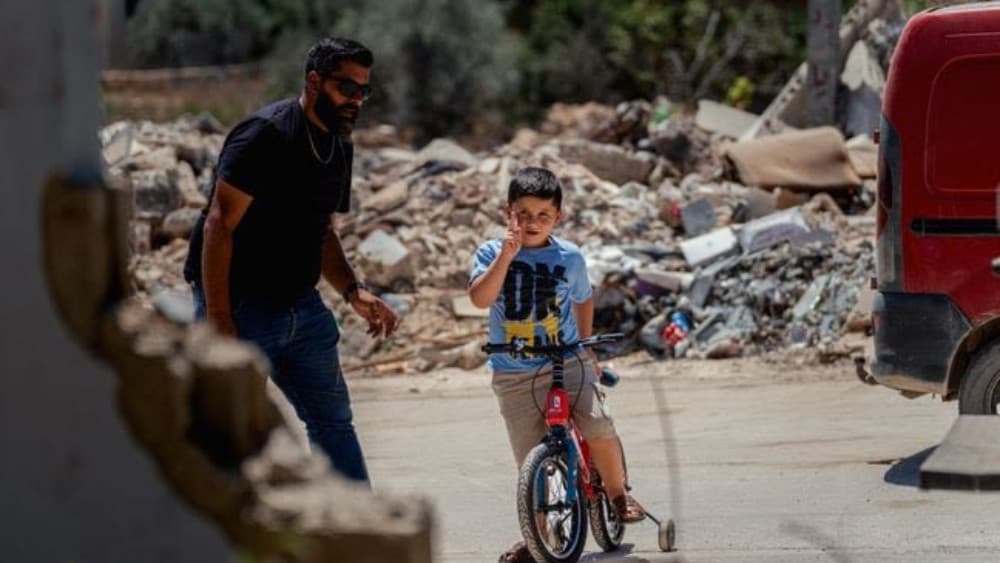
Below the diplomacy, Lebanon was already in collapse. More than 1.3 million people had been displaced, which is roughly a quarter of the population. The UN had been forced to more than double its emergency aid appeal, raising it from $308 million to $639.9 million as of June 5, according to OCHA.
For Lebanon’s 250,000 Palestinian refugees, already stateless and structurally excluded from the Lebanese economy, the bombardment meant a second displacement inside a single lifetime for many families.
Israeli evacuation orders south of the Zahrani River emptied the camps of Rashidieh, Burj al-Shemali, and el-Buss. Shatila and Burj al-Barajneh in Beirut were hit and road-sealed. UNRWA, already stripped of US funding and facing a $220 million shortfall, was forced to cut services by 20%, reduce school weeks, and close five schools in Ain al-Hilweh, according to field reporting from War on the Rocks and Al Estiklal.
In the West Bank, the Israeli military separately extended a closure order over three refugee camps in Jenin and Tulkarm until July 31, keeping more than 33,000 Palestinians displaced since January, according to the UN Secretary-General’s Office.
The Dahiyeh strike did not start this crisis. But it made plain that no ceiling -- geographic, diplomatic, or humanitarian -- was holding.



.jpg&w=3840&q=75)
.jpg&w=3840&q=75)

.jpg&w=3840&q=75)